


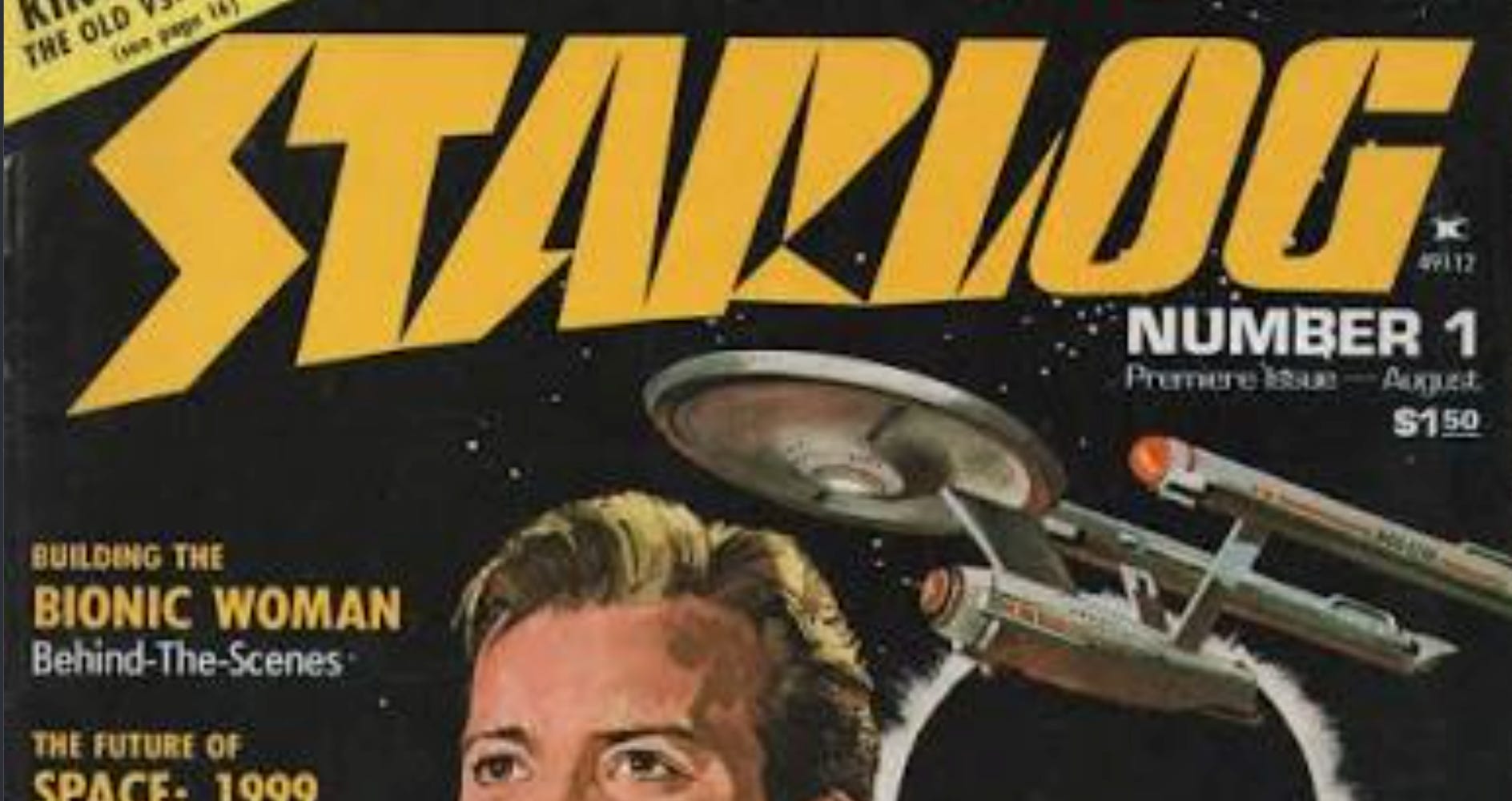
Starlog comes back November 13, 17 years after its last issue, and the full 33-year run of the original magazine is back online for free. The new edition is Starlog #375 in continuity, billed as Volume 2, Number 1, with cover art by Armenian artist Gabriel Yeganyan. It will publish once a year, and Fangoria Holdings, the company behind Fangoria and Gorezone, owns the revival.
The back issues are on the Internet Archive here: https://archive.org/details/starlogmagazine. An earlier upload of the run had vanished from the site by 2022, so readers who wanted the old issues lost access for a stretch before this one. The new issue can be pre-ordered at starlog.com/products/the-starlog-magazine-2026.
How Starlog Started
Kerry O’Quinn and Norman Jacobs ran a small periodicals company in Manhattan that began with a soap opera magazine in 1972. In 1976 they planned a one-shot magazine about Star Trek, a show then living in reruns. Paramount asked for a minimum royalty that their startup could not cover. A distributor turned the idea down with the line “Star Trek is dead!”
O’Quinn dropped the single-show format and built a magazine around science fiction film and television in general, with Trek as one subject among many. David Houston, a high school friend of O’Quinn’s, worked on the concept and later edited. O’Quinn handled the editorial side while Jacobs ran typesetters, engravers, and printers.
The first issue, dated August 1976, was scheduled as a quarterly. It sold out, and the partners moved to an issue every six weeks, then monthly.
Why Starlog Mattered
Starlog launched in a gap. Star Trek sat in reruns, and Star Wars and Close Encounters had not yet arrived. O’Quinn said later that most of the science fiction people were consuming at the time was old material, and that when the genre exploded the magazine became its voice.
It filled pages with behind-the-scenes photographs, effects coverage, set reports, and interviews, years before the internet existed to supply them. O’Quinn landed a George Lucas interview that ran across three issues. For decades the writers covered Star Trek, Star Wars, and Alien, and the magazine was one of the few places fans could find reliable news and interviews about the genre. Despite the science fiction label, Starlog printed no fiction. It covered the people making the movies and shows.
Starlog also anchored a publishing group. Fangoria launched from the same company in August 1979. Future Life, Comics Scene, and Cinemagic followed. Starlog reached its 100th issue in November 1985, and by the end it had published 374 issues and more than 25,000 pages.
How It Ended
The magazine industry took a serious fall in 2001, and the company behind Starlog was eventually sold to Creative Group, led by longtime Fangoria editor Thomas DeFeo. The Brooklyn Company bought Starlog and Fangoria and their related assets in July 2008. Starlog published its last print issue, #374, in April 2009. In March 2009 it had already become a sister site to Fangoria’s website, and production halted on issue #375, which had been scheduled for May 2009.
Fangoria survived as the lone print title from the old Starlog group. Cinestate released a new Fangoria in 2018. In August 2020, Tara Ansley and Abhi Goel acquired it from Cinestate.
Who Is Behind the New Starlog
Fangoria Holdings runs the revival, and Ansley is a co-owner. Much of the Fangoria staff is involved. The editor in chief is Annalee Newitz, an io9 co-founder. Meredith Borders is senior editor and Jason Kauzlarich is senior art director. The Starlog Podcast is hosted by Jordan Hoffman and Dave Gonzales, and a weekly email newsletter called Lodestar runs alongside the magazine.
The first issue leans toward science. The opening story looks at whether humans could farm crops on planets outside Earth. The magazine also promises deep-dive essays on favorite movies and books, along with film and TV features.
Newitz laid out the pitch on the podcast that announced the relaunch. A magazine, she said, has to offer “something that you can’t get online.” That sentence concedes what the old Starlog sold. Interviews and set news now arrive on a screen the day they happen, so a print title that comes out once a year cannot compete on timing. The new Starlog sells color photography and long essays instead, and it treats the issue as an object to keep.
Ansley gave the ownership view in a statement. She said that 50 years after launch, the line between science fiction and the real world is “increasingly difficult to separate.” That line explains the science half of the editorial mix. It also has a precedent inside the old company: Future Life, a science and science fiction hybrid, ran from 1978 to 1981 as a separate title. The new Starlog folds that idea into the main magazine.
What Changes
The old Starlog was built on access. Writers talked to the people making Star Trek, Star Wars, and Alien and published what they heard. The new Starlog is built on essays and science reporting from a writer who helped found io9, and it comes out once a year instead of every month. A reader who remembers the 1980s version should expect a different publication under the same masthead.
The archive is the other half of the story. With the full run readable again, anyone can compare the two magazines issue by issue.
A magazine that grew by putting fans next to the people making their favorite franchises now answers to an io9 co-founder and prints once a year. Will the new Starlog cover the franchises its readers remember, or will it use the name to write about whatever the editors choose?
If the golden age of Trek and Babylon 5 left a hole in your sci-fi diet, The Stars Entwined fills it — interstellar espionage between two civilizations on the brink of war. Read The Stars Entwined on Amazon!

I know it’s not related to the post, but I want to ask why you removed your latest video from the channel you still have.