


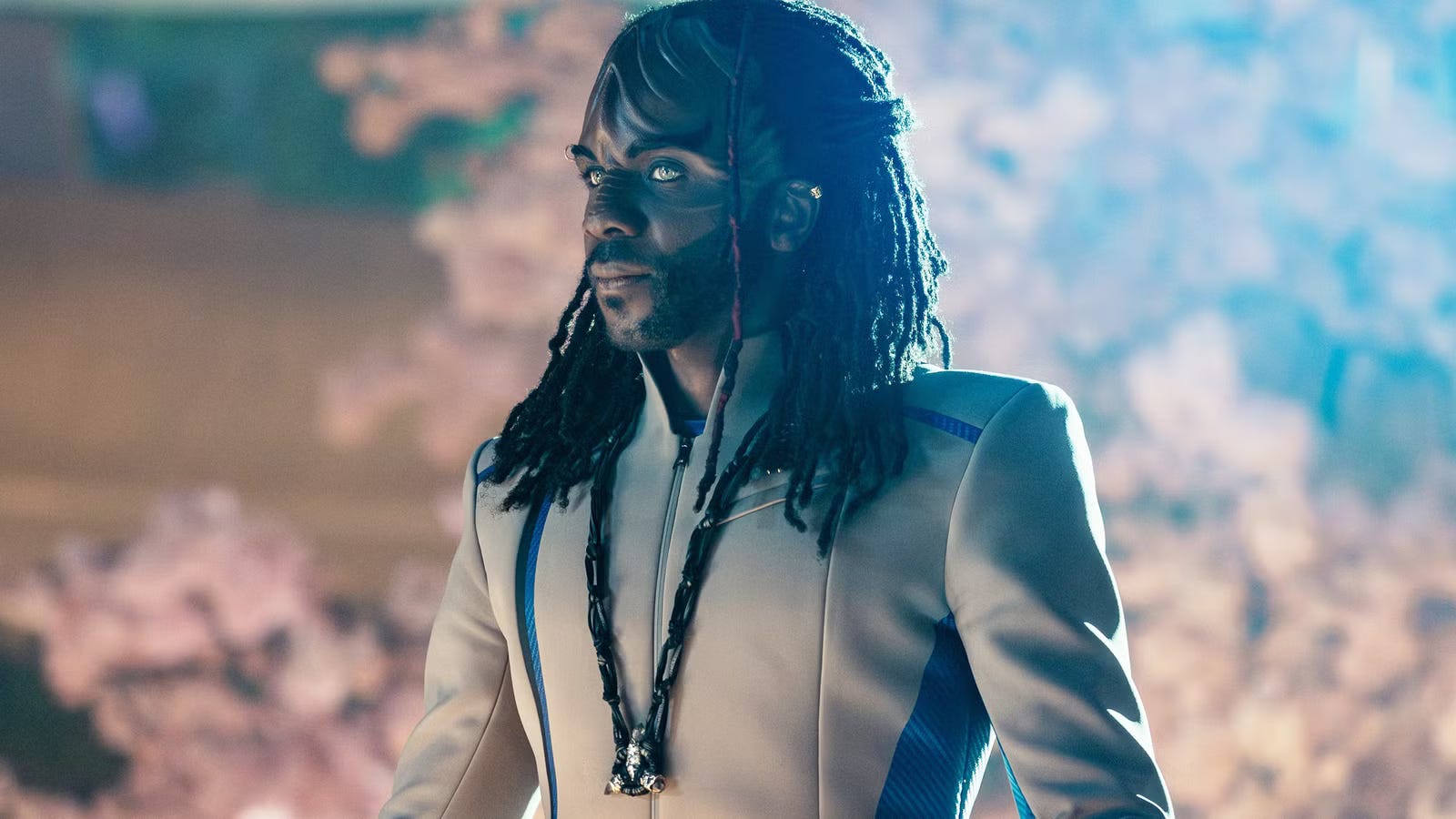
Star Trek: Starfleet Academy premiered on Paramount+ on January 15, 2026. Two months later, on March 23, the studio announced the show would end after season 2, which had already finished filming. Season 2 arrives in March 2027, and cast members say they do not know how it ends because the story wraps up before the cadets finish their training.
The cast is still working the convention circuit. At New York Comic Con, Karim Diané, who plays the franchise’s gay Klingon, Jay-Den Kraag, sat for an interview about what comes next. He was asked what viewers can expect from season 2.
“If anybody was excited by seeing gay things in the first season, ba-by! If anybody was upset by gay things in the first season, prepare to be pissed off.”
He laughed after saying it, and the show he was promoting had already been told it would end.
The same interview contained a second answer worth reading. Asked what he would tell the next Star Trek creatives to include, Diané said, “Include real people. People look so different. I look so different from you, I am so different from you, and you are different from me. I hope that we both can continue to see ourselves when we watch this TV show.”
That line is not a one-off, despite being devoid of any real substance. Diané has spent the year answering criticism of the show by attacking the people making it, and the answers follow a pattern.
In March, he said that when angry people attack him online, “It is rooted in racism, homophobia and sexism. These negative things have nothing to do with me.” He said most of the criticism “really is hate for the sake of hate.”
In the same interview, he credited Alex Kurtzman with explaining the YouTube commentary to him. “On YouTube, there is an overabundance of negativity when it comes to not just me but the show in general. Creators make money off it because negative taglines on YouTube get more clicks than positive ones. A lot of times it is just a way to make money, which is so evil.”
He also described what the show is trying to do with masculinity. “Society expects men and masculinity to look one way, and it’s so rigid that almost nobody fits that standard. Men are expected not to be emotional, not to need friendship, or not to like other men. They’re expected to do it on their own, pull up their pants, and dive into battle. We’re turning all of that on its head with this show.”
At the Trek Talks panel in April, after the cancellation, he went further. “Star Trek has always ruffled feathers, is what I’m understanding. Like from day one, from the very first episode, you know, the point of Star Trek is to ruffle feathers, is to stretch people’s minds and make space for everyone.”
He then described the messages he receives. “There also has been a lot of weird stuff, like scary messages. Honestly, some people have responded to this violently, and that really tells me that we’re actually doing exactly what we’re supposed to be doing, truly, because the point of Star Trek is to kind of, like, push that needle forward.”
On the angry comments under the Lanterns trailer, he told the panel, “Bro, relax, why are you mad?” and said it showed “people are going to be mad regardless.”
Asked in October whether anger over the show contributed to its cancellation, he deflected. “I think that there are multiple factors, and it’s impossible to pinpoint it on one thing. I’m just an actor. I don’t have the answers to that question. That’s probably a better question for Alex Kurtzman.”
Robert Picardo, who has played the Doctor since Voyager premiered in 1995 and returned for Starfleet Academy, has offered two different explanations for why the show ended.
After the cancellation, he blamed the culture. “Every Star Trek show was criticized in its first two or three seasons, and then took often till season three to get on track. And even though I think the quality of our show was great, we were kind of killed in the cradle, and I believe part of it is the present political moment in our culture that diversity, that all of Star Trek’s core values are now out of fashion temporarily. We see diversity under attack, and therefore Star Trek is under attack because that’s what Star Trek’s always been about.”
He added a prediction: “I think that a lot of the voices now that are so loud and negative will not be as loud and negative.”
At a convention in San Antonio in June, he blamed the studio. “I wish we had been given more time to build an audience. Our show was conceived under the prior ownership regime at CBS Paramount and once the new owners took over, we had no support with the release of the show. We didn’t get any ads. You couldn’t even find us. I had friends who said, where is Starfleet Academy? I said, it’s on Paramount+. And they said, I have Paramount+, I can’t find it. After the premiere episode, it kind of dropped off the menu.”
At the same convention, he turned to the franchise’s future. “I’m a little concerned about Star Trek moving forward because we were criticized for having too much diversity and inclusion, and that’s a core value of Star Trek. I don’t know how you make Star Trek without it. I’m hopeful that whatever next Star Trek, and I know there’s going to be a hiatus, that it keeps those values. That it always is the United Nations in space, not America First in space. And that it remains cooperative. It’s a vision of cooperation between space faring planets in the future and it’s not let’s go out and conquer the planets of Venezuela, Iran, Greenland, and Cuba.”
The two explanations do not match. One says viewers rejected the show’s politics. The other says Paramount never gave the show a chance to find viewers. Both come from the same actor. If nobody could find the show, the audience cannot be blamed for leaving it, yet the public message from Diané and Picardo has been aimed at that audience anyway.
The scores show the gap. In March, the series held 88 percent on Rotten Tomatoes and 1.8 out of 10 on IMDb. That is not a split audience. Critics approved and the viewers the show needed did not show up, which is how a series ends up canceled two months after its premiere with a second season already shot.
Paramount+ announced the end with a short statement. “We’re incredibly proud of the ambition, passion, and creativity that went into bringing Star Trek: Starfleet Academy to life,” CBS Studios and Paramount+ said.
The cancellation lands inside a wider retreat. Season 2 of Starfleet Academy and the final season of Strange New Worlds are the last Star Trek series on the Paramount+ schedule. Once they air in 2027, no new Star Trek series has been announced. A film is in development.
That ends the run of live-action Star Trek television that began with Discovery in 2017 under Alex Kurtzman, who has overseen the franchise’s television output since then. Discovery ran five seasons. Picard ran three. Both Diané and Picardo, asked why this show ended, pointed at forces outside the writers’ room. Picardo named politics and the studio’s new owners. Diané sent the question to Kurtzman. Meanwhile the cast has spent the press tour telling viewers off instead of winning any of them back.
Diané describes online criticism as rooted in racism, homophobia and sexism, calls YouTube commentary “so evil,” and tells anyone upset by season 1 to prepare to be pissed off. Picardo says the show died because diversity went out of fashion, then says it died because nobody at the studio promoted it. A cast that spends its press tour scolding the audience that did not watch is out of touch with that audience and is making the case for the cancellation. Is this how Star Trek wins viewers back, or does the hiatus look overdue? Tell us in the comments.
Instead, their chief engineer is dead, their ship is sabotaged, and an ancient alien technology is stealing souls. Book one of the Valiant Frontiers series delivers exploration, mystery, and the kind of crew you’ll want to follow across the galaxy. Read The Soul Catcher on Amazon and start the adventure.
He should be prepared to ask if you fries with that.
Welcome home, Starfleet Academy cast.