


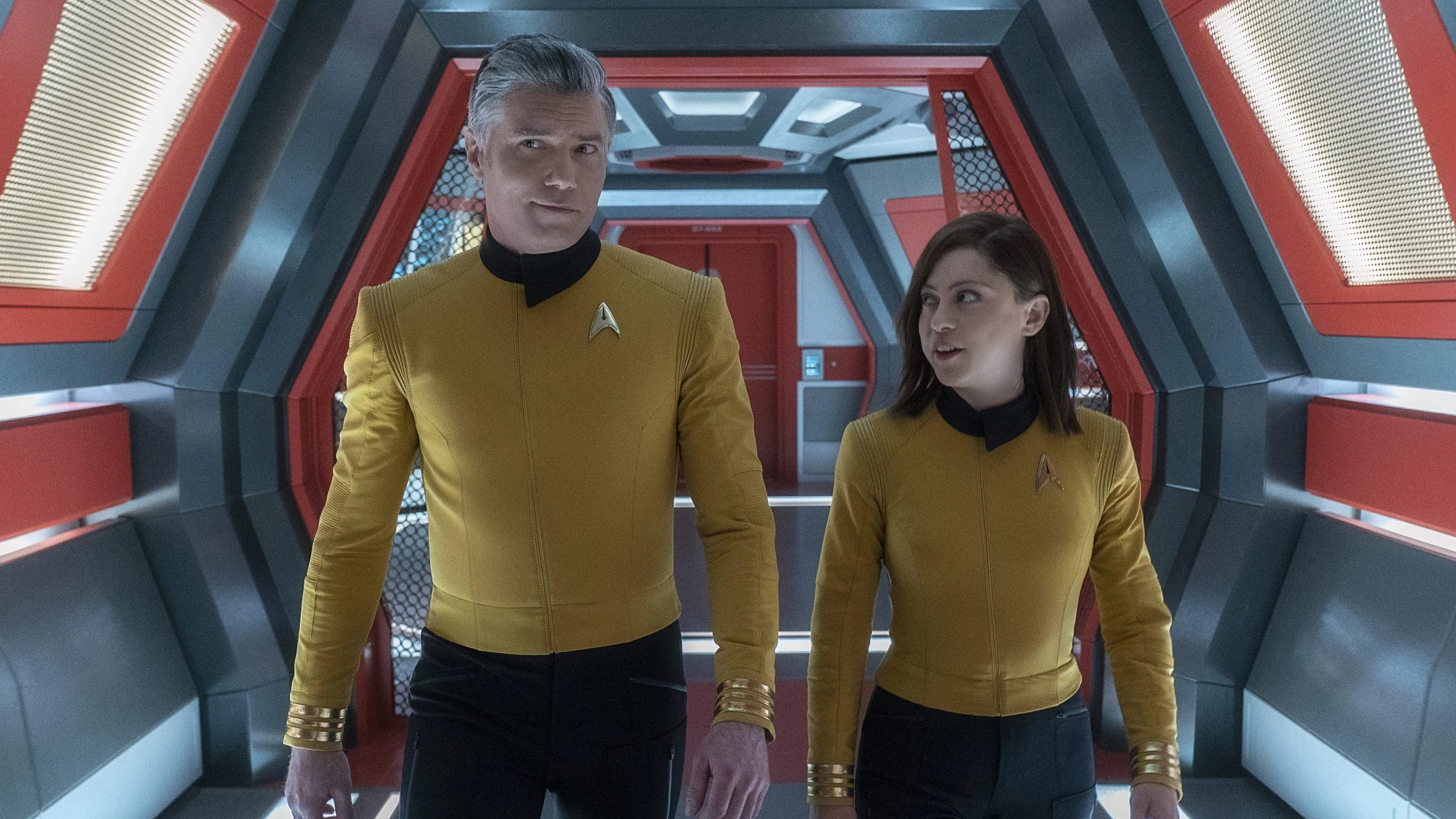
Rick Berman and Brannon Braga just said what fans have been thinking for years: modern Star Trek sounds too much like 2025, and it’s killing the immersion.
In a recent appearance on The D-Con Chamber podcast with Connor Trinneer and Dominic Keating, the two executive producers who ran Star Trek for nearly two decades discussed the franchise’s approach to language. Braga explained the philosophy that guided their era: “Writing Star Trek—and Rick, you can probably attest to this more than anybody—it’s just a particular thing. The tone is kind of a timeless one; it’s a bit more formal, but at the same time, you don’t want it to be too stiff. You want it to not be tainted by contemporary idioms, but at the same time, it can’t be free of them.”
That balance is what made classic Trek work. The characters sounded professional, intelligent, and evolved, like people from a better future who had moved past the petty concerns of our era. They didn’t talk like your coworkers at the office, or worse, modern high school students.
Berman pointed to a specific example from modern Trek that violated this principle: “I watched an episode of one of the newer Star Treks, where people were saying things like ‘Give me five.’ And it just doesn’t sit right to me. There’s a certain classical element to Star Trek.”
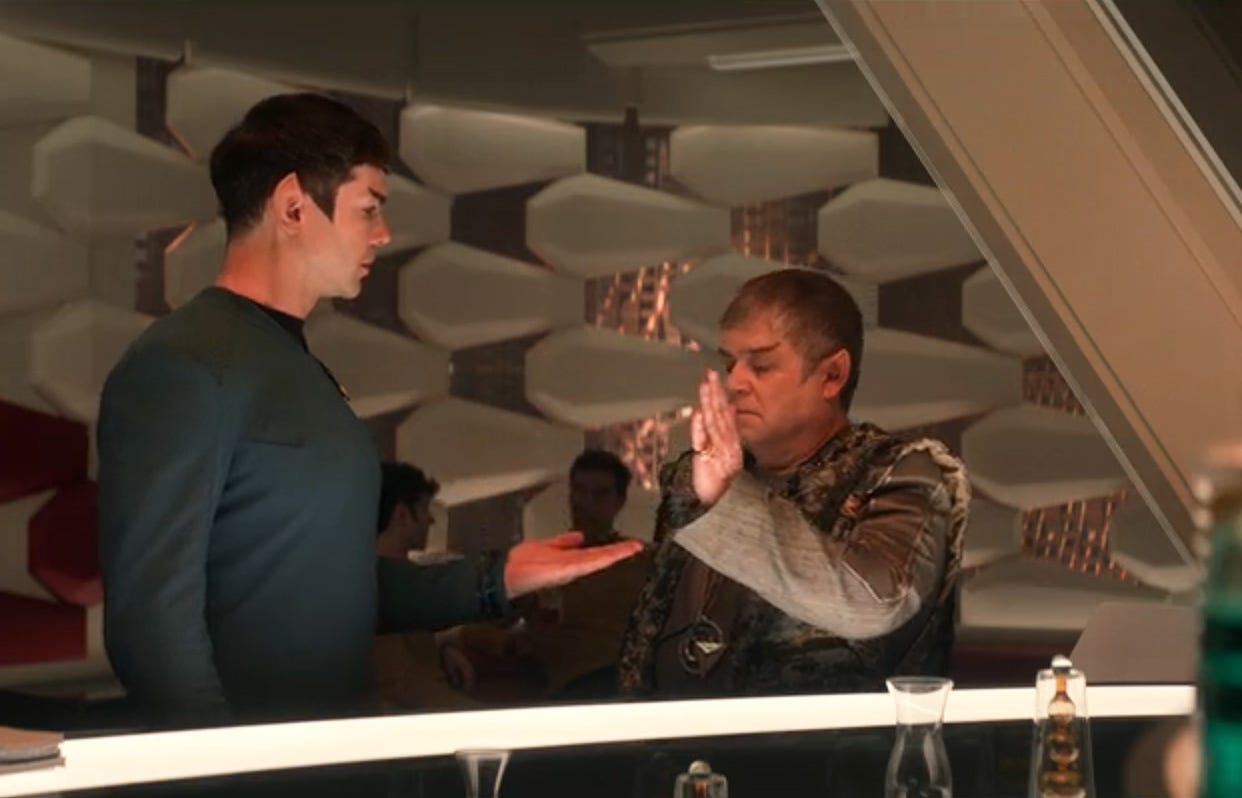
He’s talking about Strange New Worlds Season 3, Episode 8, “Ghosts of Illyria Part II,” where Spock teaches the Vulcan character Doug (played by Patton Oswalt) about human customs, including the high five. The scene plays for laughs, but it’s jarring. Spock explaining a high five in 2259 feels like a sitcom bit, not Star Trek. The gesture will be 300 years old by that point. Would someone in 2025 need to explain a handshake to a visitor? The contemporary framing breaks the illusion that we’re watching the future.
Discovery committed worse offenses. In the fifth episode of Season 1, “Choose Your Pain,” Cadet Tilly dropped the first f-bomb in Star Trek history. After a scientific breakthrough about the spore drive, she exclaimed: “You guys, this is so fucking cool!”
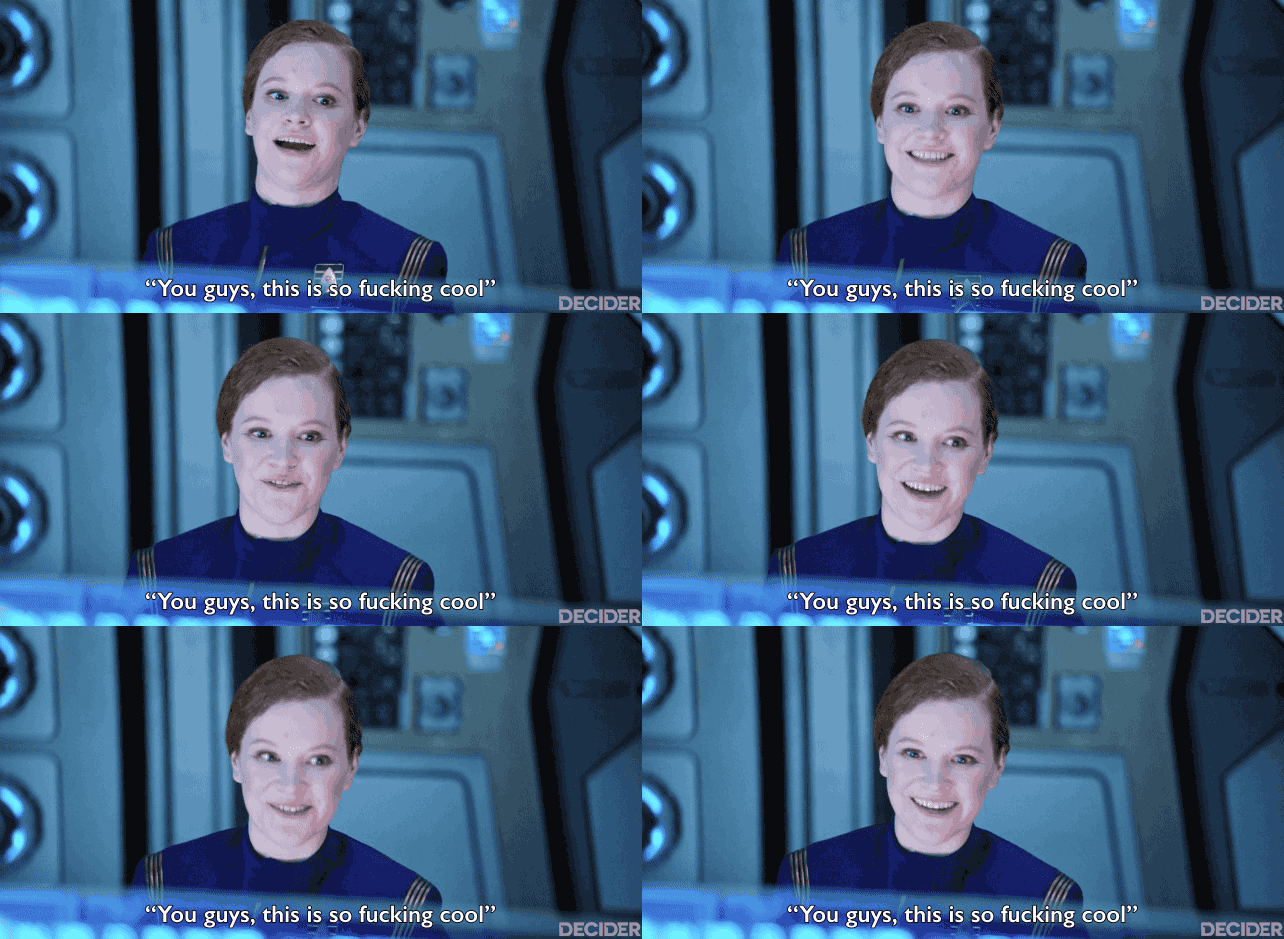
The moment made headlines. After five decades, Star Trek had finally said “fuck” on screen. Some praised it as breaking outdated taboos. Others saw it as exactly what Berman and Braga warned against, contemporary language that dates the show and undermines the setting.
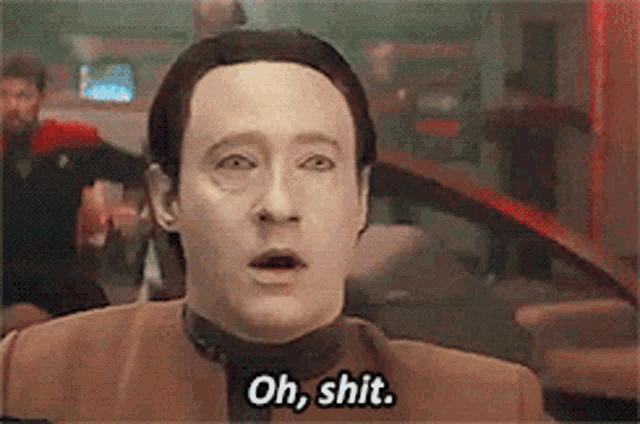
The problem isn’t profanity itself. The problem is context and execution. When Data said “Oh shit!” in Star Trek Generations, it worked. Data had just installed his emotion chip and was experiencing feelings for the first time. The Enterprise was crashing into a planet, and he blurted out the first thing that came to mind in the form of a curse word he’d heard humans use in moments of panic. The scene was funny because it highlighted Data’s inexperience with emotions and the absurdity of an android swearing. It was a character moment that made sense.
Tilly’s f-bomb has none of that context. She’s just excited about science and drops a modern curse word because the writers thought it would be edgy. There’s no character reason for it. It doesn’t reveal anything about Tilly or the 23rd century. It’s just a writer in 2017 putting 2017 language into a character’s mouth because streaming allows it.
Likwise, when Kirk said “double dumbass on you” in Star Trek IV: The Voyage Home, it was funny because Kirk didn’t know how to swear properly. He was a 23rd-century officer trying to blend in with 1980s San Francisco and failing. The joke was that profanity had become unfamiliar to him, a relic of humanity’s less enlightened past. The scene worked because it reinforced the idea that Star Trek’s future was better than our present.
By contrast, Picard Season 1 featured Admiral Clancy telling Picard to “shove it up your ass” during an argument. Picard himself dropped an f-bomb in Season 3 while arguing with Captain Shaw. These moments are meant to show that the characters are “real” and “relatable,” but they accomplish the opposite. They make the characters sound unprofessional and petty, like people who never grew past 21st-century emotional immaturity.
Discovery Season 3 took contemporary language insertion to another level with the character Adira Tal. In Episode 8, “Scavengers,” the Trill character, played by non-binary actor Blu del Barrio, comes out to Stamets and asks to be addressed with they/them pronouns. The scene is a direct transplant of 2020s gender identity politics into the 32nd century, complete with the exact terminology and framing used in contemporary discourse.
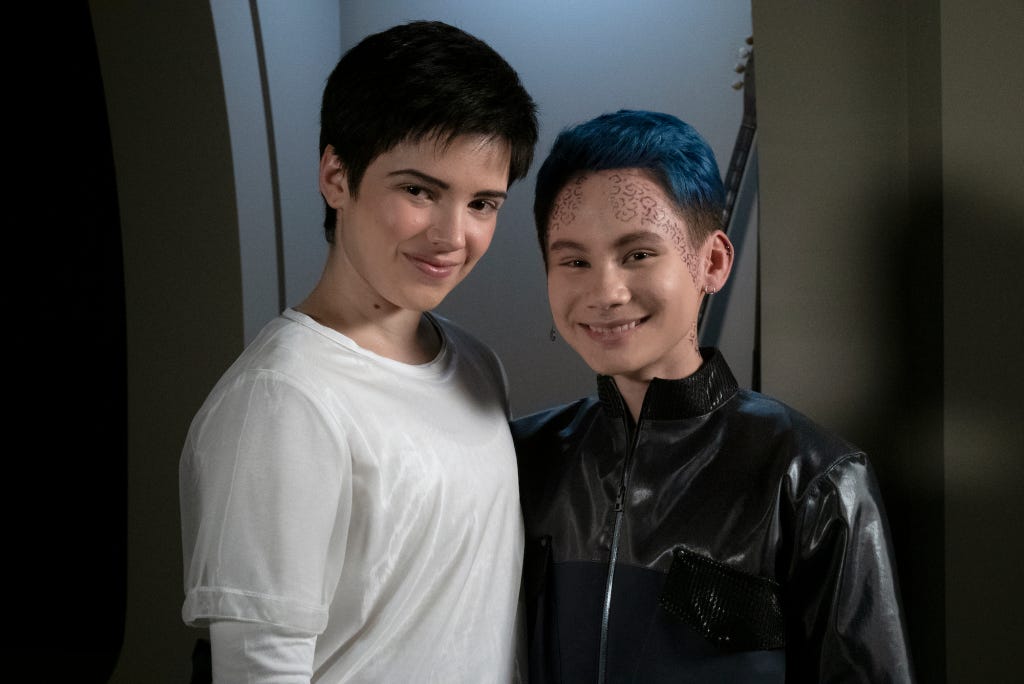
“I’ve never felt like a ‘she’ or ‘her,’ or even ‘ma’am,’” Adira tells Stamets. “I don’t really know what I am.”
Stamets responds: “Thank you for sharing that with me. And you can be whoever you want to be.”
The scene plays like a PSA about pronoun respect rather than a moment in a science fiction show set a thousand years in the future. The language is lifted directly from 2020s social justice discourse with ”I’ve never felt like” phrasing that wouldn’t exist in a society that had presumably moved past rigid gender categories centuries ago. If humanity in the 32nd century has evolved beyond our current understanding of gender, why would someone need to “come out” using the exact same language and framework we use today?
The Trill species adds another layer of absurdity. Trill symbionts carry the memories and experiences of multiple hosts across genders. Jadzia Dax in Deep Space Nine had lived as both male and female hosts and never made an issue of pronouns because the character existed beyond modern conventions of made up genders. Adira’s storyline reduces that fascinating alien concept to a metaphor for contemporary non-binary identity, flattening the science fiction into a lecture about pronouns.
The same problem plagues Strange New Worlds. Characters use contemporary slang and idioms that will sound dated in five years, let alone 200. When Pike’s crew talks like millennials at a startup, it breaks the illusion that these are professional officers in the 23rd century. They sound like actors reading a script written last week, not people who grew up in a fundamentally different society.
Braga acknowledged that Enterprise tried to loosen the formal language somewhat: “One of the reasons we wanted to do Enterprise was to loosen that up a little bit and have characters that talked a little more like you and me.” But even Enterprise maintained boundaries. The characters were more casual than Picard’s crew, but they still sounded like Starfleet officers, not college students.
The Berman era understood that Star Trek’s language was part of worldbuilding. The way characters spoke reinforced the idea that humanity had evolved. People in the 24th century didn’t use the same slang as people in the 1990s because they weren’t the same people. They’d moved past tribalism, poverty, and petty conflicts. Their language reflected that maturity.
Braga then made a playful dig at Strange New Worlds’ upcoming puppet episode: “We could have done puppets, too!” The comment was a joke, but it reflects a real concern. Modern Trek is willing to do anything for attention, including puppets, f-bombs, contemporary slang, pronoun lectures, without asking whether it serves the story or the setting.
The language issue is part of a larger problem. Modern Trek has abandoned the idea that the future should be aspirational. The characters don’t act like evolved humans who’ve overcome our worst impulses. They act petty, emotional, and crude.
Gene Roddenberry created Star Trek to show what humanity could become if we got our act together. The language was part of that vision. People in the 23rd and 24th centuries spoke with intelligence, dignity, and professionalism because they’d built a society that valued those qualities.
Modern Trek has given up on that aspiration. The characters talk like “us” because the writers can’t imagine people actually evolving. It’s cynical, lazy, and it dates the shows in ways that will be painfully obvious in a decade.
What do you think? Should Star Trek return to the more formal, timeless language of the Berman era, or is contemporary dialogue necessary to connect with modern audiences?
I’m putting out a trilogy of some of the best science fiction in years, bringing back the sense of wonder and exploration to the genre. The crowdfund is open now, and if you miss what sci-fi used to be, this is the series for you. Back it today.

In 50 years, people will still watch the early Star Treks but nobody will watch anything produced after 2000 because they will be annoyingly cringe and dated.
The central problem of Nu-Trek is that it isn’t Trek. It’s just generic slop with a thin veneer of Trek to make it easier to sell.