


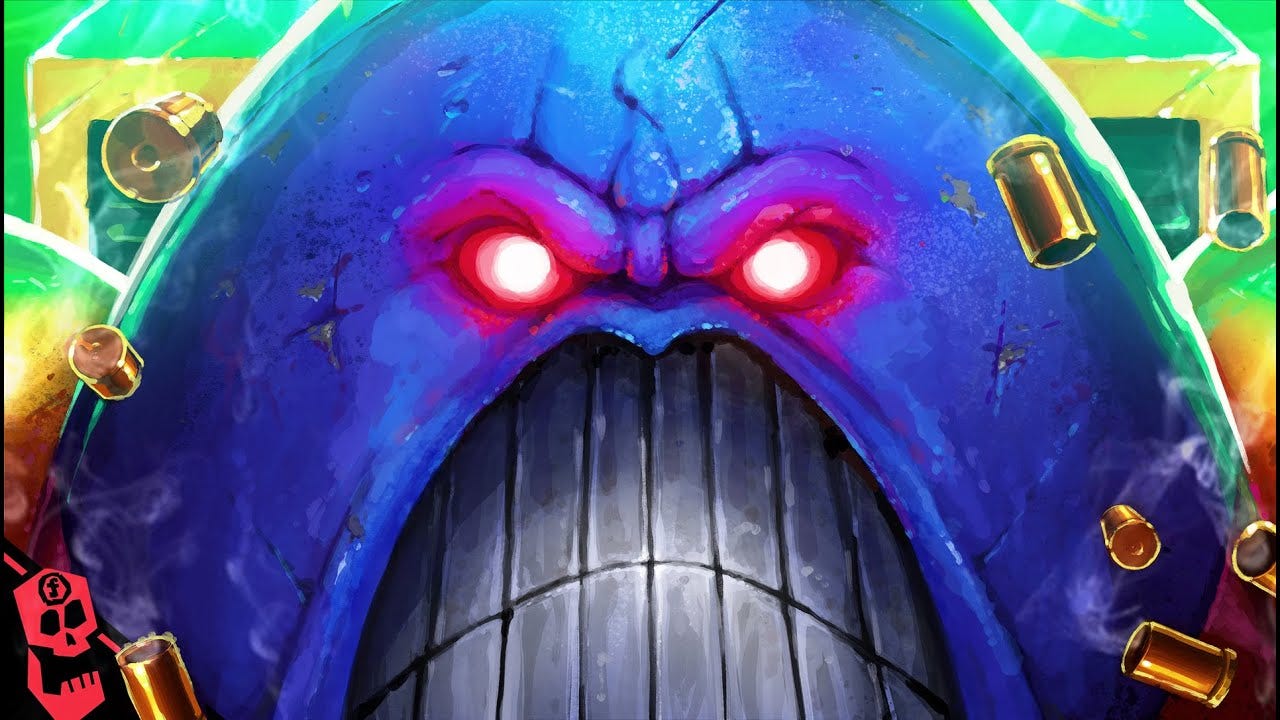
Space King, a YouTube cartoon from two British animators, asked Kickstarter for $50,000 on August 30 to fund a board game. Studio Flashgitz funded the goal in six minutes. Twenty-seven days later the campaign closed on a total that dwarfed the ask, from a studio that had never shipped a physical product. Games Workshop has reason to pay attention, and it goes back two years to a fan content crackdown that sent these animators to build a universe from scratch.
Two Animators and a Crackdown
Flashgitz is Tom Hinchliffe and Don Greger. They built their YouTube following on Warhammer 40,000 fan animation, including videos that sent Black Templars against a community of Slaaneshi hedonists in fluffy animal costumes.
Then Games Workshop tightened its fan content rules and steered animation toward its Warhammer+ platform. Many fan creators deleted their work or stopped posting for fear of legal action.
Hinchliffe and Greger answered with something they could keep. Space King is an original, creator-owned universe: a grim human empire ruled by an absent, worshipped Space King, and four Psycho Warriors named Captain, Bryce, Hatemonger and Chestnut who fight alien forces and each other. The duo reportedly turned down a network offer to hold onto the IP. A network-owned Space King could not have run a crowdfunding campaign or manufactured miniatures, so that decision paid off the day the campaign opened.
The Launch
Flashgitz announced the game on August 8 on its Tom and Don channel. About 18,000 people followed the Kickstarter page before launch, and Kickstarter notifies followers the moment a campaign goes live. The studio released Space King 5: War World the same day the campaign opened, so the audience arrived at peak attention. Hinchliffe and Greger planned that timing, and it worked.
More than 5,400 backers pledged on day one. The campaign passed $2 million in under 24 hours, roughly 40 times its goal. By September 1 it stood at $2,780,478 from 7,386 backers, and Kickstarter had tagged it a Project We Love. All 18 stretch goals unlocked, each one adding content to a lore book as funding climbed.
What a $370 Average Pledge Buys
The average pledge ran about $370. Casual board game campaigns typically land between $30 and $60 per backer. The base Recruit tier costs $99. Above it sit the Psycho Warrior set at $299, Super Psycho Warrior at $699, Psycho Monster at $1,199 and Globulus Maximus at $7,777. Fifteen slots that let backers appear as a character in the show sold out at nearly $8,000 each.
The game seats two to four players in a semi-cooperative format with five scenarios. A Command Deck controls the enemies and an Event Deck adds complications. Everyone fights the aliens, but only one player wins Space King’s favor, so backstabbing is part of the rules.
The miniatures drive the pricing. Psycho Warriors stand about 50mm, standard aliens 36mm and bosses 109mm, all pre-assembled PVC with no clippers or glue required. Games Workshop sells polystyrene kits on sprues at 28 to 32mm, and buyers assemble them. Flashgitz aimed at the hobbyist who already spends $100 to $400 on a box of plastic, and that hobbyist showed up.
The Final Count
The campaign closed September 25 at $9,670,639.
Kickstarter’s 5 percent fee and payment processing of roughly 3 to 5 percent take between $770,000 and $970,000 of that, and the rest funds manufacturing and fulfillment. Two animators did this without a publisher, a license or a network. They kept the characters, the audience and the margin.
Games Workshop reported £659.7 million in revenue for the year ended May 31, 2026, up 6.8 percent. Flashgitz just took nearly $10 million of the same hobbyist wallet, one crowdfunding campaign at a time. These are the independent creators Fandom Pulse backs: owners of their own IP who went straight to their fans and let the market decide.
Games Workshop Answers
On August 20, ten days before launch, Games Workshop filed an opposition with the US Trademark Trial and Appeal Board against Flashgitz TX LLC’s application to register FLASHGITZ for tabletop games, since Games Workshop already uses the name Flash Gitz. The Space King tabletop application was filed in February 2026.
On October 2, Games Workshop released an animation styled like Dumb Ways to Die to promote its upcoming Space Marines codex. It shows super-soldiers meeting grim ends. Fans on X compared it to Space King and called it rushed.
The Fulfillment Risk
Backers should expect boxes in December 2027, with retail copies no earlier than early 2028. Flashgitz has no manufacturing record at this scale. Across all categories, about 84 percent of Kickstarter projects deliver late, by an average of 4.3 months, and roughly 9 percent never deliver. Observers have called the December 2027 date optimistic for a first-time manufacturer, though the molds appear to be in production already.
If Flashgitz delivers on schedule in December 2027, what does a publisher still offer a creator with an audience this size?
Space marines on a holy crusade across the galaxy. If that sentence got your attention, Justified: Saga of the Nano Templar is your next read. Three books of relentless action Read Justified: Saga of the Nano Templar on Amazon!

Praise be!