


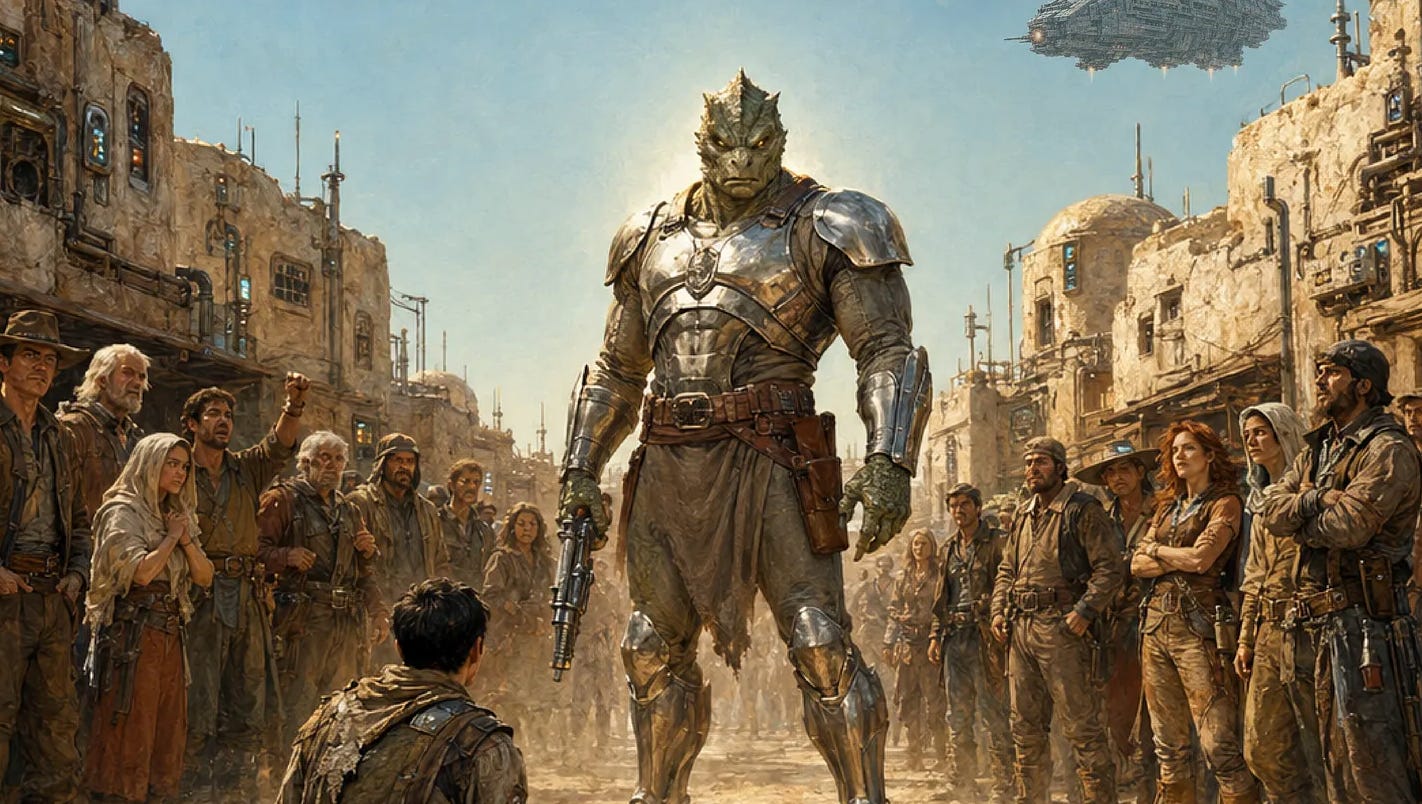
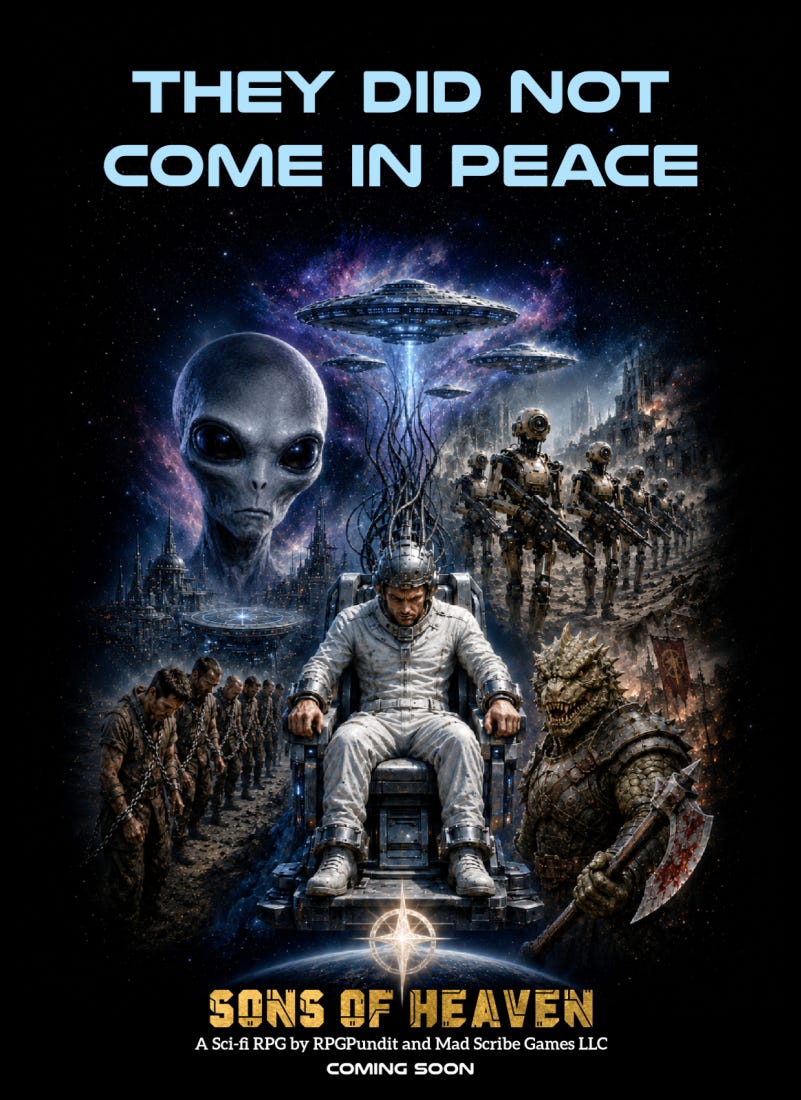
After a long road from manuscript to finished book, Sons of Heaven, a new old-school science-fiction tabletop role-playing game from Mad Scribe Games, is preparing for release. The finished files have gone to the printer, and the team is currently awaiting proof copies of the more than 300-page game.
Written by RPGPundit, with editing, layout, formatting, and art direction by Chris Miller, Sons of Heaven combines the familiar mechanics of classic fantasy role-playing games with a sprawling space-opera setting built around fallen civilizations, alien empires, frontier worlds, ancient technology, and humanity’s struggle to reclaim its place among the stars.
For longtime tabletop gamers, one of the game’s biggest advantages may be its familiarity. Sons of Heaven uses an old-school D20 system designed to be broadly compatible with the Basic/Expert tradition of Dungeons & Dragons and related old-school games. Players who have spent years rolling twenty-sided dice in fantasy campaigns should therefore find much of the game’s mechanical language immediately recognizable.
“One thing I really like about the game is that you don’t have to learn some completely alien rules system just because you’re playing science fiction,” said Miller. “If you’ve played old-school D&D, a lot of this is going to feel very natural. You can concentrate on learning the setting and having fun instead of spending three sessions trying to figure out how the game works.”
The Bronze Age Collapse - Among the Stars

Mechanically, Sons of Heaven may have its roots in old-school fantasy gaming, but its setting looks considerably farther afield.
RPGPundit, an academic historian with a longstanding interest in history, religion, mythology, and esoteric traditions, describes Sons of Heaven as, in part, a science-fiction interpretation of the collapse of the Bronze Age.
Instead of ruined kingdoms separated by mountains and seas, however, Sons of Heaven presents the remnants of a once-great interstellar civilization scattered across the galaxy.
For 9,000 years, the Human Confederation united mankind across the stars. That civilization was finally shattered by the 13th Machine War. Countless worlds were devastated, billions died, and the political order that had held humanity together disappeared.
What remains is a dangerous galactic frontier filled with ruined colonies, alien occupiers, pirates, Reavers, lost technology, forgotten worlds, and relics of an age when humanity commanded an empire spanning the stars.
Players are not simply spectators to that decline. They enter the setting at a moment when the future is still undecided.
They can explore lost worlds, recover ancient technology, fight the Sauri occupiers, trade along dangerous frontier routes, hunt legendary treasures, battle Reavers, build alliances, or search for the prophesied Son of Heaven who may someday restore mankind to greatness.
RPGPundit characterizes the game’s genre as Space Opera: enormous in scope, filled with exploration, warfare, strange civilizations, adventure, and mythic themes. Although recognizable genre conventions are present, considerable effort went into making the setting its own universe rather than simply reproducing the appearance or assumptions of established science-fiction franchises.
“I was actually a little skeptical when Pundit first started talking about doing science fiction,” Miller said. “He’s a historian, and he’s done a lot with historical settings for D&D. Science fiction seemed like a pretty big departure. Boy, was I wrong. I think he knocked this one out of the park.”
The setting also incorporates ideas drawn from mythology, history, and comparative religion. Some of Joseph Campbell’s ideas can be found beneath the surface, alongside both subtle and not-so-subtle echoes of Christian parables and recurring themes familiar from ancient myth.
The result is science fiction that looks toward the future while drawing much of its inspiration from humanity’s distant past.
A Long Road to Publication
Getting Sons of Heaven from manuscript to finished book proved considerably more difficult than originally anticipated.
The game had initially been expected much earlier in 2026, but artwork became one of the project’s largest obstacles.
Given the controversy surrounding generative AI in the tabletop industry, the original intention was to source human-created artwork wherever practical. For a small independent publisher producing an illustrated book of more than 300 pages, however, the economics quickly became difficult.
“People sometimes underestimate just how expensive a heavily illustrated RPG can be for a small publisher,” Miller said. “A good individual piece can cost hundreds of dollars, and professional cover art can easily run into the thousands. Once you start talking about filling a 300-page book, you’re potentially looking at tens of thousands of dollars and a very long production schedule.”
Miller had encountered that problem before. His first published RPG, Ankur - Kingdom of the Gods, cost more than $25,000 to produce, with roughly 90 percent of the production budget going toward artwork.
“That experience definitely changed the way I look at publishing,” he said. “Independent publishers don’t have unlimited budgets. The artist understandably needs to get paid for the work, usually before the publisher has made a dime from the book. Meanwhile, the publisher and authors can spend months or years working on something without knowing whether they’re even going to break even.”
Miller’s perspective on the issue is complicated by the fact that he has an art background himself.
“I don’t hate artists. I used to be one,” he said. “I was an art major in community college back in the ‘90s. I’ve been the starving artist. I understand that side of the argument. But I also understand what it’s like trying to produce a professional-looking book as a tiny publisher with limited time and limited money.”
Eventually, the realities of the project’s budget and schedule led to the decision to use AI-generated imagery.
That did not immediately solve the problem.
Miller spent months experimenting with Midjourney but struggled to produce artwork that he felt was good enough for the finished book. The project stalled, and the prospects for completing the necessary illustrations began to look increasingly uncertain.
Then newer generations of both ChatGPT’s and Midjourney’s image-generation technology became available.
“The difference was dramatic,” Miller said. “Suddenly I was getting results where I thought, ‘Okay, this might actually work.’ The results were stellar… pardon the pun.”
Miller upgraded to a premium AI plan and began producing the illustrations needed for the book. But better technology did not eliminate the workload.
With more than 300 pages to design and illustrate, generating suitable images became a substantial project in itself.
Teaching AI to Imagine a Different Future
One challenge was particularly important: Sons of Heaven needed its own visual identity.
RPGPundit wanted the game to evoke the enormous scale and excitement of classic space opera without directly copying the visual vocabulary of major science-fiction properties. That requirement made AI-assisted illustration considerably more complicated.
“When you tell an AI that you want something to look like space opera, it has a huge amount of existing pop culture influencing what it thinks that means,” Miller explained. “If you’re not careful, you can wind up with something that starts looking suspiciously familiar. We didn’t want Star Wars. We didn’t want Star Trek, Battlestar Galactica, or Buck Rogers. We wanted Sons of Heaven.”
The solution was increasingly elaborate prompt construction.
Rather than asking for the style of a particular artist or franchise, Miller began breaking visual styles down into their individual components: lighting, composition, materials, brushwork, color palettes, perspective, anatomy, surface texture, costume construction, environmental details, and other characteristics.
“The trick I eventually learned was that you have to describe what makes a style work rather than simply naming the style,” he said. “You describe the techniques. You describe the lighting. You describe the texture, composition, colors, materials, and how the image should be staged. Some of my prompts ended up six paragraphs long. A really complicated prompt could take me an hour to put together.”
That process had to be repeated across the book.
Miller sees the experience as another part of a continuing education in independent publishing. He is self-taught in layout and graphic design and has now been working in publishing for nearly a decade.
“I still feel like a novice sometimes,” he said. “There’s always something new to learn, and every book shows you something you could have done better on the last one. But I can also see the improvement from project to project. I think this is my best book to date.”
Production suffered another setback when Miller developed pneumonia, putting him out of commission for roughly a month. After recovering, he began an extended push to finish the project, frequently spending eight to twelve hours a day on the book for weeks at a time.
The result is now finally at the printer.
AI Art and the Reality of Indie Publishing
The use of AI-generated artwork will inevitably be controversial, particularly in the tabletop gaming community, where debates surrounding generative AI have become increasingly heated.
Miller does not expect Sons of Heaven to settle that argument.
Instead, he sees the project as an example of why independent creators are increasingly experimenting with the technology.
“For a small publisher, AI can be a godsend,” he said. “That doesn’t mean human artists don’t have value. Of course they do. But if you’re trying to produce hundreds of pages of illustrated material, the traditional approach can turn a book into a two- or three-year project costing tens of thousands of dollars. That’s simply outside the reach of a lot of independent creators.”
Miller believes AI will continue to change the economics of publishing regardless of where individual creators stand on the technology.
“Like it or not, AI is here, and I think it’s going to change the way a lot of businesses operate,” he said. “We’re still figuring out what that means. For this particular project, it allowed us to make the book we wanted to make at a scale we could actually afford.”
Old-School Gaming in a New Galaxy
Ultimately, however, Sons of Heaven is intended to be judged at the gaming table rather than by the tools used to produce it.
The game is aimed particularly at players who enjoy old-school role-playing but want to venture beyond traditional fantasy without abandoning familiar mechanics.
That includes the Grognards who may already have a favorite game, and may not be interested in learning an entirely new rules engine just to experiment with science fiction.
“I know a lot of longtime gamers have one or two systems they love, and that’s what they play,” Miller said. “I’m the same way. That’s why I think Sons of Heaven has an advantage. If you’re already comfortable with old-school D&D, you’re not starting from zero.”
Nor does the game necessarily require abandoning an existing fantasy campaign.
“Even if you aren’t looking to start a permanent science-fiction campaign, I think this could be a great game to keep on the shelf for one-shots or for those weeks between your regular campaigns,” Miller said. “You already understand the basic language of the rules. Grab some players, make a crew, and go see what’s waiting on the next planet.”
For Miller, the project also represents the broader value of independent tabletop publishing at a time when many longtime fans have become frustrated with the direction of large entertainment companies.
“We’re trying to be the change we want to see in the hobby,” he said. “Independent creators can take chances that giant companies sometimes can’t, or won’t. But if people want alternatives, those alternatives have to be supported. The little guys only get to keep making games if people are willing to give those games a chance.”
And after months of setbacks, experimentation, illness, long workdays, and hundreds of pages of production, Miller is eager to finally put Sons of Heaven into players’ hands.
“I know I probably sound like a car salesman when I talk about it,” he said, “but I’m genuinely enthusiastic about this setting. I’m proud of the work I’ve done on the book, and I really do think it’s worth playing.”
The game’s back-cover copy offers perhaps the best introduction to the universe players will soon be able to explore:
The Human Confederation is dead.
For 9,000 years it united mankind across the stars. Then came the 13th Machine War. Worlds burned. Empires fell. Billions perished. Today, the last survivors struggle to endure among ruined colonies, alien conquerors, ruthless pirates, and the forgotten relics of a civilization that once spanned the galaxy.
In Sons of Heaven, you decide humanity’s future. Explore lost worlds, recover ancient technology, battle the Sauri occupiers, outwit Reavers, trade on the frontier, hunt legendary treasures, or seek the prophesied Son of Heaven who may restore mankind to greatness. Every jump into hyperspace could uncover fortune, forge alliances, or awaken dangers best left forgotten.
Gather your crew. Plot your course. Reclaim the stars!
Sons of Heaven is out and ready for action.