


Welcome back to the second week of Superluminary, a wonderful science fiction tale by John C. Wright that we’re pleased to present as a serial each Sunday here on Fandom Pulse.
Episode 03: The Dark Tower
Like an immense, ungainly spider, the ghastly Pluto-adapted body of Aeneas broke out of the ice and moved across the frozen atmosphere of the nocturnal surface.
He flew yards at every step, feather-light. Steam rose from his footfall, soared high into the vacuum, and fell back as snow. With every step, his legs shrank, as he left an inch of bone-hard leg-tip behind, frozen.
The moon Charon was seven times larger than the full moon seen from Earth, but only five times dimmer. Charon neither rose nor set. It did not move in the plutonian sky, but shed a baleful light over the rippled glacier of frozen gasses which was the surface of Pluto.
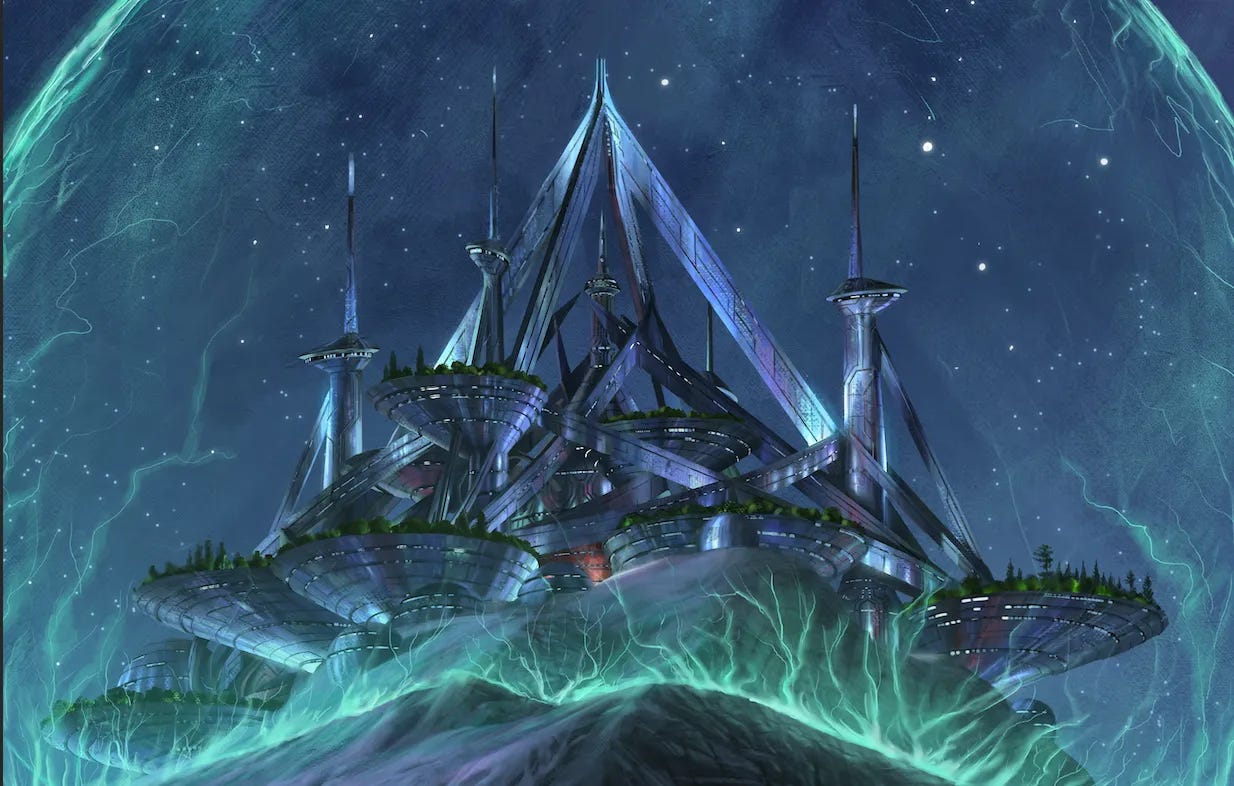
To his left rose the cone of a cryovolcano. Molten nitrogen poured sluggishly from the cone, and steam-plumes of hydrogen soared up. To his right, translucent mountains of water ice loomed in the form of rippling glacier fields. Before him rose the black cylinder, crowned with antenna, half embedded in a hill of snow: the dark tower of Lord Pluto.
On and on he stepped, aching and weak.
His outer layers smoldered, trying desperately to keep the gasses exchanging between his animal and vegetable lungs. This let him breathe, barely. A bank of photosynthetic cells surrounding a bioluminescent core kept the vegetable cells working, but the chemical stores were draining rapidly.
He half-walked, half-floated up a frozen waterfall, seeing the separate layers each atmospheric gas had deposited along the streambed walls. The ones with the higher freezing points had precipitated first, forming lower ice layers of black and blue-gray. The oxygen snow was bright blue, nitrogen pigeon-gray, helium pale ivory, and the hydrogen snow was milk-white, glistening in the vacuum under the naked stars and motionless, dead moon.
His egg shape minimized his surface area. Around his brain and organs were concentric insulating shells of enamel, horn, and scale. From atop opened a prodigious set of spidery legs.
He weighed thirty pounds. The journey was only a mile and a half. But the heat loss into the surface with each step ate away at him. Aeneas was low on oxygen, low on stored fat, and had already dissolved an unhealthy amount of tissue and bone for water and raw materials. Organs used for longterm processes, his appendix and colon and so on, had been cannibalized.
Progress was nightmarishly was slow.
Nonetheless, he had a reasonable hope. The nighttime atmosphere was frozen, leaving behind a vacuum that insulated him.
His reasonable hope died as he approached the tower, for be began losing heat through his armor rapidly, and his legs began icing up, growing heavy and brittle.
One whole leg snapped off, and then, a few steps closer to the tower, a second.
Aeneas dipped his periscope. His legs were mired in a slushy liquid. If he stumbled and fell into it, the heat loss from convection would kill him as swiftly as a lightningbolt.
On he went, more carefully. With each step, larger pieces of leg were being left behind, and now white icicles were clinging from the lower and upper joints, jamming the muscle groups.
Why was it so cold now? Where had his friendly vacuum gone? He craned his periscope, and saw a moat of liquid oxygen bubbling and steaming at the base of the dark tower.
“Waste heat is boiling the snow. There is a cloud of atmosphere around me.”
The signet ring replied: oxygen boils at a higher temperature than nitrogen or hydrogen. The cloud is hydrogen.
A leg snapped. He had but five left, two of which were becoming numb and unresponsive. His reserves of cellular material were gone. He had no time left for any more biological tricks.
“Can I generate a field from my Sach’s organ?”
You can, but it will cause severe burns in your flesh, and puncture your armor. With your armor breached, you would last less than five minutes.
“My vision is going. Can you see a door or window in that tower?”
I detect no tower.
“What? It is a huge cylinder. It is a thousand feet tall and a hundred feet wide!”
That is a space vessel.
The mystery did not distract him. “Any openings?”
Yes. A weapon port. It is blocked with snow. It seems to be pointing at you.
“Where?”
There, sir. But I warn you…
Aeneas did not wait to hear. He used the last of his strength to erect a magnetic field between two of his three still-working legs. Out of the moat Aeneas drew up a bolder-size globule of liquid oxygen.
Liquid oxygen was paramagnetic.
He threw it, and sent a vast charge of static electric lighting after it. As he’d hoped, the hydrogen layer hanging above the moat burned blue and exploded.
Gaseous hydrogen was flammable.
Combining into water, the two chemicals froze, nor was the microscopic amount of heat escaping from the tower enough to melt or evaporate it.
Vacuum returned. Snow melted, revealing a small octagonal opening: an open missile launch tube. Aeneas scrambled through the now-burning moat of liquid oxygen, warm and giddy. Self-inflicted lighting burns and whistling cracks in his armor dazed him, even with the pain centers in his brain turned off, and with every stimulant in his pharmacological glands flooding his bloodstream.
He slid down into the open tube, losing his last working legs in the process.
Aeneas dared not faint yet. He was in the cylindrical missile tube, but liquid oxygen was pouring in after, robbing him of heat and life. With the very last of his fading strength, he found and aimed a second, smaller, and steadier electrical discharge at power leads running to the motor controlling the launch chamber. The firing mechanism was built like a giant revolver, to rotate a second chamber into position after each shot.
The cylinder rotated, and he was ejected like a spent cartridge. Aeneas fell with dreamlike slowness into and across the gunnery chamber, striking the far wall. A wash of liquid oxygen splashed around him, shattering the metal deck with cold.
The whole chamber was sitting on its side. The missiles here should have been hanging by their tails, ready to be lowered nose-first into what, had the ship been under spin, would have been the outer hull underfoot. Everything was horizontal. Chairs, carpets, and control boards were clinging to one vertical wall, lighting fixtures to the opposite.
Oddly, there was neither heat nor air here, nor artificial gravity. No lights shined from any machine.
Aeneas sent a thought-message to the nearest missile, hoping to contact the kamikaze brain. No answer. “Rude creature!”
Sir, this is a pre-Imperial missile. There is no artificial mind aboard. However, there is a first aid kit in the airlock.
Aeneas was puzzled at the idea of an internal airlock. The oval door was halfway up the sideways overhead. Aeneas climbed to it awkwardly with his leg stumps, blessing the low gravity. He talked as he climbed, to keep himself awake.
“So this is from before when technology was magic. Imagine being able to go into any thought-shop and having your brain imprinted with the know-how! Legally! Free knowledge!”
Information was written in those days, sir.
“Odd. I suppose if no machines were to do it, men would have to read. A little undignified. Still, the people of those days must have loved it. A world with no secret technologies. No Lords of Creation! Imagine it!”
I cannot imagine it, sir.
“Agreed! It must have been wonderful!”
No, I mean I am not equipped with powers of imagination.
“Where are we? You called it a space vessel. Gravity chariots don’t look like this.”
Not a modern vessel. The cylindrical shape allows her to be spun for gravity. She was not designed to make planetfall, and certainly not designed to be half buried nose-first in the glacier ice of Pluto.
“Why would anyone spin a ship for gravity?”
He did not hear the answer, because then his gaze fell upon the emblem emblazoned on the airlock hatch: a three-headed dog.
Aeneas felt a chill in his soul.
This was the Cerberus.
He was aboard the dreadful, legendary ship.
The last time the ship had been seen, Aeneas had been a little boy playing the gardens of the Ishtar Plateau, in the fragrant shadow of Mount Freyja, overlooking the perfumed north polar sea of Snegurochka. The Cerberus, the ancient superdreadnought and spaceborne palace of his mad Grandfather, had taken up a menacing orbit about Venus. He remembered seeing his mother crying when no servants were around.
“I thought it would be more… luxurious. Harems. Gold. Wine centrifuges. Do you think grampa is here?”
I cannot imagine.
Once inside the airlock, the hatch shut, atmosphere was pumped in. Weight slowly returned. The heat, the oxygen, the moisture revived him.
Aeneas found a modern First Aid kit and broke the seal with a swing of his periscope. Inside the kit were ampoules of blood and bone marrow, totipotent cells and other biological materials. He opened one ampoule after another, absorbing the materials directly into his center of mass.
Restoring himself to his earth body was easy, since the cell memories yearned to return to their wonted shapes. Soon Aeneas stood on the deck in human shape: He was nine foot tall, a layer of convincingly human skin over his hidden layer of armored scales. With his metal bones and muscles of ultradense fiber, he was over four hundred pounds in earth-normal gravity.
Working the airlock might alert Lord Pluto.
“Maybe he went to the conclave at Everest. And he keeps no servants.”
Do not be at ease. It is forbidden to be on this world. It is death.
The inner airlock hatch was round, and a sideways ladder led to it, designed to be climbed out of, not crawled through.
On the far side, Aeneas straightened up and stared in astonishment.
He now stood on an unrailed circular balcony overlooking a wide well. It was a five hundred foot drop. Whatever was at the bottom, Aeneas could not see at this angle. But a reddish light was splashed along the undersides of the balconies.
In a circle with him were cryocoffins with transparent lids. Had the ship been under spin, the sleepers would have been prone. But the ship stood on her nose. The men inside the coffins were hanging head-downward.
All were unmodified. Some were greyhaired, or wrinkled, or scarred, or blemished like characters from a history lesson. Oddly, the coffins were chained shut.
There were fifteen of the nudes upside-down in coffins on this balcony. There were ten balconies below, nine above.
Three hundred crewmen.
“Stars in heaven!” said Aeneas in a hoarse whisper. “These are the three hundred. Were they asleep this whole time?”
Not asleep, sir.
“Grandfather said none of them survived!”
Nor did they, sir.
All the eyes of the upside-down crewmen flicked opened. The eyes were dead, their faces, expressionless. A sensation of weakness, faintness, dying, washed over Aeneas. He staggered, but did not fall. He clamped shut the scales of his subcutaneous armor, blocking the death-energies. An unarmored man would have been killed instantly.
Their pallor was not due to cryonic suspension. Their cells had been adjusted into the negative bands of the life-energy spectrum. They were not alive, but absorbed life.
These had been turned to zombies, just as Thoon had done to his guards, but at the same time refashioned into vampires, as Thoon had been. They were necromatic automatons, soulless soul-eaters, creatures of negative-life.
Just then, a hand fell on his shoulder, and spun him around.
“Who dares trespass on my keep?”
It was the cold voice of Lord Pluto. But no one was there.
Aloud, he said, “Sir, through no fault of my own, am I here…”
A sharp blow stung his face.
“It is vain to plea for life. Your name?”
Aeneas charged his energy-control organs. Lightning crackled from fingertips and between palms. He sought a target.
“I know you now. The biotech monster, son of Lady Venus. The anarchist. Will you match yourself against me? I am the eldest.”
Pain ignited his brain. All his muscles locked.
Paralyzed, Aeneas toppled over the edge, and into five hundred feet of air.
Support John C. Wright’s current work, Starquest by picking up the first book in his new series, The Space Pirates of Andromeda.

Space Opera must be Great! Gallant! Gigantic! Grandiose!
This tale told by a Grandmaster vows to return the glory that was lost!
Remember the days gone by, when science fiction was fun?
Now new hope is here!
If you are weary of weak, wan, woke and wasted works, your wait is ended!
Here is an epic, as grand as any tale of old -- here you will hear wonders told!
Of course there is a Space Princess, and Space Pirates galore, and an Evil Galactic Empire.
Of course there is a super-weapon known only as the Great Eye of Darkness!
Here meet Athos Lone, Ace of Star Patrol, in his one-man mission of vengeance!
The Ancient Mariner, like an iron ghost, when slain, seems to rise again!
The mysterious spymaster called Nightshadow walks in dark worlds but serves the light!
An Imperial Deathtrooper must reverse his loyalties, and fight his own clone-brothers!
Fate has set these unlikely heroes against the Four Dark Overlords
An utmost evil the unwary galaxy thinks long dead!
Can Darkness fail and Light prevail?
Read On! For All True Tales are but Part of a Greater!
The more I read this story, the more I'm drawn in.
This is classic sci-fi.
Great writing!