


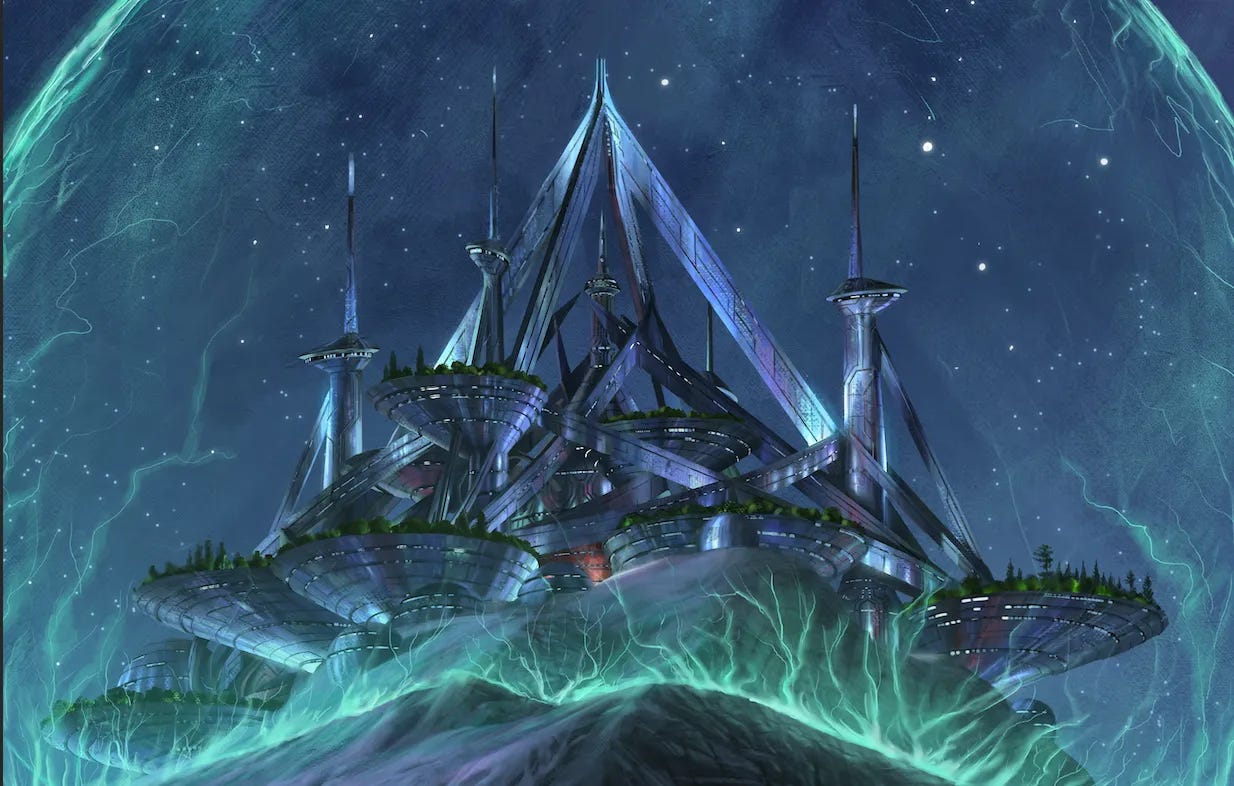
Welcome back to our Serial Sunday, featuring Superluminary, a wonderful science fiction tale by John C. Wright that we’re pleased to present as a serial each Sunday here on Fandom Pulse. This is the final chapter of this particular serial. Do you want more of this type of content? Let us know in the comments.
Episode 13: Ripping the Fabric of Reality
Aeneas gave the command to the warpcore. The great dynamos feeding power to the warpcore throbbed. The armature spun into a spherical blur of silver. The red light of Doppler shift lit the warpcore as it came alive, sullen red as a coal on the floor of hell.
The singularity was hollow. The ultradense substance called hypermatter formed an empty sphere of black hole material, but it surrounded a node or oasis of unwarped space at its heart, like a miniature continuum whose lightcone could be tilted in any direction.
Because an event horizon surrounded the inner micro-continuum on all sides, the volume, diameter, density, and time relation of the inner to the outer universe was indeterminate, held perpetually in Heisenberg uncertainty. A faster than light effect of quantum entanglement allowed one half of a particle pair outside the inner continuum to establish or edit the spacetime metric of duration and distance between the two. This enabled Aeneas to tilt the lightcone of any object within the operational range of the warpcore and orient it to the metric of the inner continuum, along with whatever fundamental physical constants (most importantly, the speed of light) he desired. There was no theoretical upper limit on how large the warpcore field could extend; there was a practical limit, however, based on the mass of the warpcore itself. With a warpcore at his command, Aeneas had enough mass to established a warp field around an entire planet.
The dark mass in the sun was equal in size to a gas giant. It filled almost half a percent of the Sun’s unimaginably vast volume. How Lord Tellus, acting alone, had constructed and placed it there was incomprehensible. Whether Aeneas could match the feat and reverse it was unknown.
A robotic voice announced, “Warp executed. The dark mass has returned to normal timespace in a positive matter state. Success!”
But Aeneas stood there, healthy and motionless.
Saturn tuned a vision plate toward a gravity-image of the sun. In the image, the dark mass of antimatter was still present at the solar core. “This is some trick!”
Uranus said softly, “You forget that we are nearly three light minutes away from Sol. The warpfield acted instantaneously, but the news will not reach us for another half minute… ten seconds… five seconds… Aeneas dies… now!”
Screams filled the workroom. But they were not human screams.
Several things happened at once. The environment alarms screamed. The hull integrity alarm screamed. The gravity failure alarm screamed. The force-field alarm screamed. The high pitched whistle of pressurized air escaping into space screamed.
The Lords Uranus, Saturn, and Jupiter, were flung headlong as were all stray objects in the chamber. Their personal security alarms were screaming, and Lords Saturn and Jupiter screamed in fright as well, while the eyes of Lord Uranus, behind the eyeholes of his mask, narrowed slightly.
A blue-white light appeared around Lord Saturn as he slowed the local time-rate and sped himself up. Electricity gushed from the fingers of Lord Jupiter as he anchored himself in place with a powerful magnetic beam.
Small personal force bubbles, such as every Lord of Creation carried, appeared around Uranus, Saturn, and Jupiter. Their motion halted.
Spaceman’s fog was not just a convenient green gas cloud that converted stale air to sweet. It was also programmed to turn bright red when under sudden pressure loss, as when it whistled out through a microscopic crack. This was meant to make the location of the hull puncture obvious.
In this case, the breaks were much larger. All the bulkheads of the workchamber equidistant from the center of the warpcore had been sheared off along a mathematically perfect curve, without rubble or debris, exposing the workchamber to the vacuum of space. Hence, all the air was bright red.
Large concentric fields of force snapped into existence around the whole workchamber, preventing the further escape of atmosphere.
The self-repair circuits, hissing and straining, took material from the still-solid segments of bulkhead and re-formed it into a nanomachine paste. This mud-colored paste reached pseudopods toward gaps to patch them.
The smaller punctures were sealed at once. The larger were bandaged only with transparent fields of force, but their writhing edges were slowly contracting.
The largest opening was the farthest part of the workchamber. This had contained security lenses, self-destruction charges, and internal weapons. That expanse of bulkhead was entirely gone, leaving the wide panorama of naked space visible to the eye.
Gravity returned. Automatic force rays returned each flying bit of flotsam to its proper place. The Lords of Creation stood in midair, each anchored in place with his force rays under his command. All three stared out through the wide gap in the far bulkhead.
Two suns, an orange and a yellow, were blazing against the night sky, and a third sun, smaller than a full moon, burned like a dull red coal in the remote distance. Dozens of crescents, brighter than Venus seen from Earth before dawn, hung to either side of the twin suns, their horns pointed away. Many were ringed like gas giants.
In the Lagrange point directly between the twin suns was a spherical cloud of scores of giant and supergiant planets, looking like a cat’s eye with slit pupils, for their western and eastern hemispheres were bright with orange or yellow day, their central meridians dark with night.
Three vast rings, huge beyond description, hung between the two suns and encircled this cloud of supergiant planets. Each ring was at right angles to the other, and it was not clear whether these rings were solid, like the Mercury supercollider around Sol, or particulate, like the rings of Saturn.
The rings were eight times the radius of the orbit of the Earth. A ray of light would take an hour to cross the distance. It was manmade, unnatural, impossible to grasp.
Lord Saturn’s beard was quivering. Sparks danced in the astonished eyes of Lord Jupiter, and the golden cup had flown from his fingers. Lord Uranus tapped politely on the personal force bubble surrounding Lord Saturn, and pointed to the catwalk.
He pointed to where Aeneas was lying prone. Now Aeneas rose to his feet, gazed out at the strange, alien, foreign solar system never seen by man before. And he smiled.
Lord Uranus reacted more quickly than his brothers, and vanished. He was carrying a space contortion pearl on his person as an always-ready escape route, and he used it. Aeneas felt the ripple of timespace as Lord Uranus turned himself into Schroedinger waves and fled away at the speed of light to the pearl’s mate hidden back near Sol.
Lord Saturn was saying slowly, “Wait a moment… who told Aeneas to stand? He could not move under his own volition… unless…”
Lord Jupiter discharged an electrical bolt of thirty thousand amperes and ten thousand of degrees Fahrenheit into Aeneas. Instead of striking the young man, the channel of plasma encountered a zone of warped space Aeneas erected like a shield between himself and Jupiter. Here the speed of light had been slowed to one hundred meters per second rather than three hundred million.
The stormbolt entering this area grew redder and dimmer. It shrank along its axis of motion and grew more massive. The bolt, now a dull ball, dimmed to infrared to microwave to radiowave and was halted.
Lord Jupiter, seeing his weapons useless, now popped out of existence, using a pearl of his own.
The need for pretending to be an automaton anthroform was past. Aeneas recycled the segments in his primary brain his mother had lobotomized, and grew fresh nerve cells from his supply of totipotent cells, imprinting them with memories, tasks and habits from their analogous cells in his secondary brain.
This created a wash of heat and steam from his scalp. Hair smoking, Aeneas turned and said, “Uncle Saturn, forgive me for abducting you, but, actually, it is your own fault. I had to remove myself faster than lightspeed beyond the reach of Sol…”
“Where are we?” Screamed the graybearded man.
“Alpha Centauri. Please do not….”
But it was too late. Saturn was also gone in a wash of Schroedinger waves.
Aeneas sighed. “… do not use your pearl to teleport away, because we are four lightyears from Sol, so it will be four years before you arrive.”
Alarms, one after another, were falling silent as automatic systems cured and repaired the damage. Aeneas had calculated the shearing plane of the spacewarp precisely, using an infinitesimally thin event horizon effect to chop away any parts of the half-mile wide asteroid-lab containing any mechanisms Aeneas regarded as a threat. These were left back at the solar system. The parts of the asteroid containing robotic guards, for example, were gone. The parts containing the power supply, gravity amplifiers, neutron antennae, and banks of dynamos to power the warpcore were still present.
It had been done carefully, but not perfectly. He had enjoyed hours of uninterrupted sneaking and snooping while he was allegedly parked in his closet or kicked under a workbench. But even then there were places he was never able to enter.
Now nothing hindered him. He inspected his lonely, half-mile in diameter kingdom. Anything he did not recognize (such as a sphere of pure energy standing in the middle of Lord Jupiter’s private wing, or a red dome of Doppler shifted light in Lord Saturn’s, or a pyramid-shaped machine humming in Lord Uranus’) Aeneas simply spacefolded directly into his tame singularity roaring at the core of his lab.
His uncles knew dangerous supersciences he did not understand, but Aeneas knew that none of the slower-than-light phenomena they commanded—even if something as dangerous and swift as an exploding nova—could escape an event horizon.
There were certain locked circuits whose commands he did not know. But, now that the warpcore was his, Aeneas could establish a faster than light energy channel to break open the locked circuits from within, before the electric brains, acting at the speed of light, could react.
Aeneas quickly took control of the asteroid.
The next issue was power. The amount of energy needed to accelerate the warpcore’s worldlet mass of collapsed hypermatter up to nearlightspeed was astronomical.
The larger a gravitating body was placed at the focus of the warpcore, the larger an area of timespace could be warped, and over longer distances. The current warpcore was the mass of a Haley’s Comet: it had been sufficient to move the half mile wide mountain of Talos instantaneously through a closed timelike curve across the four lightyear gap to Alpha Centauri.
Fortunately, the active warpcore itself could be used to create a gravity-differential turbine that would draw power out of the gravity gradient of local space. Hence the warpcore’s own mass could be used to create the gravity well used in turn to power it.
Aeneas rapidly gave orders to the warpcore to create the gravity turbine, and issued commands to the robotic tools, man-sized or microscopic, to design, drill, erect, seal and pressurize and a gravity-differential turbine adjacent to the powerhouse. He adjusted the gravity amplifiers so that this chamber would not be reduced to earth-normal acceleration. The turbines themselves would take roughly thirty hours to accumulate energy into a useful form.
A normal storage battery could not hold such immense power: Aeneas established a warped zone of space between the upper and lower chamber to act as an accumulator. Here the he slowed lightspeed to a standstill, so that power fed into it, from an outside frame of reference, would seem timeless and motionless. He could draw power out of this accumulation zone at the voltages he could later choose.
Aeneas was impressed. In a day and a quarter, he alone, armed with the Final Science, could generate an amount of energy equal to the full output of all the powerhouses of all the planets and moons of the solar system.
He murmured to his signet ring, “Sig, I wonder if maybe I am too powerful to be trusted! I wonder how Grandfather dealt with it?”
I cannot speculate, sir, came the answer. But I will point out that Lord Tellus did go insane. Perhaps you could experiment on your own brain chemistry to reproduce the effects.
Finally, the asteroid Talos was sealed and repaired, and the energy needed to form an interstellar spacewarp was in the accumulator.
Aeneas, rather than sleep, flushed his body with stimulants and returned to the workchamber where the warpcore roared like a waterfall. He was eager to inspect the alien star system.
End of Book One
Support John C. Wright’s current work, Starquest by picking up the first book in his new series, The Space Pirates of Andromeda.

Space Opera must be Great! Gallant! Gigantic! Grandiose!
This tale told by a Grandmaster vows to return the glory that was lost!
Remember the days gone by, when science fiction was fun?
Now new hope is here!
If you are weary of weak, wan, woke and wasted works, your wait is ended!
Here is an epic, as grand as any tale of old -- here you will hear wonders told!
Of course there is a Space Princess, and Space Pirates galore, and an Evil Galactic Empire.
Of course there is a super-weapon known only as the Great Eye of Darkness!
Here meet Athos Lone, Ace of Star Patrol, in his one-man mission of vengeance!
The Ancient Mariner, like an iron ghost, when slain, seems to rise again!
The mysterious spymaster called Nightshadow walks in dark worlds but serves the light!
An Imperial Deathtrooper must reverse his loyalties, and fight his own clone-brothers!
Fate has set these unlikely heroes against the Four Dark Overlords
An utmost evil the unwary galaxy thinks long dead!
Can Darkness fail and Light prevail?
Read On! For All True Tales are but Part of a Greater!