


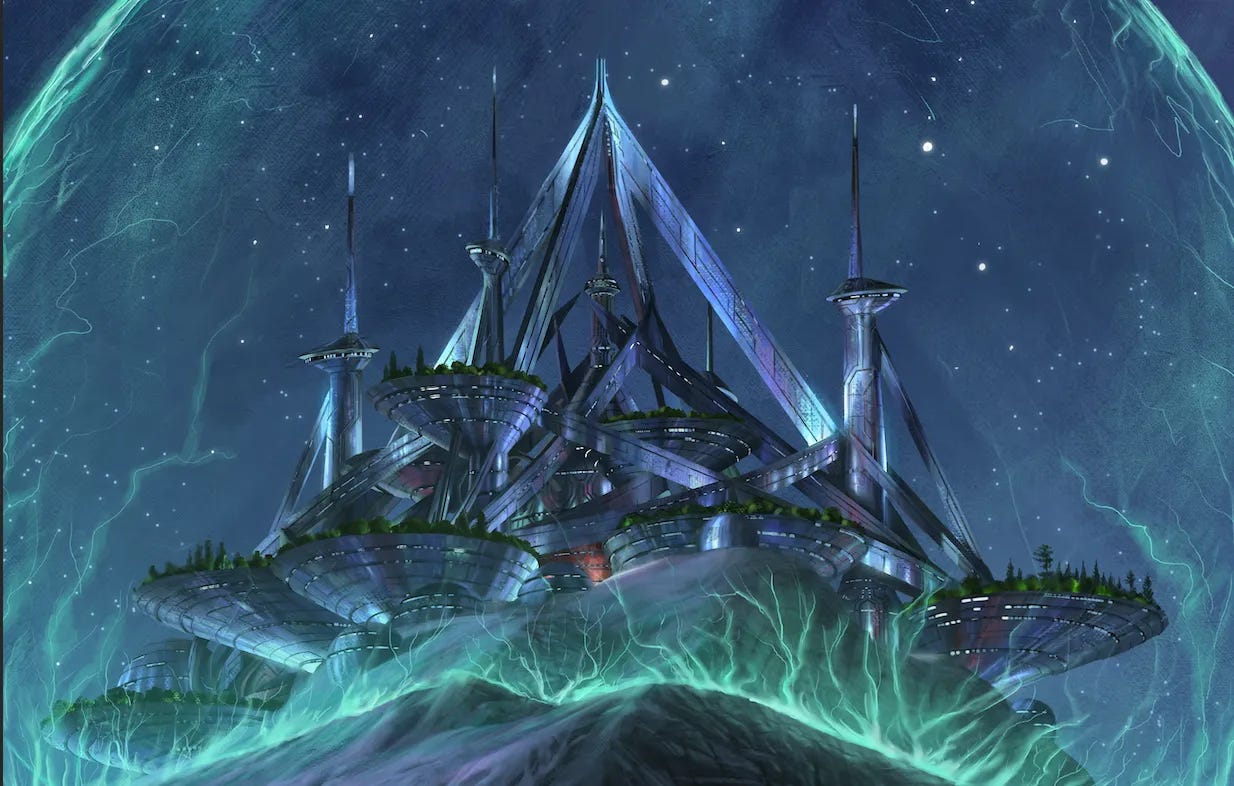
Welcome back to our Serial Sunday, featuring Superluminary, a wonderful science fiction tale by John C. Wright that we’re pleased to present as a serial each Sunday here on Fandom Pulse.
Episode 09: The Battle in the Garden of Worlds
The Lords of Creation encircled Aeneas. He sensed active neural links to weapons, energy sources, and artificial intellects, on their persons, or in powerhouses, satellites, or arsenals.
In the first second, Aeneas nullified gravity and unfurled his huge bioadmantium wings from their dorsal pocket. Each wing-scale had a separate kinetic cell and a disinertia thruster. He rocketed upward supersonically.
Meanwhile electric and positronic organs in his body discharged. Superconductive rays carried this charge into all his relatives. The positive and negative rays intersected in the mutual annihilation, producing gamma rays, mesons and bosons in bursts.
Thin winds screamed when he smashed through the roof. The Lords of Creation laughed as the electropositronic rays struck them.
He was outside. A fiery, flickering boy-shaped shadow popped into existence before him. He swerved, but the grinning shadow-boy was there too, and then behind him, and then to either side.
The flickering shadow was a space contortion of unknown type, as if the boy were teleporting himself into the same spot hundreds of times a second, ionizing and superheating the air. Between flickers, Aeneas saw the youthful face of Procopius Tell, Lord of Mercury. He had halted his aging too early, and wore a small boy’s face and form.
A stiletto-blade of flickering hot shadow, half-displaced from normal timespace, slid into Aeneas’ skin but somehow bypassed the invulnerable scales beneath. It missed his kidney and instead struck a storage organ.
This was one of Aeneas’ internal biochemical factories, filled with unstable materials. The blade materialized a small mass of superhighspeed nanomachine assemblers into the tissue. These, in a split-second, absorbed cell materials, turning everything into more of themselves. The organ should have been converted instantly and eaten his stomach, lungs and heart, adding mass as it grew. Aeneas should have died before the pain signal of the knife piercing flesh reached his brain.
But this organ was isolated from his main circulatory and nervous systems, and it was set, if it grew unstable, to eject, self-sterilize and explode. The blast sent Aeneas spinning. Lord Mercury, inertialess, wafted aside, grinning, unharmed.
In the third second, his uncle Eleftherios Tell, Lord of Neptune, pointed his trident. The gravity increased fiftyfold, but, impossibly, only touched Aeneas. His body was its own pile-driver, and hammered him flat. The grass and soil splashed upward from a sudden crater. He lay dazed.
Lord Neptune was of his mother’s race, a blue-skinned, dark-haired amphibian. Lord Neptune’s thin azure face twisted with a sour half-smile.
Meanwhile, Bromius Tell, Lord of Jupiter, had gathered up into his hand all the energy rays and radiations Aeneas had flung, and, laughing merrily, struck Aeneas with all of them as if with a many-bladed whip of white fire. He was a big, broad-shouldered, bearded man, richly dressed in gold and purple, with hair and beard as black as coal, and eyes as gray as a stormy sky.
The crater blazed with lightning. Aeneas’ skin burned, his internal organs fried, his muscles spasmed, his mouth screamed and puked blood. Lord Jupiter smiled grandly, and drank wine from the golden cup in his other hand.
The gravity relented. A round-faced uncle garbed in the simple robe of a Franciscan Friar, barefoot, rope-belted, his brown hair cut in a tonsure, now took Aeneas by the arm, and picked up his nine-foot tall, four hundred pound body easily. This was Anargyros Tell.
Uncle Anargyros ruled no planet. He was Steward of Earth, not sovereign, for the family was stalemated over who should replace the missing Lord Tellus. He maintained the weather, agriculture and aquaculture, to feed the multitudes. He joked that he ruled wilderness, not men. Hence, he was called Brother Beast.
The secret of neurosomatics was his. He controlled his internal energy cycles in ways biotechnicians could not grasp, and yoga masters not imitate.
The friar grappled him. Aeneas sensed no biomechanics inside Brother Beast, and so, for a wild moment, thought he could fling him aside. But then Brother Beast merely grew stronger than a giant, and then stronger than a titan, until the living metal under Aeneas’ skin groaned and cracked. Aeneas freed an arm, swung. The blow would have felled a tree.
Brother Beast somersaulted up Aeneas’ fist and elbow, did a onehanded handstand atop Aeneas’ head, and broke his nose with a barefoot kick. Aeneas yowled. Brother Beast grabbed his tongue with his toes, yanking it. Then he was riding on his back, and had Aeneas in a full nelson, ready to break his bioadmantium neck. Aeneas was too tall for Brother Beast’s bare feet to touch the soil.
Aeneas unfolded tentacles from his ribcage, ripping human skin aside. It was a ghastly sight. Reaching behind, Aeneas wrapped the mighty limbs of Brother Beast. The tentacles injected deadly venom, sprayed mustard gas, spewed jellied flame, and shot electric jolts. Brother Beast yelled. Aeneas strained, and…
A melancholy blonde stepped forward. This was his aunt, Zoë Romanov, Lady of Ceres.
Her signet ring twinkled. Aeneas sensed invisible life-energy pouring from remote transmitters into the body of Brother Beast. Wounds regenerated. Aeneas could not see how Lady Ceres was forming the circuit, or where the extra mass came from to replace burnt flesh.
Brother Beast yanked the metal tentacles out of Aeneas’ spine and threw them across the garden. He said calmly, “Be still, nephew! We only wish to talk!”
Aeneas said, “Who accuses me? Of what? I demand a public trial!”
Lord Jupiter flourished his golden cup. “Peace! What is all this yammer of accusation and trial? The family will discuss matters, and come to consensus, as we always do.”
Lord Neptune said sardonically, “And we will kill anyone who threatens our power. As we always do.”
Brother Beast stepped back. Aeneas stood bruised, bleeding, miserable. Tears of pain slid down his cheeks.
Frustration choked him. All his uncles had powers that broke the laws of nature. Aeneas understood none of what had defeated him. “Sometimes I resent being born into a family of Mad Scientists.”
Brother Beast smiled affably. “But the family looks out for its own, do we not? Have no fear! You will have a chance to say your say. In the meantime, please surrender your ring. There’s a good lad.”
Aeneas said, “I have done nothing wrong.”
Lord Mercury snapped his fingers. “Gotten away with nothing, you mean.”
Lady Venus said, “Give it to me. I will return it once your name is cleared.” He did. Without the ring, Aeneas had no power to metamorphosize all his cells while maintaining his life processes, not safely. Easier to rebuild a racecar engine during the race.
Lord Jupiter looked up. The air was whistling out, and cold was rushing in. “Brothers and sisters, it is more comfortable in the library. Shall we?”
Arm in arm with Brother Beast, Aeneas limped down the gold-walled, marble-floored corridors of the high palace. The many servants and guards were gone. However, wine, spirits, and tobacco were awaiting them in the library, each according to his own preference at his own chair.
Books bound in red leather filled one two-story wall. Information diamonds filled another, and neuropsionic emeralds filled a third. Windows looked down on the Himalayan peaks. Below, stormclouds roamed like black sheep.
One chair was framed in a cube of thought-insulation bars, and wire-cap festooned with neuropsionic amplifiers hung above. It was an oversized chair, meant to seat a nine-foot tall man.
His mother stepped forward. “Sit here, son.” She said to the other, “All of you might as well relax. This will take some time.”
She had the jet-black curls, olive skin, and the dark-lashed, overlarge eyes of her Hellenic ancestors. She wore a white hood set with energy gems, contortion pearls, and thought-emission ports. All her ornaments, from hair combs to shining golden slippers, held nerve impellers or mental weapons.
Her name was Nephelethea Cimon, Lady of Venus. She wed Anchises Cimon, Duke of Schleswig-Holstein-Sonderberg-Plon-Rethwisch, a cadet branch of the Oldenburg family, to whom all the crowned heads of Europe were related. He had died mysteriously, assassinated, and been buried in Sicily.
That his uncles could commit such crimes unpunished, undetected, was the grief that formed his youth, and sculpted the soul of Aeneas.
He sat, wearily. His mother positioned the cap above his head. There were no visible readout screens or controls: Aeneas sensed the signal flow channeled through her signet ring to his mother’s cortex.
Pressure filled his head as external waves were heterodyned onto his nerve signals. His mother hummed to herself absentmindedly as she worked.
Over an hour passed. All were silent. Some smoked. Some sipped wine.
Finally, Lady Venus straightened up. “He is innocent. He was attacked by an assassin, who is the one who set off the jamming field, murdered our bodyguards, and was killed by a black pearl which someone unknown placed in his bedchamber.”
Lord Jupiter said, “Unknown? You mean Father.”
She said, “He has no memory of seeing anyone.”
Lord Jupiter said, “But he suspects!”
She smiled. “I never agreed to read his suspicions.”
Spyridon, Lord of Uranus, spoke. “He confessed the assassin was his.”
He was a dark-skinned, dark-eyed man dressed in a green uniform. He wore a prosthetic skin-mask that exactly copied his own features. The mask never reflected the expressions on the face beneath.
Aeneas wondered how Lord Uranus had spied on the conversation with Lady Luna in the garden, without any trace of eavesdropping energy.
That mask now turned toward Aeneas, “Marvel not that I know your doings from afar. The information layer of the cosmos, below the physical layer, is open to my view. You brought Thoon here.”
Lady Venus answered before Aeneas could speak. “Thoon deceived him! He played along with some of the lad’s wilder political fancies. Aeneas smuggled him into Ultrapolis for some tomfoolery which would have done nothing and harmed no one. Clearly a breach of protocol, yes, but would you like my list of who has also bent rules? You could fill a harem just with the women Lord Jupiter smuggled into our halls!”
Lord Jupiter slapped his knee, booming, “Why, I did fill a harem!”
She smiled. “I remember helping you smooth over things with some of them.”
Lord Jupiter’s eyes narrowed slightly, sensing the implied threat. He nodded. “Yes. I understand your meaning. The lad is harmless! Return his ring!”
Lord Neptune said sharply, “Not so fast! Lady Luna has information.”
Lady Luna said reluctantly, “I detect vast stores of information in his subconscious mind that fit no known imprint pattern of any science.”
Lord Neptune said, “It is Father’s Final Science. What else could it be?”
Lord Mercury smirked, “Why, it could be Lady Luna, so sweet and young, tricking us! She blasted Aeneas with that freakish moon weapon of hers, and missed—how like a girl!—she now wants us to do her deed!”
Lady Luna looked startled. “Why that’s—that’s absurd! Sharing the science would make the stubborn boob no threat to anyone! I want him saved! I’m his—uh, friend!”
Lord Mercury sneered. “A friend who trapped him.”
Lady Luna stood, towering over the ten-year-old, eyes blazing emeralds. “Or you’re the one! You slew my handmaidens! Where were you two hours ago?”
“In my room, playing pingpong with myself,” smirked the little boy. “If you want him saved, telling us Aeneas has the warptech is frankly counterproductive.”
Geras, Lord of Saturn, spoke. He had halted aging late. His white hair reached his shoulders, and his white beard his belt. He leaned on a wand that held his phimaophone, an instrument that played chords too pure to be produced in reality, by sending signals directly to the auditory nerve, bypassing the ear. He was a musician of modest accomplishment, and regretted his high station.
He had always treated Aeneas warmly, in days past. But now his eyes were cold.
“The only person who could have implanted Father’s supreme science is Father. All of us crave it, but none dare trust the others. We cannot share it, nor leave him in sole possession. Mindwipe would shift the family fear from him to me: you all know I can fetch forgotten things from the past.”
Lady Venus said, “Who else saw this thought-reading of Lady Luna? Why trust her?”
Lord Saturn shook his gray head. “Why trust you? Merely the suspicion that he might be Father’s tool condemns Aeneas, for it creates incalculable risk to us. Contrariwise, why spare him? He cannot increase our power. We are omnipotent.”
Lord Mercury said, “Too much talk! Listen: Aeneas loves voting. Let’s vote. The vote to acquit must be unanimous! Agreed? Whoever votes death, just shoot.”
Support John C. Wright’s current work, Starquest by picking up the first book in his new series, The Space Pirates of Andromeda.

Space Opera must be Great! Gallant! Gigantic! Grandiose!
This tale told by a Grandmaster vows to return the glory that was lost!
Remember the days gone by, when science fiction was fun?
Now new hope is here!
If you are weary of weak, wan, woke and wasted works, your wait is ended!
Here is an epic, as grand as any tale of old -- here you will hear wonders told!
Of course there is a Space Princess, and Space Pirates galore, and an Evil Galactic Empire.
Of course there is a super-weapon known only as the Great Eye of Darkness!
Here meet Athos Lone, Ace of Star Patrol, in his one-man mission of vengeance!
The Ancient Mariner, like an iron ghost, when slain, seems to rise again!
The mysterious spymaster called Nightshadow walks in dark worlds but serves the light!
An Imperial Deathtrooper must reverse his loyalties, and fight his own clone-brothers!
Fate has set these unlikely heroes against the Four Dark Overlords
An utmost evil the unwary galaxy thinks long dead!
Can Darkness fail and Light prevail?
Read On! For All True Tales are but Part of a Greater!