



The Magazine of Fantasy and Science Fiction used to be the gold standard for short stories in mainstream publishing. Still, it’s had a tremendous fall in recent years due to diversity hire editor Sheree Renee Thomas. An industry insider spoke with Fandom Pulse and told us exactly how bad it is for the former sci-fi juggernaut.
F&SF has been respected for decades as one of the great magazines, along with Analog and Asimov’s, where short fiction can be counted on to be quality. In the last decade, C.C. Finlay was beloved by readers and authors alike for his editorial vision and personal responses to authors who submitted to the magazine. It all changed when he was replaced to prop up a black woman with very few industry credentials.
As reported in an earlier article on Fandom Pulse, the magazine went from bi-monthly and on time for decades to skipping months and finally ceasing publication entirely after Sheree Renee Thomas took over.

However, the problems ran deeper than simply being unable to keep a schedule or do the work. Writers Beware covered the topic in 2023, warning authors they “recently received multiple reports from writers whose work has been officially accepted but, months later, are still waiting for contracts and checks. Reported delays range from six months to over a year, considerably extending an (already unduly lengthy) three-year publication window.”
They also said, “Writers also report a variety of other delays: waiting for notification of official acceptance well beyond the stated acquisition timeline of 6 weeks to 6 months; receiving copy edits and proofs for accepted stories without having received a contract or payment; receiving contract and payment only weeks before the publication date, after months of waiting; completing requested revisions and then hearing nothing more. Many of the writers who contacted me say they’ve sent repeated emails asking about the delays and haven’t received a response.”
These are facets of an editor’s job at a title. Though many in the mainstream industry have blamed publisher Gordan Van Gelder, the blame should fall squarely upon Thomas, who, according to an industry insider, has done a terrible job with the magazine.
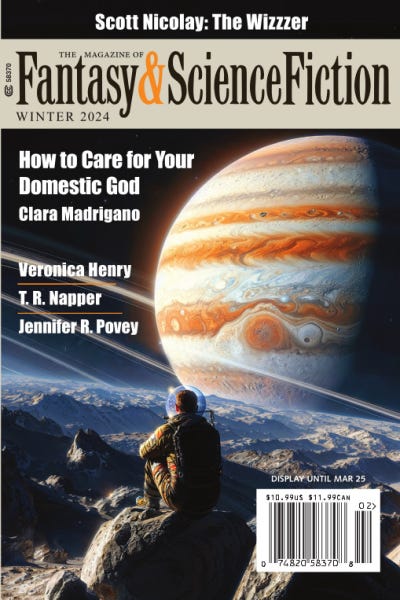
The insider told Fandom Pulse how bad it is around Sheree Renee Thomas, “She is all too happy to add "editor of F&SF" to her bio, but any actual work or promotion for the magazine? No, never. It's resume padding for her, never been anything more.”
Readers in recent times have been upset with bad story selections, something not suffered under C.C. Finlay’s tenure as the former editor was known for his consistency in the material. Even before the complete fall off of publication, Thomas had a reputation for declining to pick up stories from name authors who would bring in revenue to further promote diversity, equity, and inclusion in readership, which resulted in many sub-par stories being chosen.
Recently, the editor appeared at the Gencon Writer’s Symposium despite not having been able to get out a single issue of F&SF this year. Like many in the professional writing circles, she seems more interested in padding her speaking engagement resume than actually doing the work for the fiction magazine. According to several Gencon attendees, Thomas never mentioned the magazine or its status across multiple events outside of it being on her bio/resume.
Meanwhile, F&SF has suffered from a drop in sales, an inability to pay writers, and more. Much of it is due to bad story selection due to the D.E.I. agenda installed under Thomas’s regime. The insider says it’s possible “she happily took the job for resume padding, and either doesn't care about it beyond crowing that ‘she's the editor of F&SF’, because again, resume padding, or that she's completely over her head.”
Thomas will undoubtedly blame the short story market for being a problem in recent years, which it has, but one only has to look at the data from F&SF’s competitors, Analog and Asimov’s, to see a different story between the magazines and how badly F&SF has fallen off due to her lack of leadership.
Sci-fi short story magazines have declined for the last few decades, with F&SF leading the way in steep decline. Asimov’s and Analog, however, have made up for much of the destruction of print and bookstores through online digital sales. Amazon ended digital subscription programs, which hurt all three magazines in the short term from 2022-2023 sales figures. Still, insider reports show that subscriptions direct from Analog and Asimov’s have been growing since then and that their readership is increasing.
This recent direct digital subscription bump didn’t happen for F&SF. Going to the Fantasy and Science Fiction website, it’s woefully behind the times. It does not offer an easy-to-find digital subscription service that we could see upon research. However, it wouldn’t matter much since the magazine hasn’t published anything in over eight months.
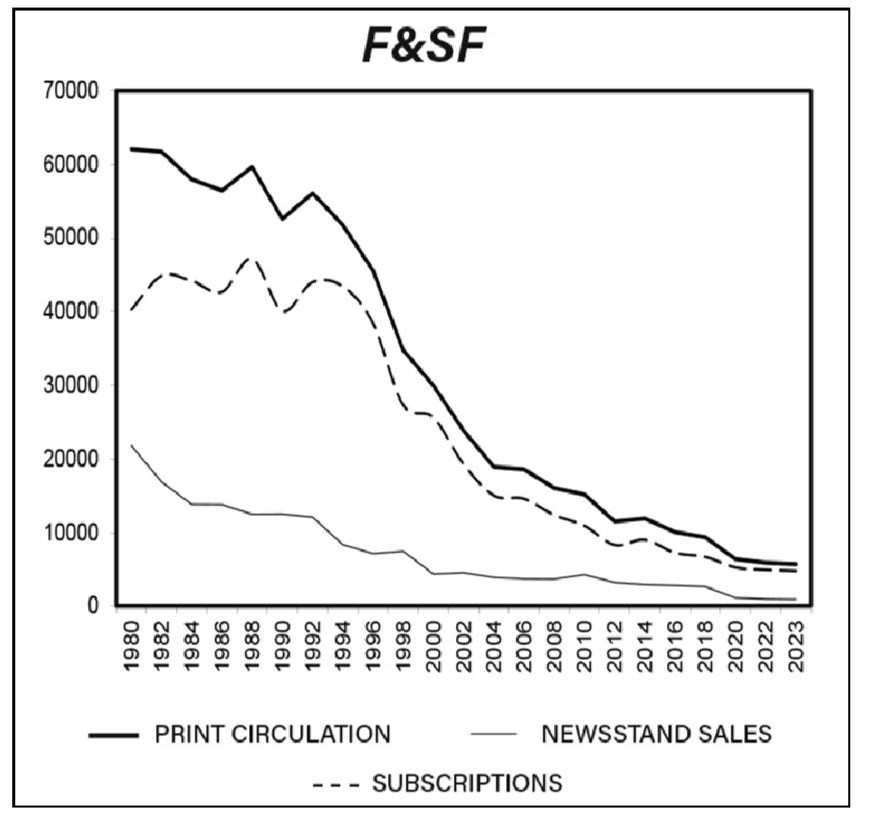
Before this, however, F&SF’s subscriptions had been continuing downward. The magazine has under 10,000 subscriptions, similar to Analog and Asimov's print versions. However, at the last tracking count, Analog had 8,400 digital subscriptions to add to the total, which F&SF does not benefit from.
Unless someone gets to work at F&SF, the magazine is in danger of going completely by the wayside in the next year. Speaking with readers, many still have active subscriptions they’re paying for that are not being delivered, and many are becoming disgruntled with the brand.
What do you think of F&SF dying due to diversity? Leave a comment and let us know.
If you enjoy Fandom Pulse and want to support our creative efforts with science fiction that honors the classics, get the new science fiction audiobook for Colony Launch on Amazon now!
