


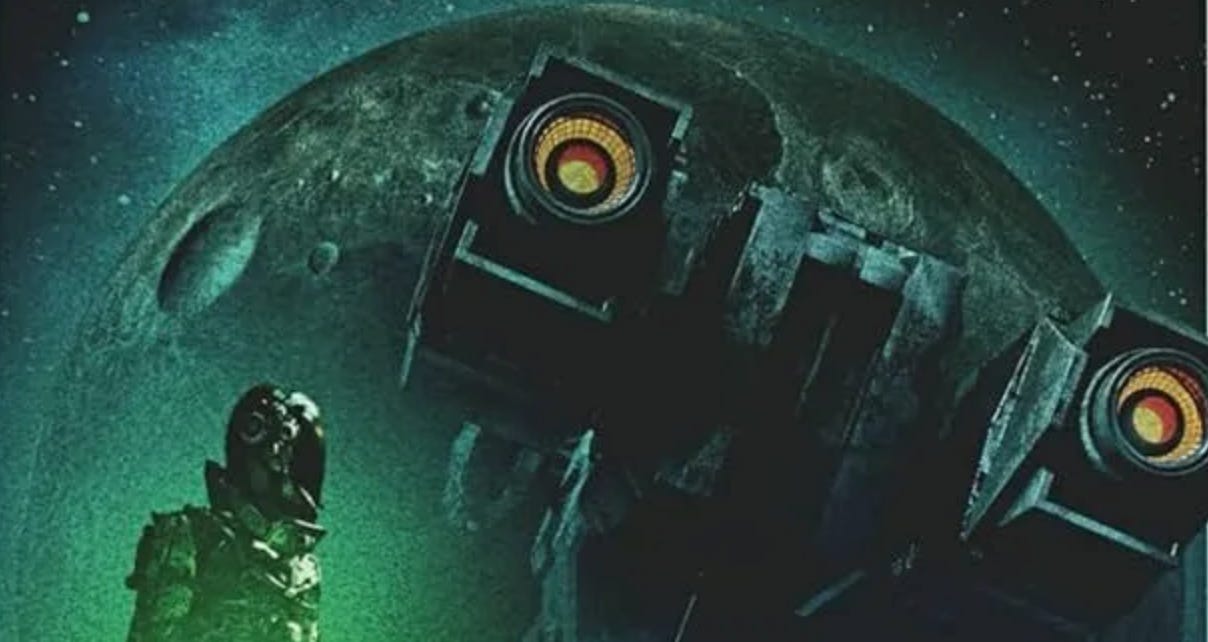
Dierock88 is the debut sci-fi novel of self-published author S.A. Oliver (Formerly published as S.A. Ernster).
The cover is always your first impression of someone’s book, and it’s one that can’t be overstated in its value. The cover for D-88 is the chef’s kiss, evocative of its type of space fantasy and oftentimes haunting locales. The image of Atlas with his green sword goes a long way in bringing both an eerie coloration and a sense of cosmic wonder to the mind before even opening the book. Bravo.
Dierock88 will feel familiar, like an old glove that still fits. It’s a single POV third person following the story of Atlas, a young man just after turning 17, who has a big case of Disney Princess Syndrome. We’re introduced to him doing a bit of daring asteroid hopping in search of adventure, as well as some lost space hulk treasure. He works with his father as a Junk Scrapper, which is exactly what it sounds like. He’s got a couple of girls on his arms, but he’s got big dreams and doesn’t know what to do about it. He just knows he wants something more, a simple life for a simple lad.

Until it, naturally, becomes much more complicated. The authorities bust his dad in suspicion of being a notorious terrorist named Typhon, and they hand Atlas over to the Horizon Corporation, which has a habit of slapping lawbreakers with heavy debt and forcing them to work it off via indentured servitude. He gets dropped into a small crew of other indentured workers with a debt so massive it guarantees he’ll be there for the rest of his life. Dierock88 is the space mining colony he’s sent to owned and operated by Horizon, who takes great pleasure in occasionally taunting him that he’ll never leave and is powerless to do so. Sometimes they force workers to watch propaganda movies or take test modules, an even worse torture than slavery.
It’s a lot for a tender guy of seventeen, and a good part of the book is Atlas navigating through his feelings, coming to terms with reality hitting him in the face like an ice-cold bucket of water. He bounces between disbelief, sadness, defiance, and anger. First for himself, then eventually for the people around him. The author does a good job of making his transition from sleepy youth daydreaming through his work life to grizzled self-reliance. From “Someone outta do something” to “I have to do something.”
It’s a theme very familiar to me in my own writing, as it’s reminiscent of the character path taken by my own debut character, a seventeen-year-old character swept up in events out of his control. Atlas and Ragoth have a lot in common, in a good way. ;)
The book goes a long way in showcasing something that doesn’t get touched on by a lot of books: young people’s dismissal of politics. Atlas is largely ignorant of or dismissive of the larger events playing in the background. There are a lot of important people in organizations and groups tossed around that he sees, but doesn’t give much mind to…until suddenly it’s his problem. He’s swept up in galactic political strife that was always playing out and dismissing it as not his problem until he found himself deep in the mire of all of it. He plays it all off as noise until he starts realizing he might play a bigger part on the galactic stage than he realized.
By the end of the book, he realizes he’s caught in a web of deception and power plays far beyond his comprehension, and rather than play someone else’s pawn, he takes matters into his own hands and does right by the people in his immediate orbit. Those people in his orbit are his supporting cast, and they are a delightful bunch of characters. The author does a great job of giving them a range of personalities for Atlas to bounce off of, and many of them become surrogate family (found family, if you will) to a lad in the midst of a parental crisis, not knowing who or what he should trust.
All of this is the center focus of the narrative as he navigates an ever-shifting life of mining, facing alien creatures, a simmering revolution, and important figures both known and unknown, all bumping into him with motives he can only guess at. The threads of a much deeper plot are hinted at, some pulled, but many left for future installments. The plot moves at a brisk pace as his indentured servitude is constantly interrupted by galactic political plots, alien attacks, strange powers, and alien machinery, all trying to converge on him throughout the book.
A good “main character pushed into slavery” plot always gets me because mentally it chains the reader to the expectation of their freedom, either won or fought for. Atlas is given trickles of hope in the form of messages from his father, from his girl, and from others that he’ll be free, only for Atlas to take his own path. Another fun little parallel to Ragoth’s journey in The Black Crown IYKYK. Atlas has multiple paths set before him, but in the end, opts to take a path of his own forging.
To quote one of the best game narratives ever in Soul Reaver 2, spoken by Kain: “There is a third choice. There are two sides to every coin, but suppose you flip a coin enough times…and it lands on its edge.”
The book is edited well, parsing out as much filler as possible, though there are a lot of passages that tread over well-worn ground. The author does a good job of making Atlas feel like a feckless, hardheaded teen at first who grows into a more well-rounded and less hard-headed individual as he sees there’s more suffering than just his hurt feelings in the universe. He, and by extension the reader, feels for the plight of his friends, and by the end of the book, you’re rooting for the path they chose to take.
The book ends well, though with a bittersweet note and the promise of more books in this universe and these characters to come. A plethora of questions were left unanswered for Atlas and the reader to contemplate. The sequel, PARADISO, is currently available in case you want to dive into more of Atlas and his crew, and I would highly recommend you do so. The book gets so much right that its few flaws do not detract from it. If it wasn’t for a very sparse smattering of vulgar language, I’d say this was perfect to hand to an early teen reader (But nothing worse than they’ve seen in a Marvel movie).
Dierock88 is a fantastic, serviceable debut, and I recommend it if you’re in the mood for some coming-of-age sci-fi. You can get the book here.
NEXT: Serial Sunday: Superluminary: The Lords Of Creation By John C. Wright Episode 12

"All I wanted to do was play my video games, but no ... ."