


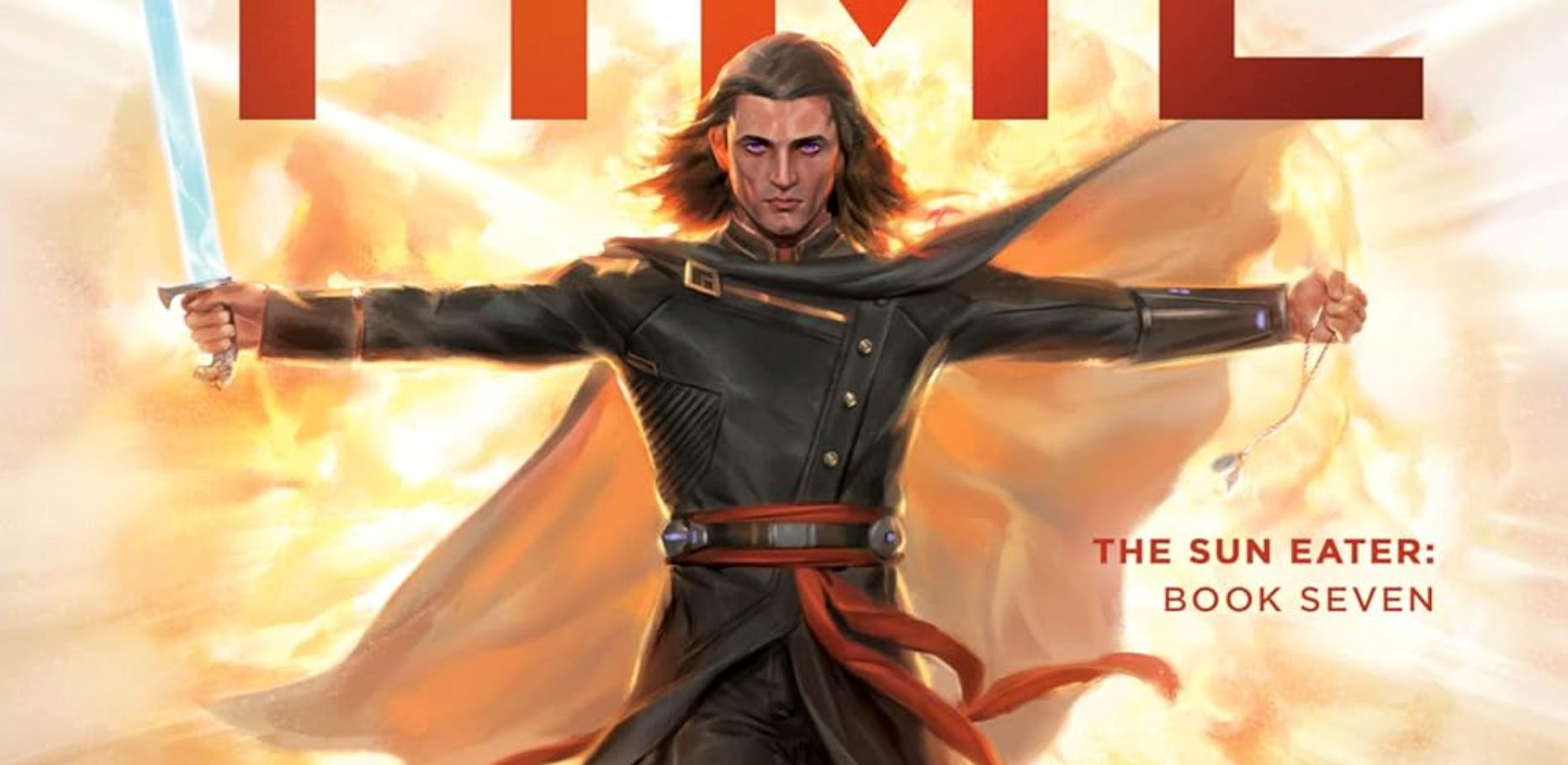
Very few authors have transcended into mainstream culture with their science fiction work in recent years, but Christopher Ruocchio has captivated an audience with his deeply personal chronicles of Hadrian Marlowe, the protagonist of The Sun Eater series.
The series concluded with the new book, Shadows Upon Time, which has been a #1 Bestseller on Amazon for weeks since its release, and he took the time to stop by Fandom Pulse and answer our questions about his work and more.
You began the Sun Eater series in your early 20s and crafted a deeply mature narrative. When did the idea of Hadrian Marlowe’s story first take shape in your mind, and what pivotal moments shaped the creation of the saga?
CR: That depends on how you count! I knew I wanted to write something as early as 8- or 9-years-old, and while I tried as seriously as any child might, I would say the best answer to your question is that the germ of what became The Sun Eater was formed sometime in high school (that would be around AD 2009/2010). I find that for me, I usually reason backward from some big narrative moment or set piece, and sort of justify things thematically from there. For The Sun Eater, that would be the actual sun-eating—the climactic battle at the end of the series, I mean. The seventh and final book, Shadows Upon Time, was really the original idea, and the rest of the series was contrived to earn that moment. But the pieces that came together to make the series came together one at a time. I didn’t make the switch to the first-person, memoir style until quite late in the game, relatively speaking. About halfway through my time at North Carolina State, I decided to wipe the slate clean and start over from one, and it was at that point the book switched from third to first-person, and Hadrian’s voice really took shape. Tolkien once said of The Lord of the Rings that his “…tale grew in the telling.” In my case, I found the author grew very much, too. I’m quite a different man than I was at the beginning. Hopefully a better one!

How did you approach the challenge of concluding a sprawling saga like Sun Eater, especially knowing it would have fans with high expectations?
CR: As I mentioned above, this last book was really the first one, conceptually speaking, and so in a sense I went into this book with the clearest notion of what it is I was trying to accomplish. It is very easy for me on the day, in the writing chair, to not think about my readers and their expectations. I have always written my books for myself, and in a sense only for myself. I’ve had this sense throughout my career that I should consider myself my target demographic, and just hope that there are enough people like me that I’ll be okay, rather than try to conform to any trends or tastes. I guess in a sense I just have faith that it’ll work out: that readers will pick up the books, that they’ll understand what it is I’m trying to accomplish, and so on. With The Sun Eater, and with Shadows Upon Time in particular, so much of what the book had to be was just baked into the pie already. Because it is the capstone to the series—and because of the memoir format foreshadowing so much of what had to happen in this one—so much of what this book needed to be was in a sense locked down before I even started outlining. So I didn’t agonize so much over the content or direction, which allowed me instead to agonize over the execution, if that makes sense.

The series uses foreshadowing by revealing how the story will end in broad strokes early on. What led you to use this device, and were you concerned it might reduce narrative tension?
CR: I really hate spoiler culture. I remember in college I got yelled at by the Doctor Who fan club for letting slip that King Arthur dies. Seriously? King Arthur? The story has been out for more than a thousand years! I hadn’t even seen the Merlin show in question. I just knew the myth. It’s ridiculous. The whole thing has gotten so out of hand. Mind you, I think it’s awful when the likes of IGN run an article spoiling the latest superhero film before it even releases, but the practice of yelling at strangers on the internet because they say something about something you haven’t read or watched yet has got to stop.
So I decided to write a story that spoiled itself, at least in part. But while I started with a bit of creative spite, I reasoned that if I gave you all a piece of the ending in advance, it sort of changes the texture of the whole story—emphasizing why and how something happens over what happens. Far from taking the tension out, I think it actually can enhance the drama, if you play your cards right. If you know a character is going to betray your hero at some point, you lose the surprise, but you amp up the anticipation. It’s a trade-off. All creative decisions are. I just think that I took the road less traveled.
Many readers describe your protagonist, Hadrian Marlowe, as neither a traditional hero nor villain. How did you balance his complexities to create such an intriguing character?
CR: So, I both love and hate Frank Herbert’s Dune at this point. I love it because it’s a masterwork of science fiction. I love the world. I love the characters. I love how theatrical it is, the sort of burlesque melodrama of it all. I love Paul Atreides, and Leto II. But I hate the thematizing. The Villeneuve films really made that clear to me. I understand Herbert’s critique of heroes and of charismatic leaders, but I don’t think he makes his case very well. In the original novel, the Atreides never do anything wrong. Leto I is a good man in a bad spot. Paul’s guerrilla war is morally justified. The Harkonnens are utterly depraved. They do nothing right. The Emperor is corrupt and complicit. The Bene Gesserit are manipulative and vile. The first thing we see Paul do is recoil at the thought that some people are less than human. He’s a good kid. Then in book 2, for no reason at all, he compares himself to Hitler. It’s no wonder most people stop reading. It’s worse than bad: it’s confusing. Herbert should have written a book about the jihad. He doesn’t earn Paul’s heel turn, instead depicting him as this Greek tragic hero, a victim of circumstance, trapped by the throne and his own followers. And don’t get me started on the Golden Path: a plan to free mankind from hero-tyrants requiring the self-sacrifice of a hero-tyrant more powerful than any in human history. God Emperor of Dune more or less says the opposite of what Herbert intended, insofar as I can tell.
And so I wanted to write something that took Herbert’s fears about heroes into account, but that also addressed the reality of the fact that the human race just produces heroes sometimes. The phrase Empire of Silence comes from Carlyle’s On Heroes and Hero Worship, the book that really crystallized the “Great Man” theory of history. The characters he chooses as heroic examples aren’t saints—he highlights Cromwell, for God’s sake, and I’m a Catholic—but they are undoubtedly giants. Hadrian is complicated because great men are complicated. Evil and divine, to borrow a phrase from Dio (the rock star, not the Roman). It was most important for him to be a big character. Larger than life. Everything about him is turned up to 11. His virtues. His mistakes. My critics (and Hadrian’s) call him melodramatic, but my critics are mostly my fellow millennials, and we are a generation that struggles with sincerity.
How does your Catholicism inform your writing?
CR: Big question. The one-word answer is “increasingly.”
