


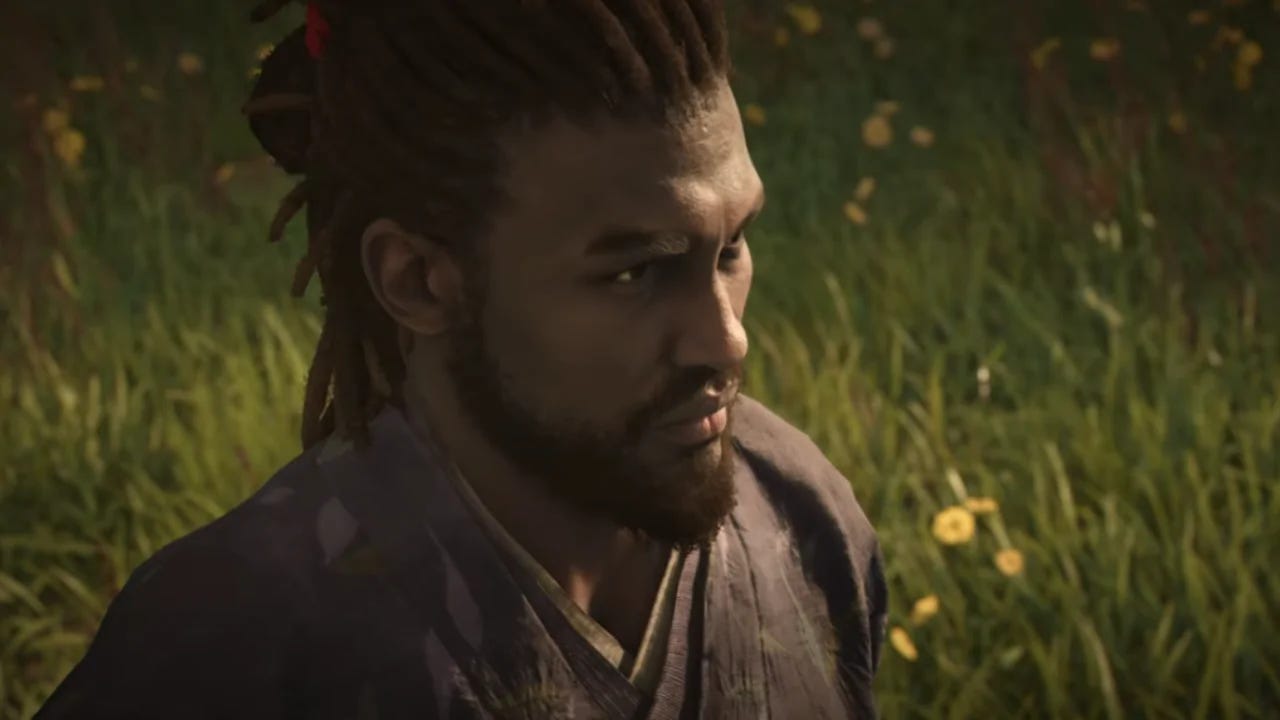
A new rumor alleges that Ubisoft scrapped a planned Assassin’s Creed game set in the Reconstruction era of the United States of America following backlash to Assassin’s Creed Shadows.
This rumor comes from former Kotaku writer Stephen Totilo and a number of alleged anonymous employees.
Totilo claims the game would be set following the Civil War in the South during Reconstruction era sometime between the late 1860s through the 1870s.
Additionally, he shares that the game would feature a former slave as the main character who moved out west to start a new life. However, he is recruited by the Assassin’s and returns to the South to fight the Ku Klux Klan.
As Totilo tells it, Ubisoft employees were informed by management that the game would not move forward because of the online backlash to Assassin’s Creed Shadows and its fictionalization of Yasuke as a samurai, and an unstable political climate in the United States.
One employee told Totilo, “Too political in a country too unstable, to make it short.”
If this is true, this is contrary to nearly all the public statements that have come out of Ubisoft while promoting Assassin’s Creed Shadows. For example, during a BAFTA event in November 2024 Marc-Alexis Côté, the Head of Assassin’s Creed at Ubisoft, said, “In today’s shifting cultural landscape, we face an additional and unforeseen challenge as discussions around representation and inclusivity in media have become increasingly prominent.”
These conversations can influence how our games are perceived but rather than shy away from those conversations we should see them as an opportunity. Assassin’s Creed has always been about exploring the full spectrum of human history and by its very nature that history is diverse. Staying true to history means embracing the richness of human perspectives without compromise.
“For example in Assassin’s Creed Shadows we highlight figures both fictional like Naoe, a Japanese woman warrior and historical like Yasuke, the African-born samurai. While the inclusion of a black samurai in feudal Japan has sparked questions and even controversy, Naoe as a fictional character has also faced scrutiny for her gender. But just as Yasuke’s presence in Japanese history is fact so too are the stories of women who defied societal expectations and took up arms in times of conflict. So while both Naoe and Yasuke’s stories are works of historical fiction they reflect the collision of different worlds, cultures, and roles. And their inclusion is precisely the kind of narrative that Assassin’s Creed seeks to tell: One that reflects the complexity and interconnectedness of our shared history.”
He added, “We’ve consistently introduced protagonists from diverse racial, ethnic, and gender identities. History is inherently diverse and so is Assassin’s Creed and the stories we tell. So to be clear our commitment to inclusivity is grounded in historical authenticity and respect for diverse perspectives not driven by modern agendas.”
Similarly in a keynote interview at XDS24, Cote revealed that part of Ubisoft’s mission is indoctrinating players into thinking a certain way. First he shared that the first question that Ubisoft CEO Yves Guillemot always asks is, “What will players learn?”
He then explained why he asks this question, “What I think has driven Yves for 36, 37 years now is this idea that video games can change the world. And you start changing the world by changing people.”
“And if you give them something to think about even while they’re having fun, right, if they can learn something, then you can like change one person you can change the world,” he added.
He also made said in an interview with The New York Times that he wants to go beyond the truth when it comes to propagandizing players in his games.
He said, “We want people to be passionate about history. What does that mean? Stay true to well-documented moments and historical figures, but not shying away from having a critical point of view and defying clichés to go beyond what is the accepted truth.”
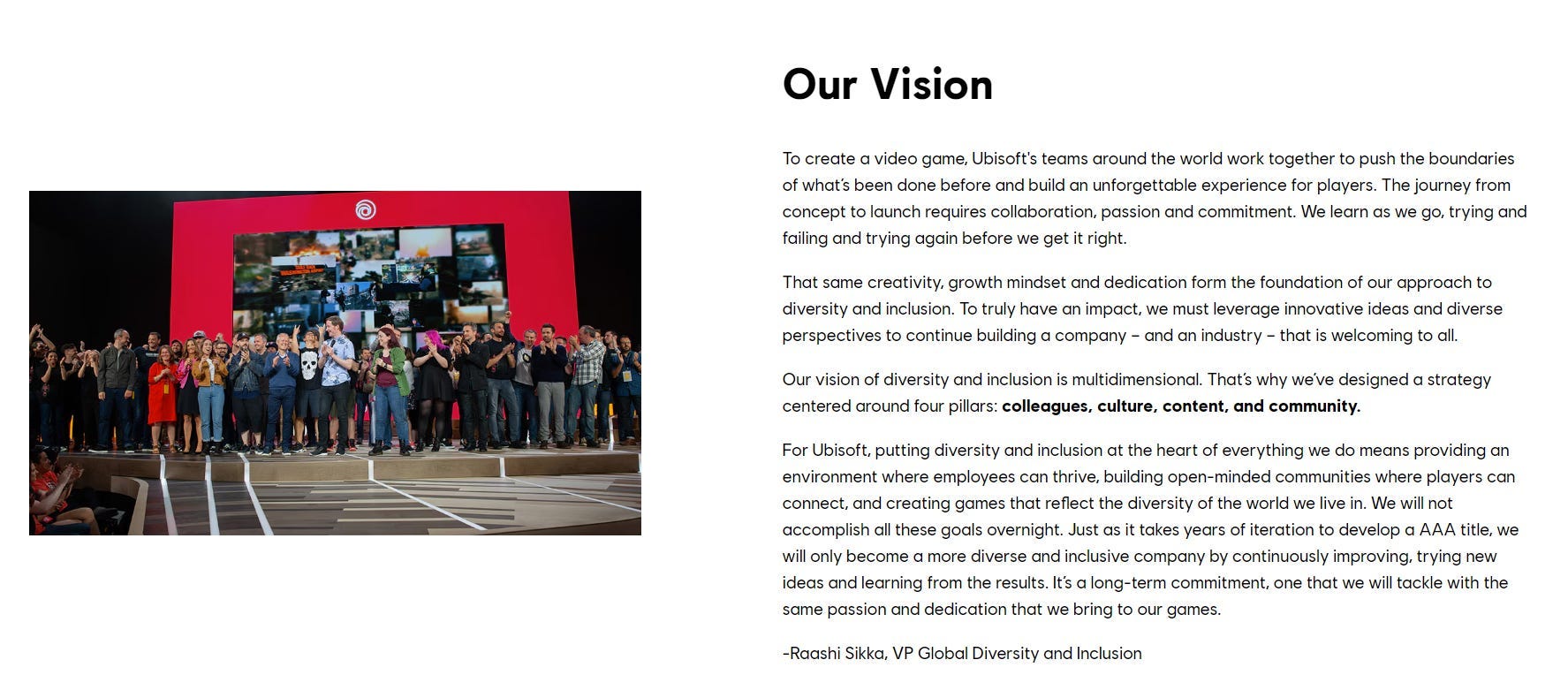
Additionally, the company’s VP of Global Diversity and Inclusion Raashi Sikka makes it clear that the company is attempting to inject the divisive and corrosive agendas of diversity and inclusion into its games.
Sikka writes on the company’s Diversity, Inclusion, and Accessibility page of its website, “For Ubisoft, putting diversity and inclusion at the heart of everything we do means providing an environment where employees can thrive, building open-minded communities where players can connect, and creating games that reflect the diversity of the world we live in.”
“We will not accomplish all these goals overnight” she adds. “Just as it takes years of iteration to develop a AAA title, we will only become a more diverse and inclusive company by continuously improving, trying new ideas and learning from the results. It’s a long-term commitment, one that we will tackle with the same passion and dedication that we bring to our games.”
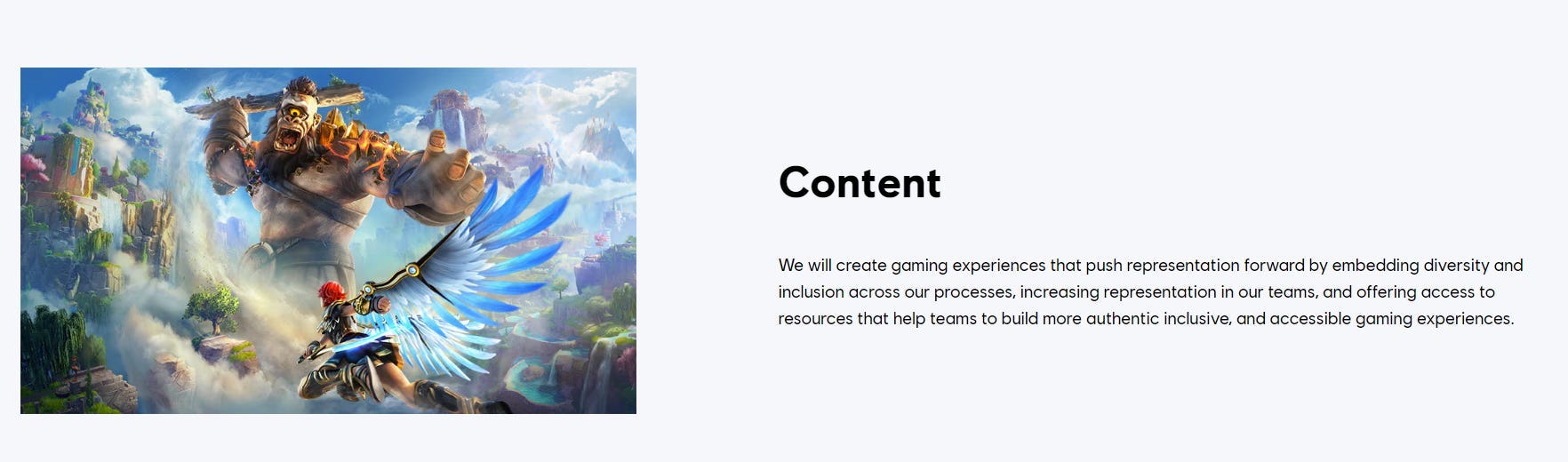
Furthermore, the company states, “We will create gaming experiences that push representation forward by embedding diversity and inclusion across our processes, increasing representation in our teams, and offering access to resources that help teams to build more authentic inclusive, and accessible gaming experiences.”
NEXT: Grummz Calls For Arrest Of X User Who Appears To Encourage An Assassination Against Him
I wonder if it was going to star a Japanese assassin...
They were going to go from a game about a black slave to another game about a black slave (ignoring the fact that the majority of human slaves throughout history have not been black)? And I thought Witches' Creed was going to be bad... (It will be.)