



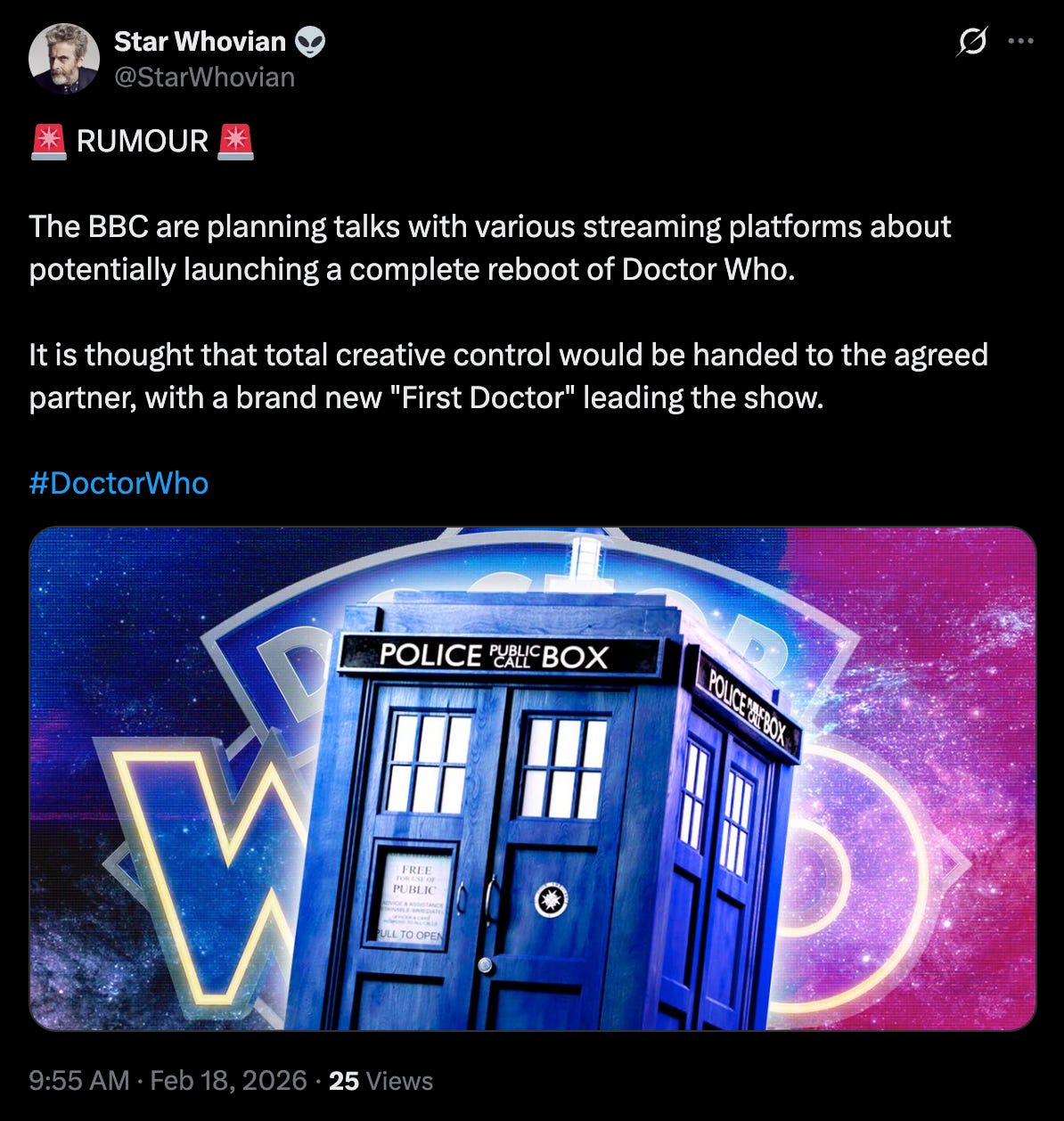
The future of Doctor Who has been uncertain since Disney+ declined to renew its partnership with the BBC following the cancellation of the Ncuti Gatwa era in 2025. Now, according to sources close to the production, the BBC is exploring an option that would have been unthinkable even a year ago: a complete reboot of the franchise.
“The BBC are planning talks with various streaming platforms about potentially launching a complete reboot of Doctor Who,” Star Whovian posted to X. “It is the thought that total creative control would be handed to the agreed partner with a brand new ‘First Doctor’ leading the show.”
The Disney Collapse
Disney’s involvement with Doctor Who began in 2023 with considerable fanfare. The streaming giant would handle international distribution for new episodes, providing production funding that the BBC desperately needed. The partnership was positioned as a new era for the franchise with global reach, bigger budgets, and the resources to compete with prestige streaming content.
It lasted two years.
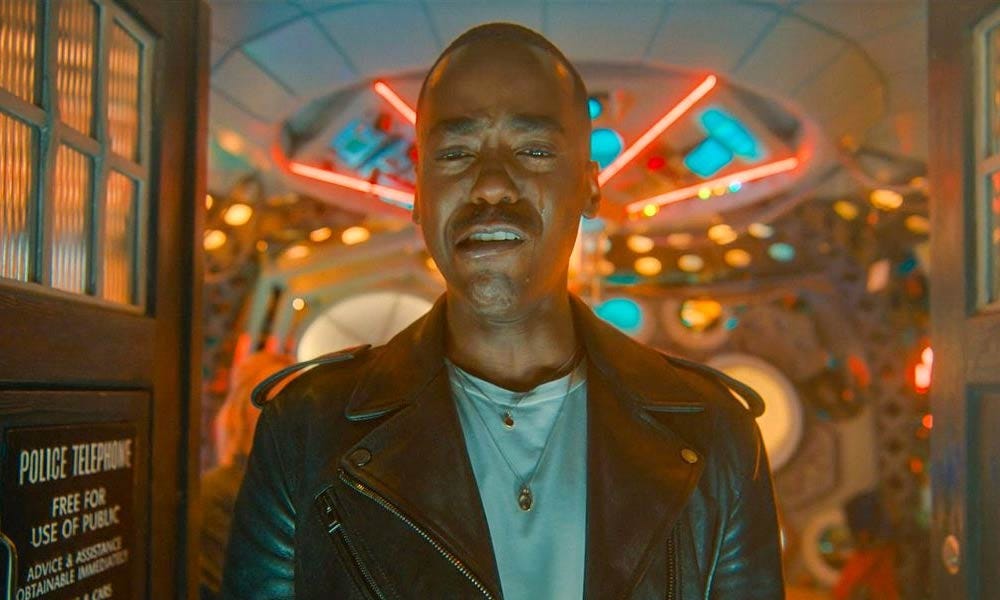
Ncuti Gatwa’s first season (marketed as Season 1 or Series 14, depending on how you count) premiered in May 2024 to mixed reception. The consolidated 7-day ratings averaged 3.80 million viewers in the UK—the lowest of any modern Doctor Who era. His second season in 2025 performed even worse, with overnight figures frequently dropping below 2 million and consolidated numbers struggling to reach 3 million.
Disney never publicly released viewership data for the show’s performance on their platform. The silence was telling. When a streaming service is proud of a show’s performance, they announce it. When they’re not, they say nothing.
In early 2025, reports emerged that Disney would not be commissioning a third season. The BBC initially denied this, with Bad Wolf Productions—the production company behind the show—issuing statements that Gatwa was contracted through 2028 and that production would continue.
Those statements, as it turns out, were not accurate. The show was cancelled. Gatwa’s contract was either terminated or simply not exercised beyond the already-filmed episodes. And Disney walked away from the partnership entirely.
Russell T Davies’ Final Episode
The end of Gatwa’s era came with a twist. The 2025 finale revealed that former Doctor Who companion star Billie Piper, had somehow regenerated into the Doctor. The episode ended on a cliffhanger, with no explanation for how this was possible or what it meant for the show’s continuity.
Russell T Davies, who returned as showrunner in 2023 to revive the franchise after the Jodie Whittaker era’s poor reception, is reportedly writing one more special episode to air at the end of 2026. That episode will resolve the Rose/Doctor situation and serve as Davies’ final contribution to the franchise.
In a recent interview, Davies admitted he has no knowledge of what comes next. “There’s nothing to report, nothing’s happening. You’ll know when you know, when we know. I don’t know,” he said. “Conversations are between the BBC and Disney. I don’t work for either of them. I work for Bad Wolf, so I’m not part of those rooms. So I literally don’t know.”
That was before the Disney deal collapsed. Now, with Disney out of the picture entirely, the BBC is left scrambling to find a new partner willing to fund a show that has hemorrhaged viewers and cultural relevance over the past several years.
The Ratings Disaster
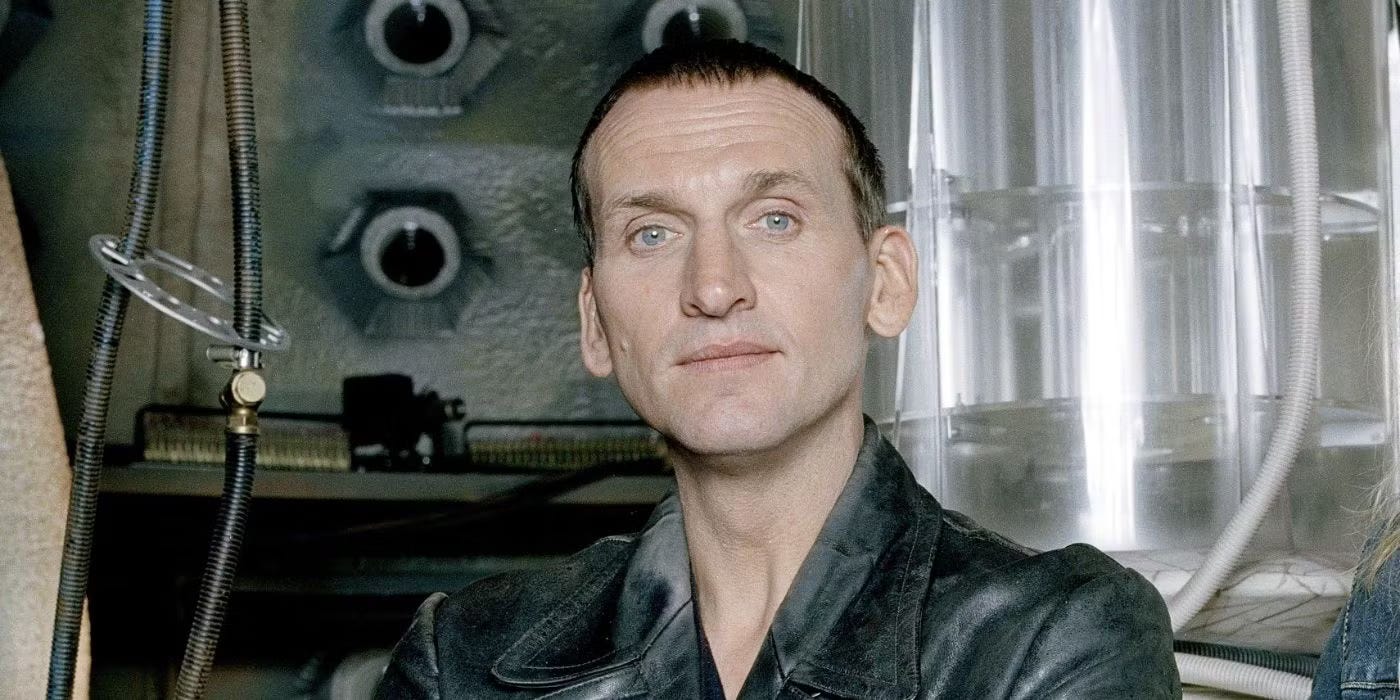
The numbers tell a brutal story. Christopher Eccleston’s 2005 series averaged 7.95 million consolidated viewers. David Tennant’s first era (2005-2010) averaged 8.35 million. Matt Smith (2010-2013) averaged 7.98 million despite lower overnight figures, demonstrating the shift to time-shifted viewing.
Peter Capaldi (2014-2017) averaged 6.42 million. Jodie Whittaker (2018-2022) averaged 6.13 million. Both represented declines, but the show remained among BBC One’s stronger dramas.
Then came Ncuti Gatwa: 3.80 million average across 18 episodes. A collapse of nearly 40% from Whittaker’s already-diminished numbers. The show that once regularly pulled 10+ million viewers for major episodes now struggles to reach 4 million even for season finales.
The spin-off The War Between the Land and the Sea performed even worse, averaging just 2.47 million viewers despite featuring beloved returning characters and being positioned as an event series.
These aren’t just bad numbers—they’re catastrophic. They represent a franchise that has lost its audience and shows no signs of recovering it under the current creative direction.
The Reboot Question
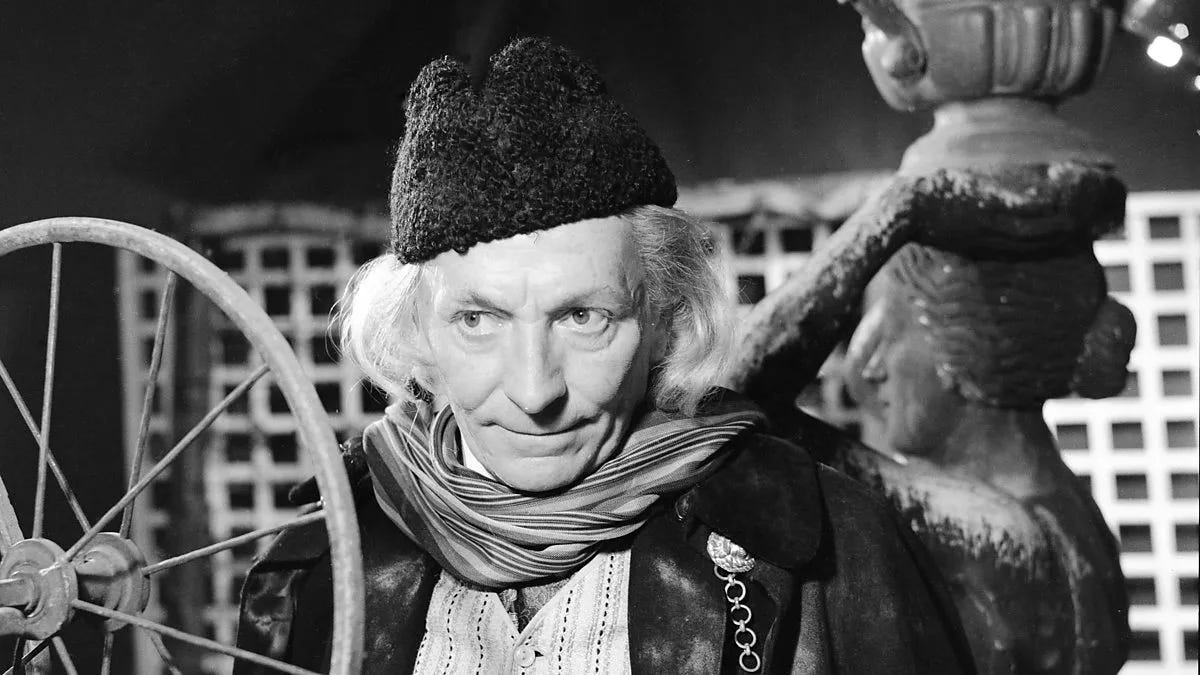
A complete reboot would be unprecedented for Doctor Who. The show’s entire premise is built on regeneration—the ability to replace the lead actor while maintaining continuity. Every Doctor from William Hartnell in 1963 to Ncuti Gatwa in 2023 exists in the same timeline, with the same history, building on what came before.
Jodie Whittaker’s era felt like a soft reboot. Chris Chibnall, her showrunner, introduced the “Timeless Child” concept that retroactively changed the Doctor’s origin and violated decades of established canon. The backlash was immediate and sustained.
Russell T Davies’ return in 2023 felt like another soft reboot. He largely ignored Chibnall’s changes, brought back David Tennant for anniversary specials, and attempted to recapture the energy of his original 2005-2010 run. It didn’t work. The audience didn’t return.
Now the BBC is apparently considering a hard reboot. Wipe the slate clean. Start over. Hand creative control to a streaming partner and let them build something new from scratch.
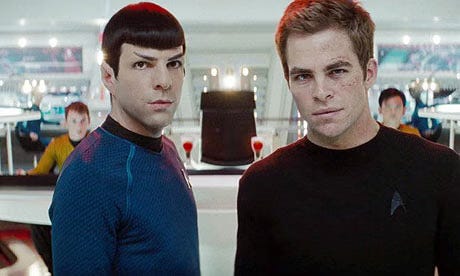
The problem is that reboots rarely work. Star Trek tried it in 2009 with J.J. Abrams’ films—they were financially successful but divisive among fans and failed to sustain a film franchise beyond three movies. Star Trek: Discovery attempted another reboot in 2017, setting the series in the original timeline but with radically different aesthetics and tone. It alienated longtime fans and failed to build a sustainable new audience, leading to cancellation after five seasons.
The only successful reboot in science fiction television history is arguably Battlestar Galactica (2004), which took a campy 1970s series and transformed it into a prestige drama. That worked because the original show had limited cultural cachet and a small fanbase. Doctor Who is different. It has 60 years of history, millions of devoted fans worldwide, and a format that already allows for reinvention without rebooting.
What Gets Lost
The beauty of Doctor Who‘s regeneration concept is that it allows for change without erasure. Each Doctor is different, but they’re all the same character. When the Tenth Doctor meets Sarah Jane Smith, it’s meaningful because she traveled with the Third and Fourth Doctors decades earlier. When the Eleventh Doctor encounters the Daleks, the weight of their history informs the confrontation.
A reboot throws all of that away. Do we really need to see the Doctor meet the Daleks for the first time again? Do we need another origin story explaining the Time Lords and Gallifrey? Do we need to re-establish the TARDIS, the sonic screwdriver, the basic premise of the show?
The regeneration model already allows for fresh starts. Cast a new Doctor, hire a new showrunner, take the show in a new direction. You don’t need to reboot to do that. You just need to respect what came before while building something new.
The Streaming Partner Problem
Handing “total creative control” to a streaming partner is a gamble. It means the BBC would no longer control the direction of one of its most valuable intellectual properties. A streaming service would make all creative decisions.
This could work if the right partner is found. A service that understands the franchise, respects its history, and has the resources to produce quality television could potentially revive Doctor Who in a way the BBC has failed to do.
But it could also go disastrously wrong. A partner focused on chasing trends, inserting ideological messaging, or simply trying to replicate whatever’s currently popular on streaming could produce something that bears the Doctor Who name but has none of its spirit.
The BBC is reportedly shopping the property to multiple platforms. Netflix, Amazon Prime Video, and Apple TV+ are the obvious candidates. Each has deep pockets and global reach. Each also has very different approaches to content and very different track records with science fiction.
What do you think? Is a complete reboot the answer to Doctor Who‘s problems, or would it be the final nail in the coffin for a once-great franchise?
For a great alternative to mainstream publishing, with sci-fi spy thriller action, read The Stars Entwined on Amazon!

Here's an idea: how about a complete reboot of the BBC?
Just make everything from Jodie's time to Gatwa's into a bad dream that Rose had, that ends with her thinking she regenerated into the Doctor as the dream ended, and then she wakes up. There. I just fixed traditional Doctor Who for you. You're welcome. ~Dr. Jordan Avon