


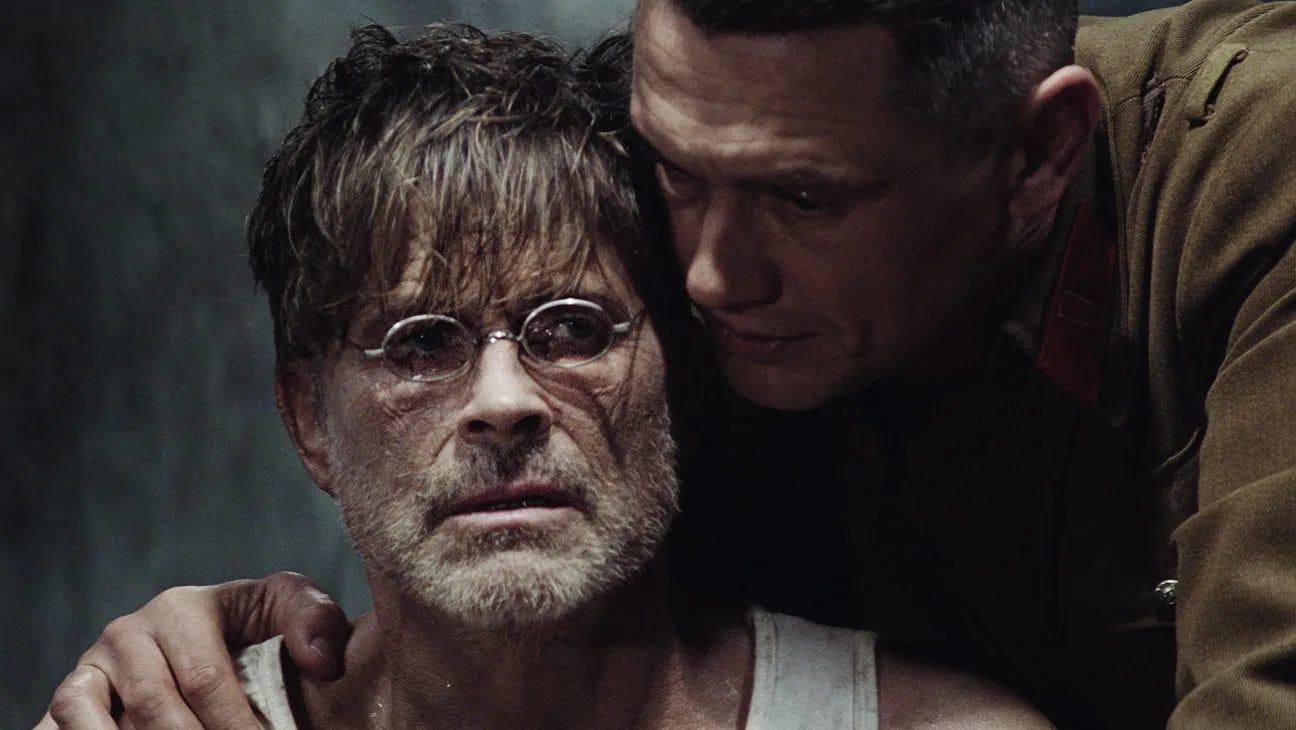
Confession is Ben Shapiro’s first feature screenplay. Václav Marhoul, the Czech director of The Painted Bird, directed it. Rob Lowe stars as the professor Alexei, with James Franco as Vladimir, his former student turned interrogator. Jennifer Jason Leigh, Nick Nolte, Kodi Smit-McPhee, Emile Hirsch, Brad Dourif, Dean Norris and Richard Brake round out the cast. Five of those actors besides Lowe have Oscar nominations. Bonfire Legend produced it, the Daily Wire is distributing it, and it runs 132 minutes. It is the most star-heavy cast the Daily Wire has ever put together.
The setup is a two-hander in a prison cell. Alexei is a drunk and dissolute former professor, arrested on a charge of conspiring with a dissident priest. Vladimir wants a signed statement. The interrogation is personal because the two men know each other, and the film asks what a man owes the truth when a lie would free him and his family from the people holding them.
It world-premiered on October 15 at the 42nd Warsaw International Film Festival, in the International Competition. On November 11, it ran for one night in about 100 U.S. theaters, open to paying members, and it landed on the Daily Wire’s streaming service the same day.
Lowe appeared on The Free Press’s Second Thought podcast with Suzy Weiss on Tuesday, November 17. Weiss asked him directly whether he worried about doing a movie with a conservative media company.
He said the film was “turned down by every single film festival.” The Daily Wire has said he meant everywhere other than Warsaw, and the film did play there in competition. What an industry veteran is describing is the experience of sending a cast like this one into the festival world and getting nothing back, and the festival circuit is where films like this one normally earn their reputations.
He said of the festivals, “I see what they’re picking up, and it’s all political.” Lowe watches the circuit for a living and has done it for four decades, and he sees a pattern in what gets selected. A festival lineup is the sum of programmers’ private decisions, and no film ever gets a written explanation of why it lost. That is why he can only describe the pattern he sees and cannot cite a rejection letter that names politics.
He described the response from distributors as “crickets.” Netflix and others never engaged. In this business, silence is how a buyer says no without putting anything in writing, and a project with this cast would normally draw at least a call.
He said the Daily Wire distributing the film “wasn’t originally going to be the life of the movie.” That is a gracious line toward the company that put it out, and it comes from a star with no ideological stake in the Daily Wire. His message was that he was glad someone said yes, and that he wants people to see the film.
Lowe did not oversell the film. He called it a “tough watch.” He said he read the script, thought it was fantastic, and called Shapiro to tell him. Shapiro asked whether Lowe knew any leading men in their fifties who would not be scared just because Shapiro wrote it. Lowe told him, “Yeah, me.”
He also explained himself. “Why wouldn’t I also work with the most right-wing writers in the world?” he said, pointing out that he has worked with the most left-wing writers in the world. In Variety, he put it this way: “For every Jane Fonda I have a Ben Shapiro.” That is a working actor refusing to apply a political test to a script, in an industry that applies one all the time.
Lowe’s account does not stand alone. Hollywood’s treatment of conservatives has been documented for years, and much of the documentation comes from the industry’s own trade press and its own people.
The Hollywood Reporter reported in 2016 that supporters of Donald Trump in the industry feared mixing it up with their liberal colleagues. Conservative actors formed Friends of Abe, a group that met quietly for years to give each other moral support and professional encouragement. Pat Boone told The Hollywood Reporter that there used to be more conservatives in the business, and that today’s stars keep quiet to avoid backlash. James Woods said in 2017 that the blacklist against conservatives in Hollywood is very real, and he stepped back from the industry. Alec Baldwin has said he knows arch-conservative actors he won’t name, and that conservative artists feel they are treated unfairly by their peers. Drea de Matteo, a Sopranos alum, told Variety about the consequences of running against industry groupthink.
The reviews thus far are poor, and the film’s audience should know that going in. The Hollywood Reporter’s Frank Scheck called it a “dull, turgid slog.” His main complaint was length and dialogue, and he wrote that the leads give it their all but never convince him in their roles. Variety’s Joe Leydon called the drama “sluggishly talky,” though he credited Lowe and Franco with finding emotional sparks in stilted dialogue. Slate’s Rebecca Onion found parts of it tedious and said she still enjoyed seeing Franco on screen again.
Shapiro was good-humored about the pacing. When a viewer in the Daily Wire’s live chat called the movie tedious, he answered, “It turns out prison is… slow.”
Other critics saw it differently. Christian Toto gave it 3 out of 4 and said the cast gave the film gravitas and historical heft. Rod Dreher’s piece in The Free Press carries the headline “‘Confession’ Is a Masterpiece.” (The Free Press hosted a screening with the Daily Wire and also hosts the podcast where Lowe spoke.) On Rotten Tomatoes, the audience score sits around 90 percent from more than 100 ratings, against only six critic reviews. Audiences and critics split along familiar lines on a conservative-written film, and anyone who follows the Daily Wire’s releases has seen that split before.
The Daily Wire made a film with a real director and a cast of working Oscar nominees, shot on 35mm, about a man who will not sign a lie. It earned a world premiere in competition at a legitimate international festival. It put the film in about 100 theaters on one night and on streaming the same day, so the audience that wanted to see it could. A company that was told, in effect, to stay in its lane built a feature that attracted Rob Lowe and James Franco, and it did so while making films in a country where a conservative company is expected to make documentaries and stop there.
You can think the movie is too slow and still say that. The right answer to a bad review is a better film next time. The wrong answer to a conservative film is a door nobody will explain.
If every rejection was about the filmmakers, what keeps those festivals from saying so on the record?