


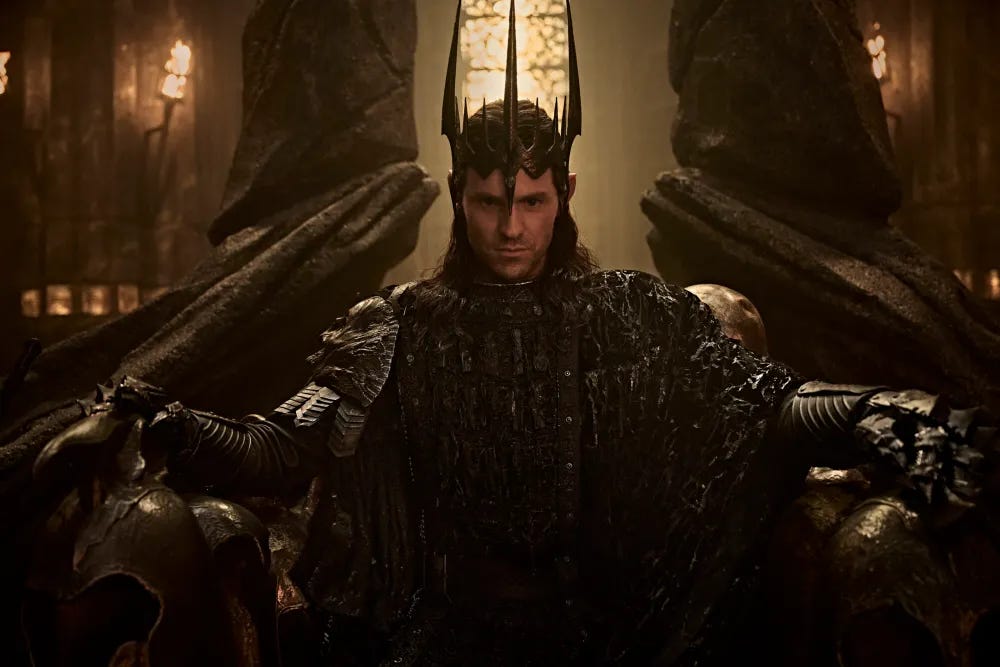
Amazon released the first four episodes of The Lord of the Rings: The Rings of Power Season 3 on November 11, more than two years after Season 2 premiered. The first of them, “Marnûkh,” runs about an hour and fifteen minutes. Amazon is holding the rest of the season back, with episodes five and six arriving November 18 and the last two on November 25. A show that took this long to come back, on the most expensive production Amazon has put out, had time to build something. The premiere shows what it built.
Where It Starts
The episode opens with a quick recap and a voiceover from Galadriel describing the war with Sauron, then jumps five years ahead. Viewers who skipped the first two seasons can follow it. Sauron holds most of Middle-earth, the Elves hold Lindon and Rivendell under the protection of their three rings, the Dwarves have hidden theirs, and Sauron has been handing out rings to Men.
The time jump helps. Picking up directly where the last season stopped would have meant another run through the same stalled storylines, and starting from a new point gives the show room to move. There is plot in this one, and some action. That puts it ahead of Season 2.
Sauron’s own storyline is the engine. He is trying to forge a master ring in Mordor, and his first attempt incinerates an Orc he talked into wearing it. He destroyed Celebrimbor’s records after the fall of Eregion, which leaves him without the knowledge he needs, so he sends his servants out to find whatever survived. One of them is Marnûkh, the Orc the episode is named for, who is sharper than the others and who the story clearly intends to matter.
The Chronology Problem
The structure itself is the first issue. In Tolkien, Sauron forged the One Ring around the year 1600 of the Second Age, and the war between Sauron and the Elves began in 1693, after the Elves took off their rings. The order matters because the war is the consequence of the Ring. Here the war is five years old, Sauron still cannot make the Ring, and the episode keeps him trying. The show had to invent a reason for Sauron to be at war before the Ring existed, and that decision from the first two seasons keeps producing plot problems.
Galadriel the Soldier
The episode gives Galadriel a flashback to meeting Celeborn in the First Age. He finds her dancing alone in a glade, she says she was practicing her sparring, and the two spar. Even in the memory, she is a fighter first.
The present-day battle that follows opens the episode’s action. Galadriel leads the fight in a woodland, and at one point she spins in circles with her sword and an Orc drops with every turn. A scene like that has no tension, because nothing in it threatens her. The show later puts her up against a Naznagôl, one of Sauron’s ring-bound servants, and she escapes with Arondir after being overmatched. That fight is the one that carries any danger. In the books she is the Lady of Lothlórien, wise and regal, and the show keeps casting her as the army’s commander.
The Rings of Men
The strongest moment is the one Sauron’s storyline gives the audience in Barad-dûr. He hands out rings to Men, and he makes the Men fight each other for them. Theo is among them, and the episode ends with the men fighting to the death over a ring. It is brutal and clear. A Dark Lord who stages his own gladiator contest for the right to serve him reads as someone dangerous.
Númenor and the Dwarves
The Númenor storyline moves forward and does not irritate the way the others do. It is the least bothersome thread in the episode.
The Dwarf storyline is the opposite. Durin’s brother Thráin enters a secret partnership with Sauron, which is a better plot beat than most of what the Dwarves get. Then the episode reveals a past between Durin’s wife Disa and Thráin and builds drama out of it. The effect is to make Durin the cuckolded party in a storyline that was already hard to take seriously.
Gandalf and His Names
Season 3’s credits now name the Stranger, played by Daniel Weyman, as Gandalf, and the episode has him in the Second Age with Tom Bombadil, who sings. The name itself is where the show departs from the books.
The show reached it in the Season 2 finale. The Stoors called the Stranger “Grand-Elf” after he saved them from the Dark Wizard, and he heard Gandalf in it. That phrase is not in Tolkien. Tolkien took the name Gandalf from Gandálfr, a Dwarf listed in the Dvergatal, the catalogue of dwarf names in the Old Norse poem Völuspá. It joins gandr, a staff or wand, with álfr, an elf, and Tolkien’s text gives it as “Elf of the Wand.” Men of the North gave him that name because he traveled on foot leaning on a staff and they took him for one of the Elves, a mistake Tolkien says they made. The elf is real. The “grand” belongs to the show. The writers did put in a nod to the root, when Nori calls a branch a “gand” in Season 2, but they built the origin of the name on a pun Tolkien never wrote.
Gandalf was never one name in the books, and each of the others carries its own context:
Olórin is the name he had in Valinor, in Quenya. He was a Maia who served Manwë and lived in the gardens of Lórien, and he learned pity and patience from Nienna. This is the name that applies in the Second Age, before he came east.
Mithrandir is Sindarin for “Grey Pilgrim,” the name the Elves gave him. Círdan the shipwright welcomed him at the Grey Havens and gave him Narya, the Ring of Fire, one of the Three.
Tharkûn is the Dwarvish name, in Khuzdul, and it means “Staff-man.” It points to the same staff the Men of the North named him for, which is how three peoples ended up with three names for the same habit.
Incánus is the name the people of the South used.
Gandalf is the name from the North, and the one that stuck.
In The Two Towers, Gandalf lists these names himself, which is where the roster comes from.
The Second Age problem comes from the same source. The Istari arrived in Middle-earth about the year 1000 of the Third Age, more than a thousand years after the Second Age ends. The one thread in Tolkien’s writing that puts Olórin in Middle-earth in the Second Age is a recorded conversation with Galadriel. Nothing in it resembles the show’s version, a Second Age wizard learning his craft from Tom Bombadil. That apprenticeship is the show’s invention, and the show has no reason for placing Gandalf here except that audiences know him.
Sauron
Everything above comes back to Sauron. The setup from the Season 2 finale carries into this episode: Sauron’s war is aimed at Galadriel, and he wants her as his queen. She hears his whispers when she lies alone in bed, and his promises to make her queen come back to her. A hallucination of Celebrimbor’s corpse, hanging on a wall in his fortress, taunts him that he cannot form real connections with anyone.
That is the writers’ diagnosis of the Dark Lord: a lonely man who did not get the girl. Tolkien’s Sauron is a fallen Maia, the chief lieutenant of Morgoth, a being who corrupted himself because he wanted to impose order on everything. The show has him moping about Galadriel. A villain who wants to be loved is a whiny villain, and a whiny villain cannot be scary. Casting him as a human-looking figure who reads as a soft-featured romantic lead makes it worse. The episode leans on the motivation, and it is the part that makes the audience roll their eyes.
Verdict
“Marnûkh” is a mediocre premiere. It has a time jump that clears room, a Sauron-Elves war with some momentum, and a good scene of Men killing each other over rings. It also has a premise from the first two seasons that cannot be fixed by moving the start date. The chronology is wrong, Galadriel is the warrior, the Dwarves are a joke, Gandalf is out of period and carries a name the show reinvented, and the Dark Lord is a suitor. A season that has four episodes dropping at once does not leave much room to recover.
Amazon’s gamble with Season 3 is that a five-year jump and a faster release will make viewers forget the first two seasons. After one episode, what part of the premise do you think the show can still repair?
Six books. One unforgettable world. The Adventures of Baron Von Monocle is steampunk adventure with the kind of worldbuilding and heart that made you fall in love with fantasy in the first place. Start the series on Amazon.
Oh, come on….Season 3 just came out. LOL