


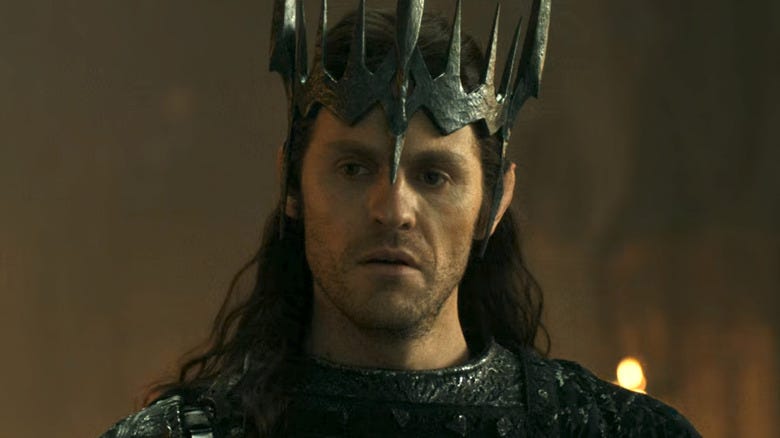
The Lord of the Rings: The Rings of Power ended its third season with a standoff, a surrender and a smirk. Amazon sold this as the War of the Elves and Sauron, and the war never happened. Sauron forged the One Ring in episode 7, took it off his finger in the finale, and knelt before Ar-Pharazôn without a battle. It is a better season than the second. It still misses what makes Middle-earth work.
The finale deserves credit on one point. Sauron’s surrender to Pharazôn comes straight from Tolkien. In the Akallabêth, the Númenórean fleet lands, Sauron’s servants desert him, and he submits and is carried to Númenor as a prisoner. The showrunners moved closer to the lore here than they did in the first two seasons. Getting a story off the rails and back toward the source is hard, and this season at least points in that direction.
The execution is where it comes apart. In Tolkien, the Númenóreans face Sauron alone. In this finale Gil-galad, Elrond, Galadriel and Celeborn all stand in Pharazôn’s camp, with the elves at the front of a human king’s army. Elrond gives a speech to the rank and file about mortality and leads a Quenya battle cry, and the scene leads to almost no fighting. The elves are present for a battle that doesn’t occur.
Compressing time makes it stranger. In Tolkien’s chronology, Sauron forges the Ring around the year 1600 of the Second Age and surrenders in 3262. The show gives the audience days between the two events. The long, slow corruption of Númenor, which fills centuries in the books, now has to happen in season 4, almost certainly after another time jump. The standoff itself ends when Rhûn’s forces desert after Khamul appears to fall, so the deciding event is one army leaving. The finale runs 71 minutes, and most of that time goes to Gandalf, who resists Sauron’s temptations, frees Pallando from a Ring, fights Khamul, and watches Pallando die before Tom Bombadil takes the Ring. The clash of armies the season promised is squeezed into what remains.
Gandalf in the Second Age is itself an invention. In Tolkien, the Istari don’t arrive in Middle-earth until around the year 1000 of the Third Age. The show has placed a wizard at the center of a story that happens thousands of years before wizards came.
Episode 7 shows the real problem. The show treats the forging of the One Ring as the most important event in the story, and the episode reflects that. Sauron spends most of it inside Mount Doom. The Balrog narrates nearly the whole forging in a stream of voice-over, which pulls attention off the man doing the work. The Balrog also seems to know about Rings that didn’t exist in its day, and its closing list of Morgoth’s followers names characters who died in the First Age. When Sauron collapses, the Ring slides across the rocks and onto his finger on its own. It is cheesy, and after a season of buildup it lands as anticlimax.
The forging isn’t what makes the Ring matter. What makes the story is the effect the Rings have on the world. The Nine turn kings into Ringwraiths. The Seven feed dwarven greed and draw dragons. The Three keep Lothlórien and Rivendell unspoiled and kindle courage in those who hear Gandalf’s counsel. The One gives its maker dominion over all the others. The Second Age is a story about what power does once it exists, and a show that spends its season building the machine and skips the results has missed the point.
That is where this season fails. Over eight episodes, the audience never sees an Elven ring do anything. The elves are described as resisting at the borders of Lindon and Rivendell with uncorrupted rings, but that is a line of text. Nobody sees Narya, Nenya or Vilya at work. The only Elven ring moment of note comes at the end, when Gil-galad, Círdan and Galadriel hear Sauron’s voice through their rings and take them off. That is a reaction to a power the show never demonstrated.
The corruption angle makes it worse. In the books, Sauron never touched the Three. They were made without him and stayed free of his taint, and the danger only began once he put on the One Ring. In the show, the characters treat the rings as corrupted well before the One Ring exists. That also breaks the internal logic. If the Three are not tainted, there is no reason for the Seven dwarven rings to corrupt their bearers. The Nazgnagôl, the show’s early Nazgûl, are changed instantly when Sauron hands out rings, while Tolkien shows slow ruin in Gollum and Bilbo. If lesser rings do that much damage that fast, the One Ring has little left to do. The show has removed the thing that makes it unique.
The characters don’t carry the weight either. Galadriel slays a dozen orcs in one scene and is helpless against them in the next, and she falls out of a tree and alerts a patrol. Her reunion with Celeborn is the first sign of the Lady of Lórien in the finale, and that direction is the right one. As a lead, she has not yet earned a following. Gandalf’s material swings between tones, with a slapstick staff gag and an evil elephant in a story about the fall of a continent. Sauron is the most interesting character left on the screen, and that is a problem when the show requires the audience to root for the heroes.
Critics scored the season accordingly. Season 3 sits around 78 to 81 percent on Rotten Tomatoes, below the 84 and 85 percent of seasons 1 and 2, which makes it the lowest-rated season of the show. The series has been renewed for season 4, with filming expected to begin in early 2027, and the showrunners have long planned a five-season run.
Season 4 now has to deliver the Fall of Númenor with Sauron as the only character carrying momentum and no hero the audience has been given a reason to follow. Can Amazon show the Rings working on the world, or will the war end again before it begins?