


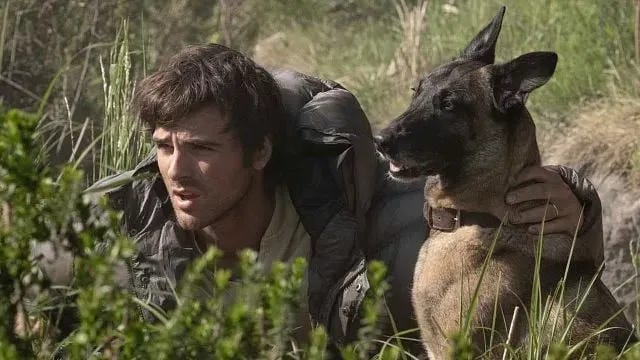
Ridley Scott’s new post-apocalyptic thriller The Dog Stars hits theaters August 28, and the first wave of reactions out of its London premiere shows a filmmaker once again leaning on visual polish to paper over a screenplay critics can’t defend. The film stars Jacob Elordi as Hig, a pilot surviving in a world gutted by pandemic, and Josh Brolin as Bangley, the ex-Marine who shares his homestead. Margaret Qualley, Guy Pearce, Allison Janney, and Benedict Wong round out the cast. It’s adapted from Peter Heller’s 2012 novel of the same name, with Mark L. Smith writing the screenplay.
The reactions split down the middle, and the negative side is not gentle. Critic Adam Patla called it “a well-made but utterly soulless apocalyptic tale” built on a heavy-handed screenplay. The HoloFiles went further, describing it as “a painfully generic post-apocalyptic thriller indistinguishable from The Last of Us.” Next Best Picture’s Matt Neglia made the sharpest point of all: no matter how well Scott stages a shot or how much his cast delivers, a film is only as strong as the script underneath it, and this one doesn’t hold up its end.
That criticism lands harder because it’s not new. Scott hasn’t made anything close to universally loved since The Martian in 2015, which earned a Best Picture nomination and broad acclaim across the board. Everything since has been a mixed bag at best. Alien: Covenant underwhelmed both critics and the box office. Napoleon sits at a 6.3 average score, a costume epic that split historians and audiences alike. Gladiator II landed at 6.4, a legacy sequel nobody asked for and few defended with any conviction. House of Gucci scored a 6.6, remembered more as a meme than a film. The Last Duel fared better with critics at 7.3, but it bombed commercially so badly that Scott himself blamed younger audiences for not showing up. Ten years of near-misses is a pattern, not bad luck.
Compare that to Steven Spielberg’s Disclosure Day, his first sci-fi film in eight years. It opened in June to a genuinely split reaction of its own: some outlets called it a return to form, while others flagged screenplay holes and pacing problems straight out of the Scott playbook. Collider noted the film’s thematic reach exceeds its grasp. The box office backed that up. Disclosure Day grossed just under $250 million worldwide against a $115 million budget, barely clearing its marketing costs and falling well short of Spielberg’s other sci-fi outings like War of the Worlds and Ready Player One.
Two of the biggest names in the history of the genre, both working from big swings, both landing somewhere between “fine” and “forgettable.” What connects them isn’t a shortage of talent. It’s a production pace that leaves no room to fix a script before the cameras roll. Scott told interviewers in 2024 that The Dog Stars, a Bee Gees biopic, and Gladiator III had him booked solid for three years straight. That’s not the schedule of a filmmaker chasing his best work. That’s a filmmaker chasing output. Spielberg’s situation is different on paper, since Disclosure Day was his first genre film in nearly a decade, but the result reads the same: a script that needed another pass and a director too committed to the production to demand one.
Unlike Scott’s last few releases, The Dog Stars isn’t even generating pre-release noise. There’s no viral marketing moment, no trailer everyone’s dissecting frame by frame, just a quiet stream of first reactions from a London press junket that mainstream audiences will likely never see. SlashFilm noted flatly that audiences aren’t turning out for Scott’s movies the way they used to, and the early box office projections back that up.
Both directors built their reputations on scripts that earned every frame they filmed. Alien didn’t need volume. Close Encounters didn’t need volume. Somewhere along the way, volume became the goal anyway.
Does Hollywood’s appetite for legacy directors cranking out one project after another explain why so many recent prestige releases feel undercooked, or is something else driving veteran filmmakers to keep signing onto scripts that clearly weren’t ready?
Sign up for the Ayla Rin: Gateway to Doom Crowdfund, coming soon for great cosmic comic books with a cover by legendary Green Lantern artist, Ethan Van Sciver:

NEXT: Lanterns Episode 2 Review: HBO Can’t Resist the Shock Value Even When the Mystery Works
Hollywood has utterly lost its way. The nepotism, cronyism, gatekeeping, ego, entitlement, greed, and out of control DEI has gutted everything.
Items 1-3 have made the rot generational and inescapable. The system doesn't exist to give talented people opportunities, it exists to give the friends and children, grandchildren, and great grandchildren of talented people opportunities.
It's not just actors. It's directors, writers, producers, editors, studio heads, assistants, skilled crew, stunt crew, and even down to the union crews pushing equipment crates and running cables.
The whole system is so grossly inbred that every picture looks like the Hapsburg jaw, feels like a fit of epilepsy, and bleeds red on the accounting books like a hemophiliac.
We saw a sneak showing last night, it is not a bad movie, but it is not a good movie. Way too many plot holes, even my wife was pointing out stupid things that someone with limited would never do. And it was about 30 minutes too long, really needed a tightened up script. Lots of tropes, not many original story beats. Cinematography was nice, but I felt even that could have been better. Spoiler alerts, if you saw a military or tactical uniform, you knew that the you were either looking at a bad guy or the character was going to do something you were not supposed to like. Obviously zero technical advisors that knew anything about weapons or tactics. The anti-bourgeois scene seemed like an insert to make liberals happy in a shoot-em-up move. We also laughed in the car later several scenes that appeared to be the result of the memo to central casting to "send me one of everything". The kumbayah ending was unrealistic and about the only trope subverted. It felt like Scott wanted to make a zombie film without zombies, several elements felt like Day of the Dead lifts. I would say wait for it to come out on cable.