


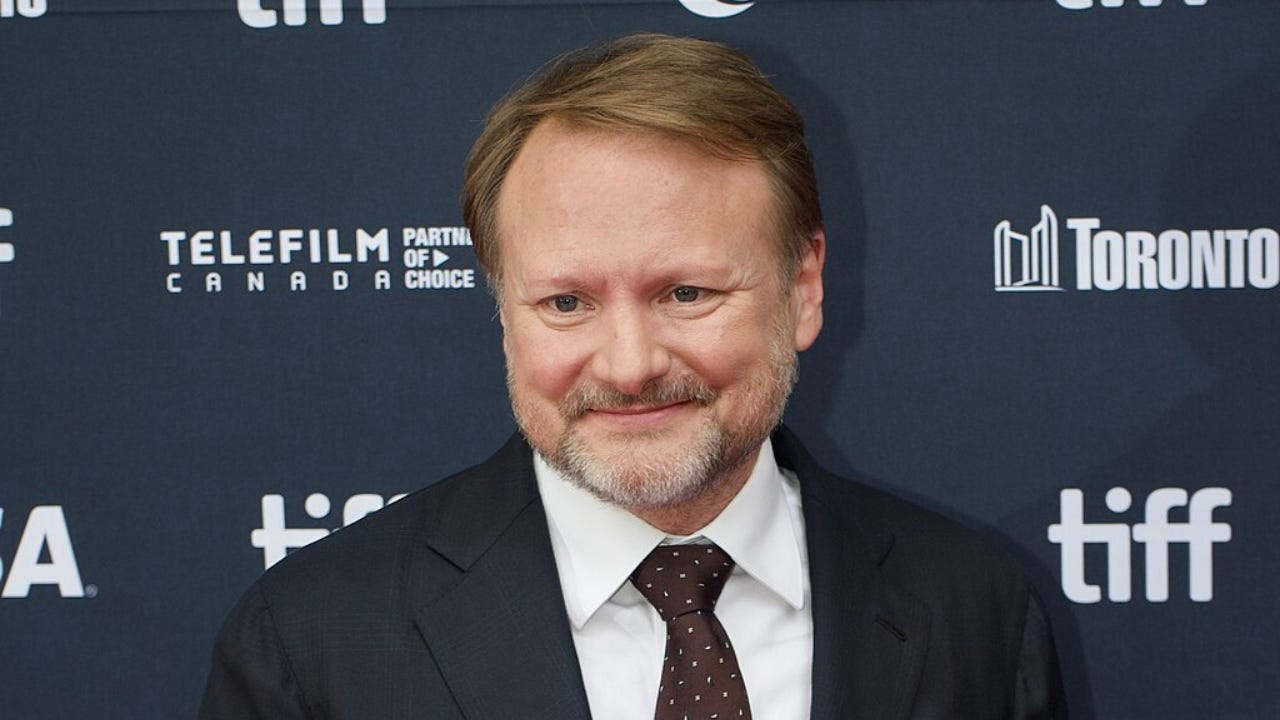
Boiling down the essence of a Rian Johnson film often leaves one with what Peter J. Leithart has described as pop‑postmodernism: the cultural style of dismantling inherited forms while pretending to conjure meaning from the fragments. Unlike the dense theoretical postmodernism of Derrida or Foucault, pop‑postmodernism packages skepticism in witty, accessible narratives. It thrives on irony, meta‑commentary, and genre subversion, offering audiences the thrill of cleverness without the burden of critical thought.
Johnson’s The Last Jedi dramatizes this impulse by dismantling the mythic scaffolding of Star Wars. Luke Skywalker is stripped of his heroism, the Jedi order is mocked as obsolete, and the film revels in the collapse of tradition without offering a coherent replacement. Similarly, Knives Out parodies the detective genre, exposing its artifice rather than affirming the rational pursuit of truth. In both cases, the narrative gestures toward meaning but refuses to anchor it in permanence.
Leithart compares this cultural posture to the biblical image of “shepherding wind” from Ecclesiastes. To shepherd wind is to chase futility: to attempt mastery over what cannot be grasped. Pop‑postmodernism, in its attempt to generate coherence ex nihilo (from within the self rather than from tradition or transcendence) embodies this futility. What we are left with are gestures toward profundity while denying reality.
The current danger is that audiences will mistake this futility for wisdom simply because it has been dressed as wit.
The Hollow Morality of Pop‑Postmodernism
This is seen in recent commentary Johnson gave in an interview with Polygon, where he described the “worst sin” of Star Wars. He said, “But I also know that the worst sin is to handle it with kid gloves. The worst sin is to be afraid of doing anything that shakes it up. Because every Star Wars movie going back to Empire and onward shook the box and rattled fans, and got them angry, and got them fighting, and got them talking about it. And then for a lot of them, got them loving it and coming around on it eventually.”
Notice Johnson’s use of the word “sin” and even assigning a degree to it (”worst”). He then proceeds to say, “I’m not a believer anymore. I’m no longer a Christian.”
The question immediately arises: on what foundation, then, does he build his moral judgments? He speaks of “sin” in the context of Star Wars, claiming that the “worst sin” is handling the saga with kid gloves. Yet outside of the Christian framework, “sin” is emptied of its meaning. It becomes nothing more than a personal preference dressed up in moral language.
Andrew Wilson, host of the podcast The Crucible has repeatedly exposed this cultural sleight of hand. In his commentary and debates, Wilson notes that when people abandon Christianity, they do not abandon morality altogether, they simply replace Christian moral categories with subjective preferences. They retain the vocabulary of virtue and vice, but without an axiom, without a transcendent anchor, those terms collapse into self‑expression. “Sin” becomes whatever offends one’s taste; “virtue” becomes whatever affirms one’s identity. It is morality without a foundation.
Johnson’s invocation of “sin” illustrates this perfectly. He borrows the gravitas of Christian language while severing it from its source. In Christian teaching, sin is rebellion against God, a violation of His law, and a rupture of communion with Him. It is objective, rooted in divine authority. But Johnson’s “sin” is merely the failure to provoke, the refusal to rattle boxes. It is not sin at all, but a stylistic preference masquerading as moral seriousness.
This is the essence of pop‑postmodernism: the attempt to create meaning ex nihilo and to shepherd wind. It dismantles tradition, borrows its vocabulary, and then pretends that its clever inversion is profundity. But without Christ, there can be no true moral structure or anchor, only personal taste. And, unless one applies force behind it, one’s personal preferences can be taken or left. One cannot command allegiance nor bind conscience nor sustain a culture on the hollow semantics of personal taste.
NEXT: ‘The Lord Of The Rings: The Rings Of Power’ Season 3 Might Not Arrive Until 2027

Hardy a surprise that an Atheist is an awful, self-serving writer, lol.
I learned from the former-Atheist Dr. Stephen Iacoboni that these secular humanists who "are no longer Christian" steal their morality by chopping off the first four commandments (the ones relating to God) and keeping the final six commandments (the ones relating to people) as if they derive from nature and not from the God they just cut out of their lives.
Modern cinema no longer relies on telling stories of good vs. evil. Now it's mean vs. nice. A thing is wrong if it's mean, plain but far from simple, since the definition of "mean" is a matter of interpretation. I will give you an example of this in action. If I say something unkind about Larry behind his back, is that a moral failing for speaking evil of Larry (without giving him the chance of defending himself) or is it mean because it would hurt Larry's feelings if it somehow got back to him? This may seem like splitting hairs, but there is a huge difference between these two things. One is a character flaw that needs corrected if I am to live up to the moral code I live by; the other is a social faux pas that can be corrected simply by keeping my mouth shut in future.