



There is a particular species of bad writing that mistakes novelty for imagination and information for meaning. It is the kind of writing that believes the reader must be dazzled, startled, or bludgeoned into noticing the world‑building because the writer has no confidence that the world itself is interesting enough to stand on its own.
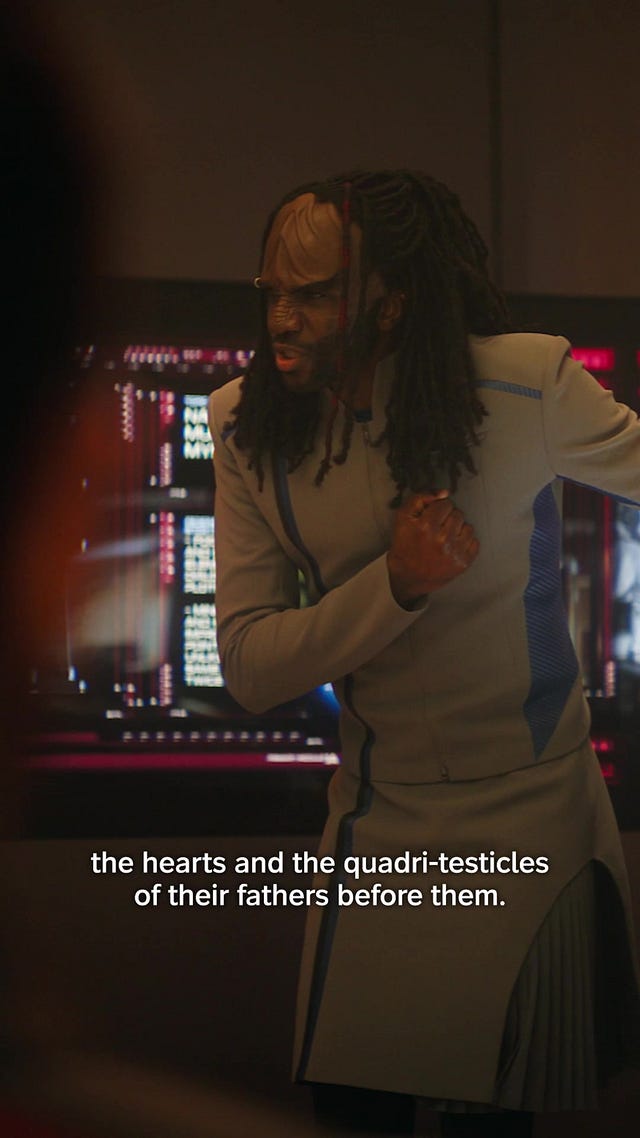
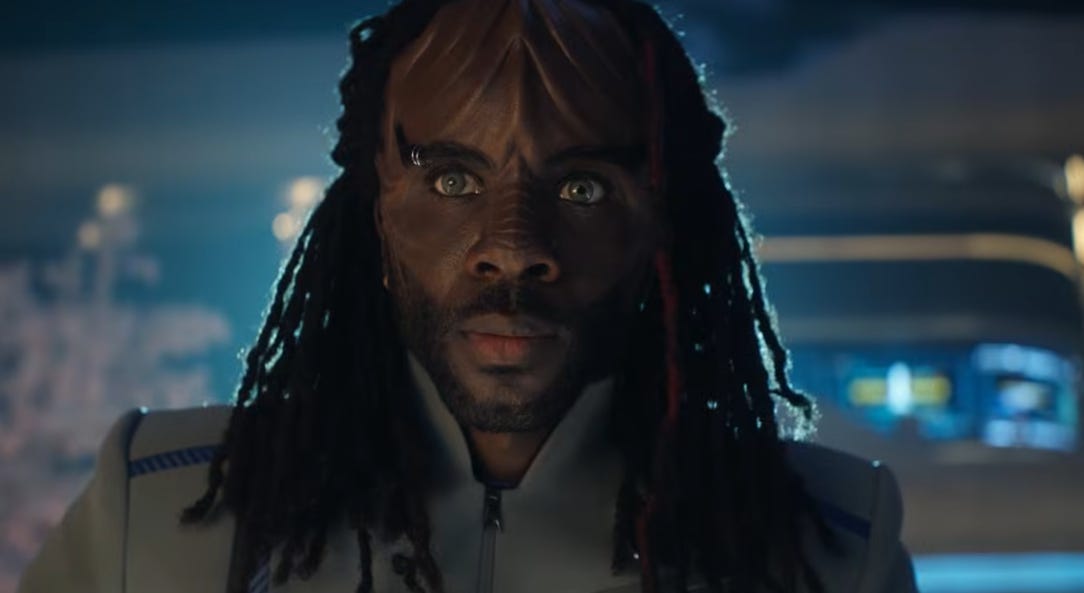
A recent specimen (among many) appears in Star Trek: Starfleet Academy, where a Klingon cadet recounts a scene from an opera and announces that the rival house has been served the “hearts and the quadri‑testicles” of their fathers.
 Tiktok failed to load.
Enable 3rd party cookies or use another browser
This is the sort of line that tells you everything about the writer and nothing about the character.
A Klingon, one assumes, would not pause to marvel at the number of his own reproductive organs. He would not speak of “quadri‑testicles” any more than a human poet would rhapsodize about his “dual‑kidneys” or “bi‑lungs.” The term exists only for the benefit of the audience, and even then only for the portion of the audience the writer assumes must be bribed with fictional anatomical trivia to stay awake.
C. S. Lewis once warned young writers against the temptation to “tell us what is not worth telling.”
Absurdity can be delightful when it arises naturally from the world. However, the detail here is meaningless. Having a character announce, with the subtlety of a foghorn, that Klingons have four of something humans have two of, does nothing for the story. It is useless trivia.
The line stands as a small but telling monument to a larger problem in contemporary writing: the belief that world‑building is accomplished by piling up facts rather than by revealing a world through the eyes of those who inhabit it.
Write what the character would say, not what you want the audience to notice.
Fandom Pulse is reader-supported independent journalism. Paid subscribers get exclusive scoops and investigative reporting daily.
Dive into Space Fleet Academy: Year One, the bold, unapologetic sci-fi epic that’s the real answer to woke Starfleet Academy nonsense! Humanity’s future hangs by a thread and Earth’s elite Space Fleet Academy trains the next generation of officers to defend civilization against cosmic threats, alien dangers, and internal decay. The book explores high-stakes space battles, rigorous training, and timeless values of duty, honor, and human excellence.
If you’re tired of sanitized reboots and craving a fresh, no-holds-barred academy adventure that actually respects heroism and exploration, grab this book now.

NEXT: Podcaster Matt Jarbo Explains Why He’s Boycotting ‘Project Hail Mary’

"Write what the character would say, not what you want the audience to notice"
This is a great piece of advice. Modern writers have this issue with using their characters as mouthpieces and joke delivery vehicles.
It doesn't seem to matter how awkward the dialogue, how uncharacteristic the words, how overstated the feeling, how unsuited to time and context the thought, modern writers MUST have their characters prattle on pointlessly so that YOU, the uneducated, unwashed, unenlightened, unthinking, unimaginative SMOOTH BRAIN can understand and appreciate their so carefully crafted MESSAGE.
It also doesn't seem to matter who the character is: their wants, their needs, their motivations, their fears, their weaknesses, their triumphs, and their failures--they are all factory processed, homogenized cut-outs pretending to be different when the only "differences" are cosmetic.
It never occurs to these fart-sniffers how dull and crude their creations are. They all speak and think and act just like SoCal Fine Arts majors.
It's no wonder they insist on "looks like me" characters. They can't even imagine a world where "thinks like me" characters don't exist. Looks Is as deep as their thoughrs can go. They're so absorbed by their mjnd-virus it's impossible to conceive anything that doesn't conform to the hive's crushing will.
Just when you thought this could not get any gayer.
Atleast they showed restraint by stopping at quadri-testicles instead hexa-tesitcles. Too much gay for them to handle yet.