



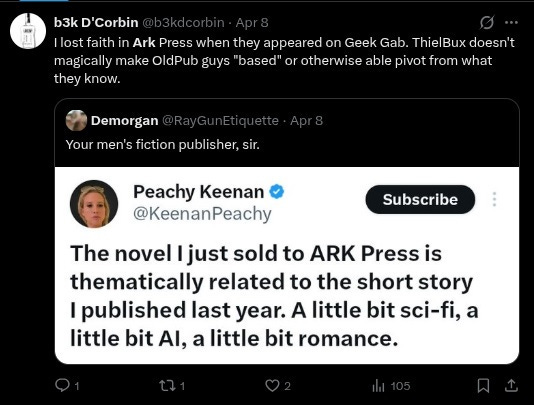
The quiet dismissal of popular author David John Butler from Ark Press landed with a thud because it confirmed what many in the counterculture sensed but hoped would not be true: The project was never built to last. Instead, it imitated an industry that has been failing in slow motion for decades.
Butler handled the news with class. No theatrics or public bitterness to see there. He wished them well and moved on like a pro. That reaction earned him even more goodwill, which only sharpened the contrast.
As author Ryan English noted, a lot of interest in Ark existed precisely because Butler was there. Remove the human anchor, and the whole edifice becomes abstract again, another logo floating in an already crowded marketplace.
As many predicted, copying the New York publishing playbook was a fatal error. That model survived into the twenty-first century only because it was subsidized by legacy backlists, corporate consolidation, and government-adjacent institutions. Strip those supports away, and the clunky machinery collapses under its own weight.
Startups do not get to coast on prestige accumulated in 1978. Nor do they enjoy decades of compound advantage. They lack a captive distribution network and automatic media coverage. When a new press adopts the same hierarchy, risk aversion, and spreadsheet logic as deadpub, it inherits all the weaknesses without any of the insulation.
What’s tragic is that it could have worked. Linked to billionaire Peter Thiel, Ark Press had options: Buy backlists with proven demand. Aggressively back younger writers who already had readership and credibility. Or accept losses in exchange for visibility by operating as a vanity press with a mission.
But each of those paths required commitment and capital deployed with intention. So what they chose instead was familiarity. From signing philosophy to assumptions about how culture gets made, their embrace of comfort came at the expense of momentum. And once the internal logic inevitably asserted itself, personalities became interchangeable, and relationships became expendable.
The reaction from readers and fellow writers was immediate because it mirrored a broader pattern. People are tired of institutions that talk about cultural renewal while behaving like timid managers. They have seen this movie before. A promising banner goes up. A few recognizable names get attached. Then the MBAs arrive, and the edges get sanded down.
For years, Conservative intellectuals told us that politics follows culture. It was the mantra that launched a thousand essays, speeches, and tweets. The one thing they did not do was back up all those words by spending money on creators unless a profit projection justified it.
That omission was not accidental. A system is what it does, and those decisions laid bare the self-styled culture warriors’ priorities. Their trademark slogan provided moral cover while allowing donors and institutions to behave like cautious hedge fund investors. Politics was framed as downstream so responsibility could always remain upstream with you, the subjects of cultural vandalism. Democracy means the buck is almighty and stops nowhere.
The Left does not operate that way. Hollywood studios have poured billions into films that hemorrhaged cash because the message mattered to the people writing the checks. Jeff Bezos continues to bankroll the Washington Post despite annual losses that would end any private startup overnight. Contra the bean counters, those decisions were not mistakes.
Because unlike their alleged opposition in the Mammon Mob, the Moloch Cult understands what Conservatism blinds its adherents to: Cultural power is expensive. It requires patience, demanding constant support long after spreadsheets turn red. You do not build narrative dominance by insisting that every project meet quarterly return estimates.
Ark Press ran aground on reality. It wanted the aesthetic of resistance without paying the price of conviction. Its front men sought to play gatekeeper without assuming the burden gatekeepers once carried. And at the first sign of friction, their corporatist reflexes kicked in.
The fallout is not limited to one press. Writers have picked up the signal. We notice when loyalty is conditional. And readers perceive when people matter less than business architecture. Every time this same tragedy plays out, going independent looks more and more like the stronger horse.
David John Butler will land on his feet because he has what institutions cannot manufacture: readers who care about his work and peers who respect his integrity. Those assets travel with him. A corporate imprint logo does not.
If Conservative thought leaders genuinely want to influence culture, they need to absorb an uncomfortable lesson. Patronage precedes profit. Commitment runs before scale. The willingness to lose money on principle is not a defect. It is the admission fee.
Until their attitude changes, new presses will keep reenacting old failures with friendlier branding. They will burn goodwill and wonder why enthusiasm dries up.
Meanwhile, creators backed by people who believe in them will continue building outside those systems, one reader at a time.
The culture war is not won by declarations. Dissidents’ path to victory is sustained backing of artists who can actually make art people want, and want to defend.

Brian Niemeier is a best-selling novelist, editor, and Dragon Award winner with over a decade in newpub. For direct, in-person writing and editing insights, join his Patreon.
NEXT: Tor Books Editor/Publisher Patrick Nielsen Hayden Announces Retirement

I knew there is an issue when it was clear they only wanted to pilfer pre-existing "hit" authors vice building up any mid-level or proven startup authors.
Culture IS paramount because Culture Is Religion (literally), politics is the religion of the senile because politics does not exist.