


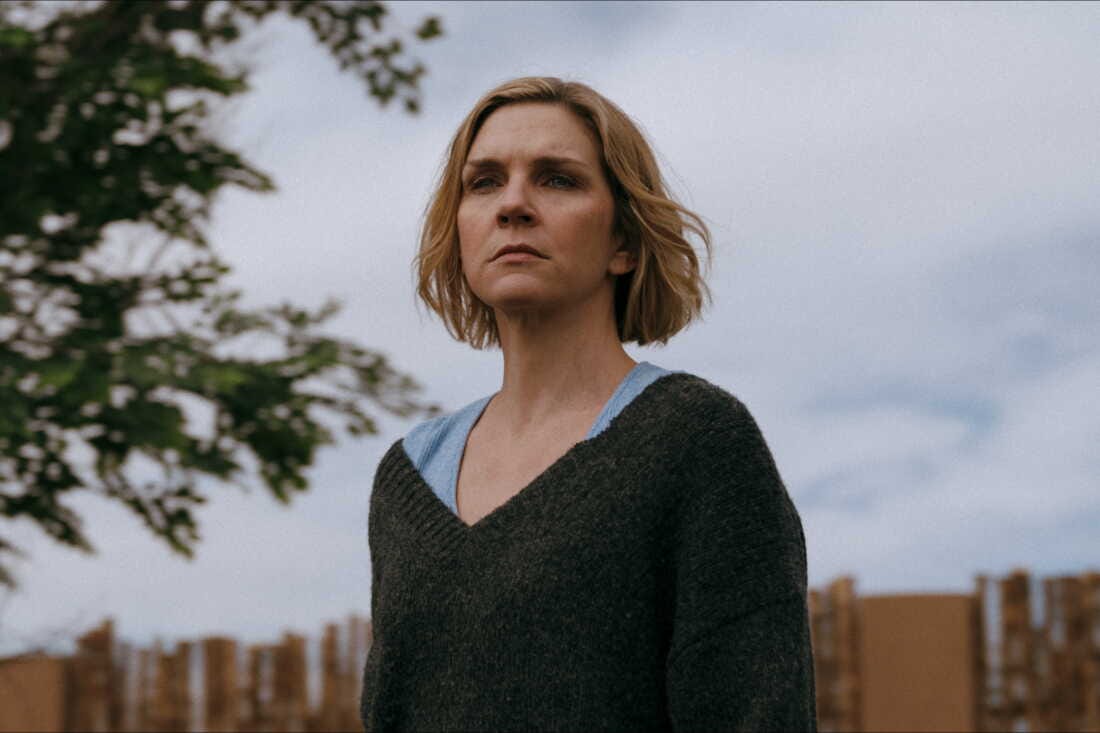
Pluribus season 2 began filming in New Mexico at the start of November on a 225-day schedule, and the premiere is now projected for August 2028, nearly three years after season 1 aired.
Vince Gilligan’s Apple TV series premiered in November 2025 with nine episodes and a cliffhanger ending, after Apple ordered two seasons up front. Forbes reported the new schedule, which has the shoot wrapping around June 14, 2027. Season 1 filmed from February to September 2024 and then spent about 14 months in post-production. Applying the same post time to season 2 produces the August 2028 date.
The production work shows where some of that time goes. Production designer Denise Pizzini built Carol’s cul-de-sac from nothing on leased land in the Albuquerque hills. There was no road, only open fields and volcanic rock, so the crew cut an access road, removed the rock, graded the site and planted the trees. The neighborhood has seven houses with poured slabs and real roofs. Pizzini said the city required environmental paperwork for the construction: “we had to have permits from the EPA because of the dust, and we had to mitigate that.”
Each house was designed individually, with stucco color samples tested in different sunlight, a separate landscape plan and an invented owner. House six belongs to a chef and house two to a divorce lawyer. Only Carol’s house and Manousos’s house are furnished. Albuquerque has extended the permit for the neighborhood so filming can continue there until summer 2028.
The other sets follow the same approach. A Peruvian village cul-de-sac was built from scratch, with the Andes added in post. Manousos’s office was built inside a converted storage facility that received a second story. The Darien Gap was partly rebuilt in New Mexico with constructed cliffs, because the Canary Islands location could not host a planned car-burning scene. Carvers worked for weeks on the ice hotel, and real ice blocks support the bed. The crew had one day to shoot at Bilbao Airport and duplicated signage on a building by the same architect.
The Agri-Jet set runs about 90 feet and holds rows of shrink-wrapped body parts that crews carved by hand, sitting at the work for days. Pizzini said: “everything you see, there are no set extensions; it is all practical.”
The camera work is built the same way. The Joining sequence is a nearly two-minute single shot of Carol driving away from a hospital. The crew mounted an LED screen in front of the car to light Rhea Seehorn and give her live footage to react to, while a rig drove the truck. Cinematographer Marshall Adams said the sequence took a day of rehearsal and a day of shooting, and that he built the driving sequence about half a dozen times. When Adams was hired, Gilligan and consulting producer Peter Gould told him not to leave anything on the table, even if that meant reshooting. Gilligan does not cut often, so each frame has to hold for a long stretch on screen.
An Episode 4 crowd sequence, shot from overhead, split its performers into color-coded sections arranged like numbers on a clock face. Stunt coordinator Nito Larioza said it needed a lot of takes and summed it up this way: “It was awesome, but trust me, it was tough.”
The shoot itself is roughly the length of season 1’s. The added time sits in the writing room and in post-production, where crews also remove passing cars digitally from scenes shot in a working city, according to Seehorn. In February, Gilligan told reporters at an Apple TV press day: “We are deeper into the process at this moment than I would like, considering how few episodes we have figured out.” He has also said: “It takes us a while. I would love to go faster if I could.”
The industry wait is growing. Ampere Analysis puts the average gap between seasons of ongoing scripted series on premium streamers at 21 months, up from 16 months in 2022. Severance and Wednesday each waited roughly three years between seasons one and two, and Stranger Things took nearly three and a half years to reach its final season. Some shows have survived the wait. Luminate reports that Severance season 1 was streamed more in the first six weeks of 2025 than in its first 12 weeks in 2022. Others have not. Squid Game season 2 drew 192.6 million views in its first 90 days against 265 million for season 1, and Poker Face season 2 fell 37% from season 1 in 12-week minutes streamed after a two-year break.
Gilligan has said he sees a longer run for Pluribus: “In my mind’s eye, I’m thinking maybe three seasons for Pluribus, but maybe it goes past that.” On the same cadence, season 3 would land around 2031. A viewer who watched the season 1 finale in 2025 will be asked to remember where the story stopped in 2028, and a series that wants a multi-season run needs those gaps closed.
If a show needs three years between seasons, how many viewers are still watching when it comes back?
First contact with the Oridians was supposed to be humanity’s proudest moment. Instead, their chief engineer is dead, their ship is sabotaged, and an ancient alien technology is stealing souls. Book one of the Valiant Frontiers series delivers exploration, mystery, and the kind of crew you’ll want to follow across the galaxy. Read The Soul Catcher on Amazon and start the adventure.

I had read about it a few days ago, and I was a bit shocked actually. I thought they'd already wrapped, and we'd be getting a trailer, especially when considering that Apple had indeed ordered two seasons from the get go… as a showrunner I would have written season 2 together with season 1 immediately, at least in treatment form… but then the article said: "will start shooting". You can't do 5 seasons at this snail pace. But iirc Gilligan said that in the end the show is planned to have a three-season arc anyway… but that would still be 10 years of his life… all that for only a few handful of episodes. That's not a life I'd want to live as an artist.
These streaming services are making a mess of it all! I yearn for the day where shows return within 6 months (let it be a year). For some reason, network like CBS is still able to do that.