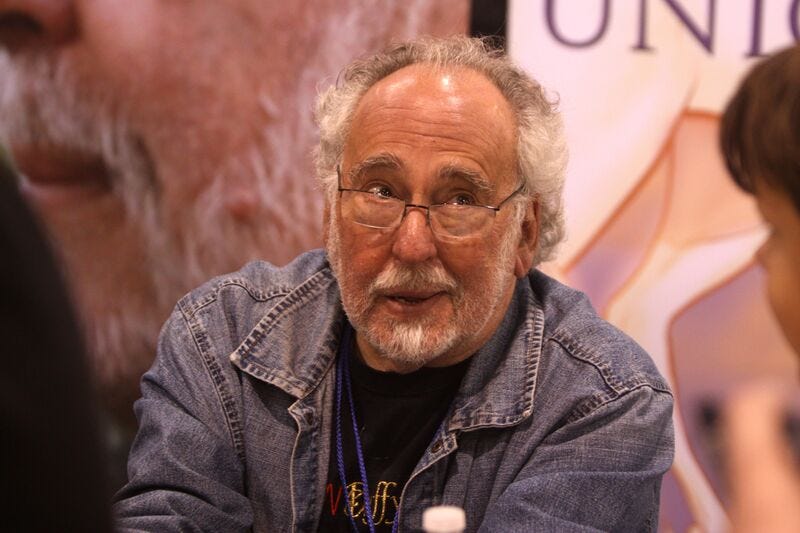
Peter S. Beagle, the author of The Last Unicorn, is one of four Special Guests at the 52nd World Fantasy Convention, which opens today at the Oakland Marriott City Center and runs through Sunday. Beagle is 87 and lives in Oakland. He published the novel in 1968, at 29, and it has since been translated into at least 25 languages. The 1982 animated film adapted from it still draws a cult audience more than four decades after its release.
Most readers know him for that one book and that one film. Fewer know that he rewrote the screenplay for Ralph Bakshi’s animated Lord of the Rings, or that he wrote an episode of Star Trek: The Next Generation built around a mind meld. Fewer still know that he spent much of his career fighting for the money and the rights his work had earned. Convention members can get books signed at the Mass Autographing, which is open to all attendees, and the World Fantasy Awards Banquet is Sunday night.
A Poet’s Scholarship From the Bronx
Beagle was born April 20, 1939, in the Bronx. His father taught history, and three of his uncles, the Soyer brothers, were painters. He graduated from the Bronx High School of Science in 1955 and entered a poem in the Scholastic Art & Writing Awards, a national contest for teenage writers and artists. The poem won him a scholarship to the University of Pittsburgh, where he earned a degree in creative writing. After a year overseas he took a Stegner Fellowship at Stanford, the university’s writing program, where Ken Kesey and Larry McMurtry were working in the same years.
His first novel came earlier than any of that suggests. He wrote A Fine and Private Place at 19, and it was published in 1960. The book is set among the graves and takes its inspiration from Woodlawn Cemetery in the Bronx. In 1965 he published I See by My Outfit, a memoir of a cross-country trip by scooter.
How The Last Unicorn Got Written

The idea for the unicorn came in 1962, during a retreat in the Berkshire Hills. Viking Press had just rejected his novel The Mirror Kingdom, and Beagle started over with a creature that had no business in the modern world. The first manuscript ran 85 pages and was set in the present day, with the unicorn traveling alongside a two-headed demon. He set it aside in 1963 and returned to it in 1965. In an essay for the novel’s 2007 Deluxe Edition, Beagle wrote that the book took close to two years and that “it was hard every step of the way.”
Viking published the finished novel in 1968, and The Bodley Head handled the British edition. Ballantine released the first paperback in February 1969 as part of its Adult Fantasy line. The story follows a unicorn who learns that she is the last of her kind and leaves her forest to find the others. She picks up the magician Schmendrick and a woman named Molly Grue, and together they confront the Red Bull, a monster that serves King Haggard.
Locus, the science fiction and fantasy trade magazine, polled its subscribers in 1987 on the best fantasy novels of all time, and the book placed fifth out of 33. A second poll in 1998 counted many book series as single entries, and it placed eighteenth there. Beagle’s discarded 1962 draft eventually reached print as The Last Unicorn: The Lost Version, and Tachyon Publications reissued it under the title The Last Unicorn: The Lost Journey.
The 1982 Film
Rankin/Bass Productions, the studio behind the stop-motion Rudolph the Red-Nosed Reindeer television special, made the film for ITC Entertainment. Arthur Rankin Jr. and Jules Bass directed from Beagle’s screenplay. The animation was done at Topcraft, a Tokyo studio whose core staff later formed Studio Ghibli. Jimmy Webb wrote the songs and the score, and the group America performed the songs.
Mia Farrow voiced the unicorn, and Alan Arkin voiced Schmendrick. Jeff Bridges voiced Prince Lír, a young knight who joins the quest. Angela Lansbury played the carnival witch Mommy Fortuna, and Christopher Lee played King Haggard.
The film opened November 19, 1982, in 648 theaters and took in $2.25 million over its first weekend. Its total in the United States and Canada came to about $6.5 million against a budget of $3.5 million to $4 million. Home video gave it a second life, and more than 2.5 million DVD copies had sold by October 2011.
Tolkien and Star Trek
Four years before The Last Unicorn reached theaters, Beagle worked on another adaptation. Ralph Bakshi’s animated The Lord of the Rings opened November 15, 1978, and covered The Fellowship of the Ring and part of The Two Towers. Bakshi and producer Saul Zaentz were unhappy with the drafts by screenwriter Chris Conkling and brought Beagle in for a rewrite. Beagle dropped Conkling’s flashback framing, opened at Bilbo’s farewell party, and built his draft toward the battle at Helm’s Deep. The screenplay credit went to Conkling and Beagle.
The film grossed $30.5 million in North America and received a Hugo Award nomination for Best Dramatic Presentation. Peter Jackson, who later directed the live-action trilogy, has said on the Fellowship of the Ring DVD commentary that Bakshi’s film introduced him to the story.
Beagle’s other major screen credit came in television. “Sarek,” the 23rd episode of The Next Generation‘s third season, aired May 14, 1990. Beagle wrote the teleplay from a story by Marc Cushman and Jake Jacobs. Mark Lenard returned as Sarek, Spock’s father, now an ambassador in the grip of Bendii syndrome, a degenerative illness of aged Vulcans. The disease strips away his emotional control, and the feelings he can no longer contain spread through the Enterprise crew until a brawl breaks out in Ten Forward.
Captain Picard, played by Patrick Stewart, takes Sarek’s emotions into himself through a Vulcan mind meld. The scene was shot in a single take. The episode drew a 10.6 Nielsen rating, the highest for the series in six weeks. Executive producer Michael Piller later said that having Picard say Spock’s name in this episode let the writers begin referencing the original series.
The Awards
Beagle’s later novels earned recognition from the genre’s institutions. The Folk of the Air, published in 1986, won the Mythopoeic Fantasy Award in 1987. The Innkeeper’s Song, published in 1993, won the Locus Award for fantasy novel in 1994, and Tamsin took a second Mythopoeic Award in 2000. His 2005 novelette “Two Hearts” returns to the characters of The Last Unicorn and won both the Hugo and the Nebula for best novelette.
The career honors came later. The World Fantasy Convention gave him its Life Achievement Award in 2011. The Science Fiction and Fantasy Writers of America named him its 34th Damon Knight Memorial Grand Master in 2018, the organization’s top honor for lifetime achievement. In 2023 the Los Angeles Science Fantasy Society gave him the Forrest J Ackerman Award for Lifetime Achievement.
The Fight Over His Rights
Beagle’s film contract is where the first dispute began. In 1979 he signed with ITC Entertainment for five percent of the net profits on the animated Last Unicorn and five percent of the gross revenue from film-related merchandise. Since 1999 the film has been controlled by Granada Media International, a subsidiary of the British broadcaster ITV. From 2003 through 2011, Beagle was locked in a financial dispute with Granada over unpaid profit and merchandising shares. On July 29, 2011, he told an audience at the Otakon convention that he and ITV had reached an agreement.
A second fight started in 2015, when Beagle sued his former manager, Connor Freff Cochran, for $52 million. Cochran and his companies filed for Chapter 11 bankruptcy on January 4, 2018, the day before the state trial was originally scheduled to begin. The bankruptcy court later allowed the suit against Cochran as an individual to proceed.
On June 21, 2019, Alameda County Superior Court Judge Michael M. Markman found that Beagle had proved his claims for financial elder abuse, fraud, breach of fiduciary duty, and defamation. He awarded $332,500 in damages, $7,500 of it for defamation. The bankruptcy court withheld permission to collect on the judgment while the bankruptcy case continued, and the rights to Beagle’s work stayed tied up in that process. In February 2021 a court-approved sale in the bankruptcy returned the rights to most of his work to an ownership group that includes Beagle.
Still Publishing
Beagle has kept releasing new work into his late eighties. The Way Home, published in 2023, collects “Two Hearts” and a new sequel novella, “Sooz.” I’m Afraid You’ve Got Dragons followed on May 14, 2024, from Simon & Schuster. That same year Suntup Editions released an illustrated hardcover of The Last Unicorn with art by Tom Kidd, and it won the 2025 Locus Award for Best Illustrated and Art Book. Palgrave Macmillan also published an academic study of the novel in 2024, Peter S. Beagle’s The Last Unicorn: A Critical Companion.
Beagle signed his film contract in 1979 and did not settle with the rights holder until 2011. What should today’s authors demand in their adaptation contracts so they are not still negotiating three decades later?
Six books. One unforgettable world. The Adventures of Baron Von Monocle is steampunk adventure with the kind of worldbuilding and heart that made you fall in love with fantasy in the first place. Start the series on Amazon.