


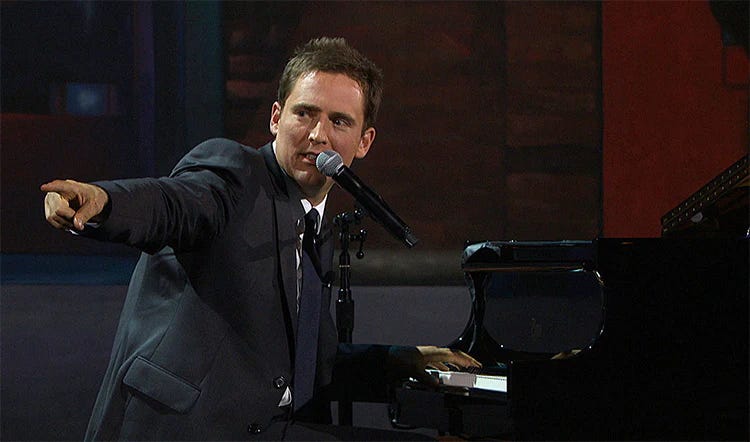
Owen Benjamin has been called a lot of things. Canceled. Dangerous. Unplatformable. He’s been removed from YouTube, rejected by PayPal, kicked out of comedy clubs in Las Vegas, and had a vacation rental delisted from Airbnb, all while convicted felons and actual criminals continued operating on those same platforms without a second glance. One thing is undeniable: when the biggest companies in the world spend real money to keep one comedian quiet, that comedian is saying something worth hearing.
His new book, How to Slay a Wizard, published by Castalia House, is exactly what you’d expect from a man who’s been through the machine and lived to tell about it, and a lot more besides. One might have expected a memoir or autobiography, or perhaps even a joke book, but what Benjamin delivered is a field guide to manipulation, written by someone who has watched it operate at every level of American life, from Hollywood green rooms to corporate boardrooms to your phone screen.

The Concept: Language Is a Weapon
The central insight of the book is simple, deceptively so, and it lands hard once Benjamin unpacks it. He opens by asking why we call it “spelling” a word. Why is cursive called cursive? Why do we “broadcast” both television signals and seeds across a field? These aren’t idle etymological games. Benjamin argues that the language of magic has always been embedded in how we talk about communication, and for a reason. Words are tools of influence. The question is whether the person using them is pointing at something real or conjuring something that isn’t there.
Benjamin defines a wizard as someone whose livelihood depends on concealment, on keeping the audience from seeing how the trick works. He contrasts this with the alchemist, whose art involves genuine transformation: taking raw material and, through real effort and real process, producing something of value.
“The alchemist’s words point at something real. The wizard’s words point at something that isn’t there.”
From there, the book moves through the mechanics of manipulation with a clarity that is almost disorienting. Benjamin walks through how drill sergeants use unpredictable commands to sever a recruit’s connection to his own instincts. He breaks down the specific phrase-structures that manipulators use in relationships and offices, showing exactly how each one hides an assumption the listener is being pressured to accept. He connects it all to advertising, politics, mass media, and the COVID compliance theater, where rules didn’t need to make sense because nonsensical demands are actually more effective at producing obedience than logical ones. Once you see it through the concrete examples he provides, you won’t be able to look at reality the same way.
The Owen Benjamin Story: Cancel Culture’s Most Interesting Failure
For readers who aren’t familiar with Benjamin’s background, the book provides plenty of context, delivered in the same frank, self-aware voice that has made him a polarizing and compelling figure. He was, by any mainstream measure, a successful entertainer with Comedy Central specials, late night appearances, Hollywood film roles, headlining clubs across the country. He toured with Julio Iglesias. He did the USO circuit in Kuwait and Qatar. His industry reputation was for being easy to work with and clean enough to perform corporate gigs.
And then, through a series of statements that ran afoul of progressive orthodoxy, he became what he wryly describes as “the most deplatformed comedian in history.” He doesn’t play the victim card. In fact, he goes out of his way not to, noting that no one owes him an apology and that he bears real responsibility for some of the chaos that followed his public unraveling. What he does offer is the honest observation that the pattern of his deplatforming had nothing to do with harm caused and everything to do with visibility. He saw through something, and the people who needed the trick to keep working reacted accordingly.
That’s the part of his story that the book illuminates with real force. The chapter titled “When They Know You See Them” describes the wizard’s response to being spotted: gaslight, diagnose, silence. Deny the reality of what you saw. Label you as crazy or dangerous. Cut you off from your social network. Reading that sequence against the backdrop of Benjamin’s actual career is sobering. Whatever his personal excesses, the playbook used against him maps almost perfectly onto what he describes.
“The wizard, when seen, has a variety of tactics… gaslight, diagnose, silence.”
An Excellent Foray Into Writing
One of the more pleasant aspects of How to Slay a Wizard is that it’s a well-written book on his first outing. Benjamin came up as a performer, and his writing has a natural rhythm, a comedian’s ear for the turn of a phrase, and the kind of concrete specificity that most pop-nonfiction lacks.
From his work in comedy, Benjamin is a master of the “show, don’t tell” concept, and it’s very well illustrated here in the way he guides you through his premises with examples.
Benjamin also has an incredible range. The book moves from etymology to neuroscience to his childhood in Oswego, New York, to the mechanics of hypnosis to Nike ad campaigns, and it never feels scattered. The wizard metaphor holds it together, and the voice is consistent throughout: direct, a little rueful, occasionally very funny, and fundamentally serious about the ideas underneath. This is a man who has thought hard about what happened to him and to the culture, and it shows.
Worth Your Time
How to Slay a Wizard has a sharp central concept, executed with skill, by someone who has earned the perspective through hard personal experience. For readers who have watched the cancel culture machine operate on creators they admire, or who have felt the grinding pressure of a culture that seems increasingly designed to make you doubt your own senses, this book offers something practical and grounding.
The wizards are real. They have names and addresses and budgets and legal departments. And the counter-spell, according to Owen Benjamin, starts with knowing your own worth and trusting what you can actually see.
How to Slay a Wizard is available now from Castalia House.
NEXT: Brandon Sanderson Halts Eye of the World Leatherbound Production Over Quality Control Crisis
"The wizards are real."
Yes, the (((wizards))) are.
I didn't realize this was already out. Definitely looking forward to reading! The series on Ladle.tv has been excellent.