


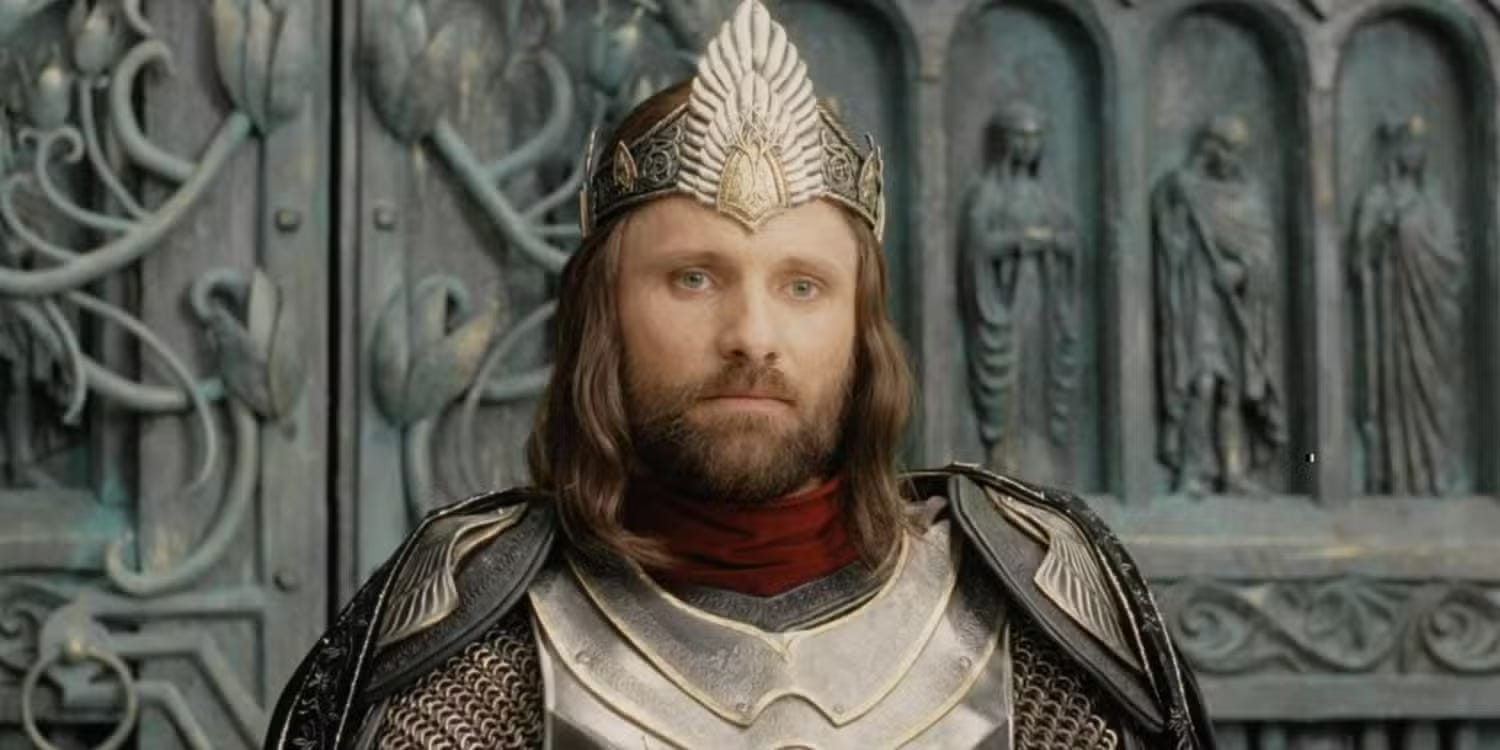
When J.R.R. Tolkien concluded The Return of the King with the destruction of the One Ring and Aragorn’s coronation, readers assumed the story of Middle-earth had reached its natural end. The Professor himself seemed to agree, writing to his publisher Sir Stanley Unwin in September 1950 that the work “concludes the whole business – an attempt is made to include in it, and wind up, all the elements and motives of what has preceded: elves, dwarves, the Kings of Men, heroic ‘Homeric’ horsemen, orcs and demons, the terrors of the Ring-servants and Necromancy, and the vast horror of the Dark Throne.”
Yet Tolkien did begin a sequel. He wrote approximately 13 pages before abandoning it entirely. That fragment, titled The New Shadow, offers a glimpse of what the Fourth Age might have been, and why Tolkien decided some stories are better left untold.
What Tolkien Wrote

The manuscript, published as chapter sixteen of The Peoples of Middle-earth, is set during the reign of Eldarion, son of Aragorn and Arwen. The timeline shifted during development, but Tolkien ultimately placed the events 100 years into Eldarion’s reign, or approximately 220 years into the Fourth Age.
The story opens by the Anduin River below Minas Tirith. An old man named Borlas, son of Beregond (the guard captain assigned to Pippin during the War of the Ring), speaks with a younger man named Saelon. The great events of the Ring War have faded into legend. Elves haven’t been seen in living memory. Hobbits are stories told to children. It is the Age of Man, and Men have grown restless in their peace.
Borlas and Saelon discuss the nature of evil—specifically, a growing darkness in the hearts of Men. Saelon recalls how Borlas once scolded him as a boy for stealing apples and damaging trees, calling it “Orcs’ work.” The word fascinated the young Saelon. The harsh correction angered him.
“Don’t speak to me of orc’s work, or I may show you some,” Saelon says. “You turned my mind to them. I grew out of petty thefts … but I did not forget the Orcs. I began to feel hatred and think of the sweetness of revenge. We played at Orcs, I and my friends, and sometimes I thought: ‘Shall I gather my band and go and cut down trees? Then he will think that the Orcs have really returned.’”
They speak of Herumor, leader of a cult called The Dark Tree that worships Sauron and Melkor. Unrest is spreading. There is discontent with Eldarion’s reign. Ships have gone missing. Borlas’ son is away at sea.
Saelon makes a mysterious invitation: if Borlas will return to this spot tonight clad in black, he will learn everything.
The fragment ends with Borlas returning to his home. In Tolkien’s words:
“The door under the porch was open; but the house behind was darkling. There seemed none of the accustomed sounds of evening, only a soft silence, a dead silence. He entered, wondering a little. He called, but there was no answer. He halted in the narrow passage that ran through the house, and it seemed that he was wrapped in a blackness: not a glimmer of twilight of the world outside remained there. Suddenly he smelt it, or so it seemed, though it came as it were from within outwards to the sense: he smelt the old Evil and knew it for what it was.”
Why Tolkien Stopped

In a letter to Colin Bailey dated May 13, 1964, Tolkien explained his decision:
“I did begin a story placed about 100 years after the Downfall, but it proved both sinister and depressing. Since we are dealing with Men it is inevitable that we should be concerned with the most regrettable feature of their nature: their quick satiety with good. So that the people of Gondor in times of peace, justice and prosperity, would become discontented and restless – while the dynasts descended from Aragorn would become just kings and governors – like Denethor or worse. I found that even so early there was an outcrop of revolutionary plots, about a centre of secret Satanistic religion; while Gondorian boys were playing at being Orcs and going round doing damage. I could have written a ‘thriller’ about the plot and its discovery and overthrow – but it would have been just that. Not worth doing.”
Eight years later, fifteen months before his death, Tolkien returned to the subject in a letter to Douglas Carter dated June 1972:
“I have written nothing beyond the first few years of the Fourth Age. (Except the beginning of a tale supposed to refer to the end of the reign of Eldaron about 100 years after the death of Aragorn. Then I of course discovered that the King’s Peace would contain no tales worth recounting; and his wars would have little interest after the overthrow of Sauron; but that almost certainly a restlessness would appear about then, owing to the (it seems) inevitable boredom of Men with the good: there would be secret societies practising dark cults, and ‘orc-cults’ among adolescents.)”
The problem was fundamental. Tolkien had wrapped up the supernatural elements of his mythology. Sauron was destroyed. The Elves had departed. The magic had faded from the world. What remained was politics, human nature, and the slow corruption that comes from comfort. That wasn’t the story Tolkien wanted to tell.
The Mythology Was Complete

Tolkien’s creative energy remained focused on The Silmarillion, the vast history of the Elder Days that had occupied him since 1917. In a letter dated July 1938, when he was supposed to be writing a sequel to The Hobbit, he admitted:
“…my mind on the ‘story’ side is really preoccupied with the ‘pure’ fairy stories or mythologies of The Silmarillion…and I do not think I shall be able to move much outside it – unless it is finished.”
The Lord of the Rings had been, in many ways, an interruption, a commercially necessary one, but an interruption nonetheless. The Professor’s heart belonged to the First Age, to the Silmarils and the fall of Gondolin, to Beren and Lúthien and the great music of the Ainur. The Fourth Age offered no such mythic resonance.
In his epic letter to Sir Stanley Unwin dated September 14, 1950, Tolkien described The Lord of the Rings as concluding “the whole business.” He had achieved what he set out to do: create a mythology for England, trace the rise and fall of great powers, and show how even the smallest and humblest could change the world. The story was complete.
What Could Have Been
The fragment of The New Shadow suggests Tolkien was grappling with a profound theological and philosophical problem: what happens after the great victory? How do Men, left to themselves without the guidance of Elves or the threat of a Dark Lord, maintain the good they’ve achieved?
His answer was pessimistic. They don’t. They grow bored. They romanticize the very evil their ancestors died to defeat. Gondorian boys play at being Orcs. Secret cults worship Sauron. The peace Aragorn established becomes, within a century, a source of discontent rather than gratitude.
This wasn’t a new theme for Tolkien. The entire history of Middle-earth is one of decline—from the perfection of Valinor to the fading magic of the Third Age. But The Lord of the Rings had ended on a note of hope, of eucatastrophe (Tolkien’s term for the sudden happy turn in a story). To immediately follow that with another fall felt like a betrayal of what the Ring War had accomplished.
In a letter to Miss J. Burn dated July 26, 1956, Tolkien made a crucial observation about the nature of evil in his world:
“No, Frodo failed. It is possible that once the ring was destroyed he had little recollection of the last scene. But one must face the fact: the power of Evil in the world is not finally resistable by incarnate creatures, however good.”
This was the theological reality Tolkien couldn’t escape. Evil would return. Not in the form of another Dark Lord—he was clear about that. In a letter to Robert Murray dated November 4, 1954, he wrote:
“…for of course the Shadow will arise again in a sense (as is clearly foretold by Gandalf), but never again…will an evil daemon be incarnate as a physical enemy; he will direct Men and all the complications of half-evils, and defective-goods, and the twilights of doubt as to sides, such situations as he most loves.”
This was the story The New Shadow would have told: evil returning not as a great external threat, but as corruption from within. Men turning against themselves. The slow rot of civilization from comfort and complacency.
It would have been a powerful story. But it wasn’t the story Tolkien wanted to tell.
The Silmarillion’s Shadow
Reading Tolkien’s letters from his final years is heartbreaking for anyone who loves his work. After his retirement and the death of his wife Edith in 1971, he desperately tried to find time to collate the materials for The Silmarillion. He despaired he would ever accomplish it.
The book had been rejected by publishers for decades. It was too dense, too technical, too full of difficult names and genealogies. It read like a history textbook rather than a novel. But it was his life’s work, the foundation upon which everything else was built.
The Lord of the Rings had been written, in part, to make The Silmarillion publishable. Tolkien hoped the success of the Ring story would create demand for the deeper mythology. It did, but not in the way he hoped. Publishers wanted more hobbits, more adventures, more accessible narratives. They didn’t want the Quenta Silmarillion.
A sequel to The Lord of the Rings would have been commercially successful. Tolkien knew this. But it would have taken time and energy away from the work he actually cared about. And for what? To write a thriller about political intrigue and cult activity in Gondor? That wasn’t why he created Middle-earth.
The Age of Men
There’s a deeper reason The New Shadow couldn’t work. Tolkien’s mythology is thematically about loss: the fading of magic, the departure of the Elves, the end of the great ages of wonder. The Fourth Age is the Age of Men, and Men in Tolkien’s world are fallen creatures, prone to corruption and quick to forget.
The beauty of The Lord of the Rings is that it ends before we have to watch that decline. We see Aragorn crowned, the Shire restored, the Fellowship honored. We don’t see Aragorn grow old and tired. We don’t see his descendants become “just kings and governors, like Denethor or worse.” We don’t see the people of Gondor forget why the War of the Ring mattered.
The New Shadow would have forced us to watch all of that. It would have shown us that the victory was temporary, that human nature doesn’t change, that even the greatest sacrifices are eventually forgotten. That’s true to Tolkien’s worldview. He was a Catholic who believed in original sin and the fallen nature of Man. But it’s not a story that honors what Frodo, Sam, Aragorn, and the rest accomplished.
In a letter to W.H. Auden dated May 12, 1965, Tolkien wrote:
“I don’t feel under any obligation to make my story fit with formalized Christian theology, though I actually intended it to be consonant with Christian thought and belief.”
The Christian story ends with redemption, with the promise of restoration. The Lord of the Rings ends with that same promise, the King has returned, the land is healed, the darkness is defeated. To immediately follow that with another fall would undermine the mythic power of that ending.
What Remains
The New Shadow exists as a fragment, a glimpse of what might have been. It’s been analyzed, speculated about, and expanded upon by fans who wonder what Tolkien would have done with Herumor and the Dark Tree cult, with Borlas and Saelon, with the missing ships and the secret societies.
Some argue Tolkien was wrong to abandon it. That the story of how civilizations decline, how people forget their own history, how evil returns in new forms. It’s a story worth telling, especially now. That The New Shadow could have been Tolkien’s meditation on the 20th century, on how quickly the lessons of one war are forgotten before the next.
Others argue he was right. That some stories are better left untold. That the power of The Lord of the Rings lies partly in where it ends, in the hope it offers, in the sense that this victory, at least, was real and lasting. That we don’t need to see it tarnished.
What’s clear is that Tolkien made his choice. He had limited time and energy, and he chose to spend it on The Silmarillion, on the stories of the Elder Days, on the mythology that had consumed him for fifty years. The New Shadow was set aside, and Middle-earth’s Fourth Age remained largely unexplored.
In the end, perhaps that’s fitting. The Age of Men was always meant to be our age, the age without magic, without Elves, without the clear presence of the divine. Tolkien gave us the mythology that led to our world. He didn’t need to show us the transition. We’re living it.
What do you think? Should Tolkien have continued The New Shadow, or was he right to leave the Fourth Age unexplored?
If you’re interested in a fun fantasy world, read The Adventures of Baron von Monocle six-book series and support Fandom Pulse!
Tolkien was wise enough to realize that not every story needs a sequel--if only modern Hollywood could learn from his example...
Well, the main reason Silmarillion was not finished by JRRT himself was because he - self-admittedly - was always distracted by things in the passages already written; sitting down to do some work on the story, finding an older sheet of paper and starting to re-write parts of what had been written earlier... He too easily dived into these opportunities to explore previous segments in new detail or because he no longer accepted his previous linguistic elements and started to correct them. And then also because he was easily distracted by mundane aspects of life, among them letters.
But I do not agree with what is written in the "Age of Men" segment above. The fall of men was at the heart of JRRT's entire work. It is not about it only happening after Aragorn's death - it started long before and the exceptions like Aragorn were too few for mankind to resist. Númenor is probably the most prominent example of how even the best of mankind could (and inevitably would) fall without connection to Eru and to the Valar and their guidance.
However, it did not start with Númenor, either. The Akallabêth is merely the Atlantis of Arda, fuelled by the fall of men. But from the very beginning when the Edain (men) awoke, there were some who more readily listened to Melkor's words. He turned the Gift of Men (death) against mankind and Eru's design, by corrupting what initially had been their special destiny, unknown to anyone but Ilúvatar himself and only granted to the second-born; and because of this, they were not shackled to Arda like the Eldar, but offered something more and not of the mortal world. Melkor twisted and darkened this unique gift and since then, men dreaded it.
So the fall of men was there from the very first moments, it was just that they at first had sufficient strength and number of faithful to resist the civilisational decline. But over time, their strength began to wane and after Aragorn, the heroic faithful were history.
If anything, the continuation would have been about the gradual corruption through mundane everyday mechanics, through unremarkable processes, the endless insidious inflow of poison, unnoticed by any but the most observant - and the obstinate refusal of the masses to see what's happening to them. That's not much of an epic story material, even if it is closer to how these forces operate in our world...