


Over the past two decades, the term “cancel culture” has become a fixture of public discourse, often invoked with a tone of lament or outrage. Some may have you believe it isn't real while others would have one understand it as a progressive phenomenon, a tool of the Left that has been used to silence dissent and enforce ideological conformity. This understanding is historically shallow.
Cancel culture is not a modern invention of the Left. Instead, it is a mechanism long employed by the Right and rooted in a tradition of moral enforcement and reputational control. What we are witnessing today, after the death of Charlie Kirk, is not an ironic twist of the Right utilizing a Leftist tactic, but the return of an old tactic to its rightful owners. Yes, indeed, the Right is reclaiming a tool it once wielded with confidence, before its political proponents gave up the ability to articulate moral arguments with clarity and conviction.
The Conservative Origins of Cancellation
Long before the rise of social media, the Right had long since engaged in practices that bear all the hallmarks of what we now call cancel culture.
The early modern Inquisitions, especially the Spanish and Roman branches, both punished heresy and institutionalized censorship as a spiritual duty. With the rise of the printing press, the Church responded by formalizing the Index Librorum Prohibitorum, a catalog of forbidden books. These included not only theological dissent but also works by Roman Catholic thinkers whose ideas were deemed speculative or destabilizing.
By the late 16th century, the Inquisition had developed a dual system: books to be banned outright, and books to be expurgated (edited to remove dangerous content.) The destruction or alteration of texts was framed as a defense of truth, a liturgical act to preserve unity and moral order. The parallels to modern cancel culture are striking. What we now call “deplatforming” is, in reality, a form of excommunication.
Skip forward into the 20th century. In 1934, amid growing concern over Hollywood’s moral influence, Archbishop John T. McNicholas founded the National Legion of Decency. Its mission was to classify films according to their moral acceptability and mobilize millions of Roman Catholics to boycott those deemed offensive. The Legion developed a system of ratings: A for acceptable, B for objectionable, C for morally condemned. This had real economic power; for a “C” rating could doom a film’s box office prospects. Studios also often edited scripts and reshot scenes to appease the Legion’s standards. Films that addressed taboo subjects such as drug use, sexuality, or venereal disease were condemned, not for their intent, but for their perceived effect on the viewer’s soul. The Legion’s influence extended beyond Catholic audiences, shaping the moral contours of American cinema for decades.
This was cancel culture in its purest form: reputational control enforced through moral classification. The Legion helped shaped content and therefore helped shape culture. It did so with the full weight of religious authority and cultural influence.
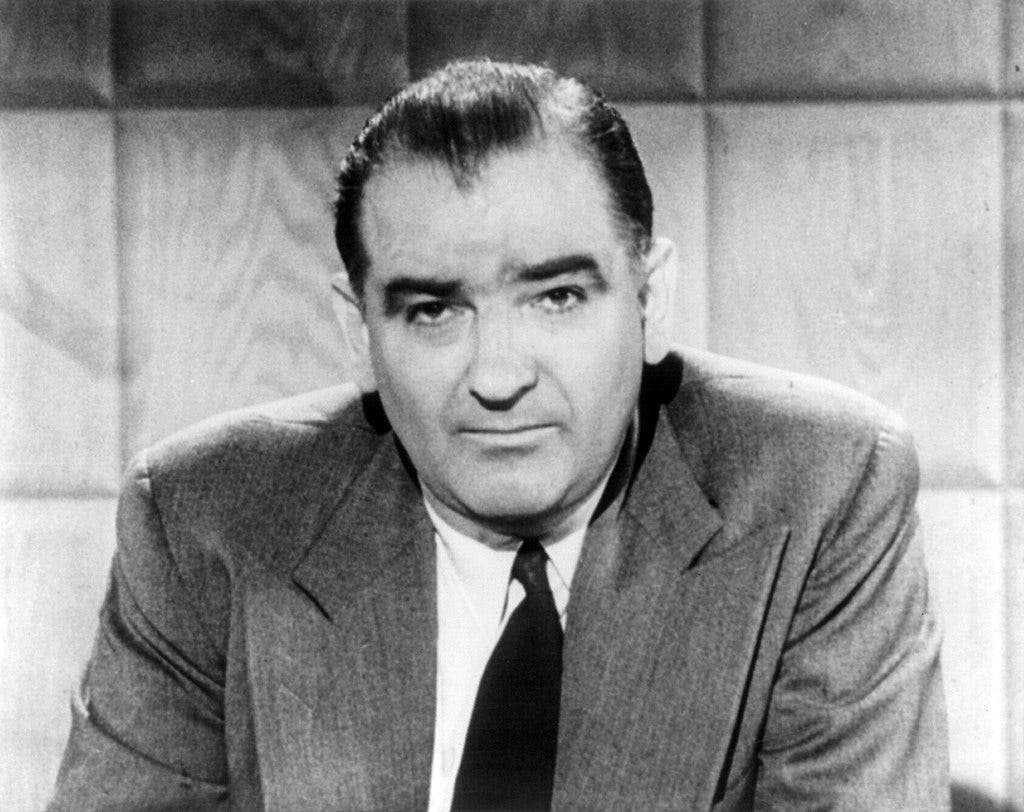
The McCarthy era also offers a vivid example. In the name of national security and moral purity, suspected Communists were blacklisted, their careers were destroyed, and reputations were ruined. These actions were expressions of a broader conservative impulse to protect the moral fabric of society through exclusion and punishment.
Another example of cancelation are the Nazi book burnings of 1933. These went beyond a simple act of censorship, but were transformed into a public liturgy of purification. The German Student Union, with support from the Propaganda Ministry, orchestrated ceremonial burnings of texts deemed “un-German,” including works by Jewish, Marxist, and liberal authors. These events were carefully staged, with fire as a symbol of moral cleansing and national renewal.
Were you ever told what books the Germans burned? Among the destroyed works were texts by Magnus Hirschfeld, whose Institute for Sexual Science housed pioneering research on homosexuality and gender identity. Freud’s psychoanalytic writings were also targeted and even allegorical fiction such as Felix Salten’s Bambi was burned, interpreted as subversive to the regime’s ideological purity. These acts were expressions of a regime that understood the symbolic power of cultural exclusion. Ideas shape souls, and the control of narrative is the control of destiny.
This history reveals that cancelation, in its most extreme form, has always been about controlling the imagination. Whether through fire or social media, the destruction of reputational capital is a performance of virtue.
The Left’s Co-option
Unfortunately, in recent decades, the Right has grown morally inarticulate. Within this vacuum, the Left was allowed to appropriate the tools of cancellation and infuse them with a new moral vocabulary. So we saw ideals such as Social Justice, and Identity Politics which became the watchwords of a progressive cancel culture that sought to expose and punish the common folk.
It should also be noted that this shift did not alter the mechanics of cancellation. Public shaming, employer pressure, and reputational destruction have remained central. What changed was the emotional register. The Left moralized cancellation through the lens of victimhood. The spectacle of harm replaced the argument for virtue.
The Reclamation of Moral Authority
The assassination of Charlie Kirk has catalyzed a new phase in this evolution. The Right is no longer content to decry cancel culture as a progressive excess. It is now reclaiming it as a legitimate tool of moral enforcement. Those who mock Kirk’s death are being targeted with the same tactics once condemned: calls for termination, social media campaigns, and state investigations.
This is not hypocrisy. It is a reassertion of moral authority. The Right is rediscovering the power of reputational control, not as censorship, but as a defense of civic virtue.
What we are witnessing is not merely a tactical shift. It is a transformation in the politics of persona. The Left has built its moral identity around Cultural Marxism. The Right is now constructing its own around traditional values. Cancellation is being wrested from the hands of the Left and becoming, once again, a rite of sanctification.
To understand cancel culture is to understand the history of moral enforcement. The Left may have rebranded it, but the Right built it. So, make no mistake, what you are seeing now is not a contradiction, but a return. Cancellation was never progressive; it was conservative and righteous. And now, it is being returned to the service of those who first forged it.
NEXT: iHeart Radio Political Commentator Keith Olbermann Wishes Charlie Kirk Burns In Hell

Except McCarthy was right. About everything.
Boomer-tier understanding of history. Watch Razörfist's video Joe McCarthy: Martyred by Marxism and educate yourself.
https://www.youtube.com/watch?v=BgUVL5v1aAc