


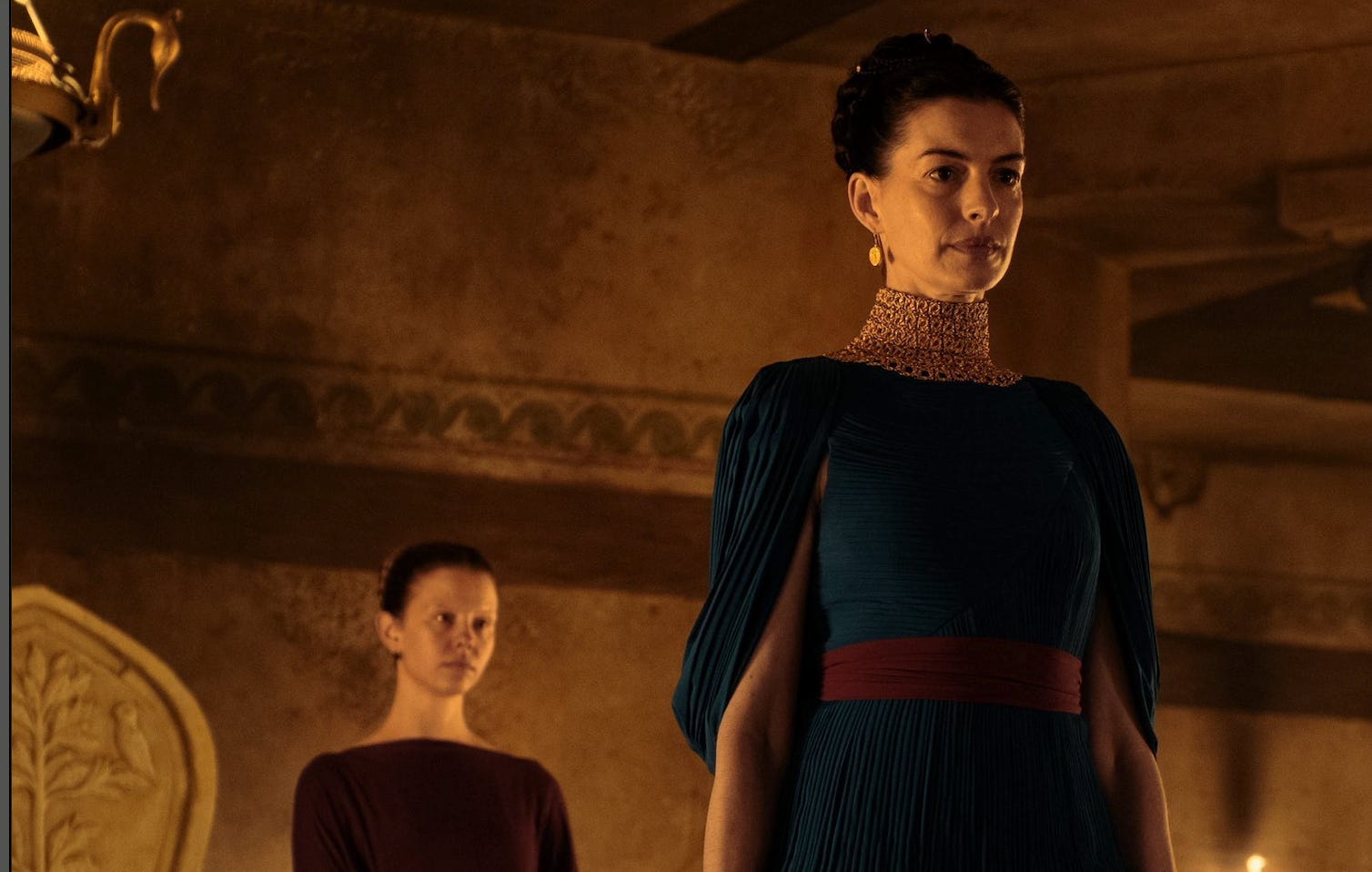
Christopher Nolan’s The Odyssey opens July 17. The press cycle is underway, and the two biggest female cast members spent this week explaining how their characters differ from the source material while dismissing the audience that objects.
Anne Hathaway plays Penelope. In Homer’s Odyssey, Penelope is the model of wifely virtue. She waits faithfully for her husband for twenty years, refuses the advances of 108 suitors, and maintains her household against sustained pressure through patience and loyalty. Homer presents her as Odysseus’ equal not because she is secretly furious, but because faithfulness and constancy are themselves heroic qualities in the world the epic describes. Penelope is admirable precisely because she does not explode. She endures. That is the point.
Hathaway’s description of the character from Nolan’s script: “There’s this impression of Penelope that she’s kind of the picture of modesty. She’s the picture of patience. And I said, ‘Chris, if I’m not mistaken, you’ve written someone who is full of fury and you seem to be implying that she’s actually Odysseus’ equal.’ I found her to be this volcano of a human that was always simmering. It was really fun when she finally exploded.”
The framing here is worth examining. Hathaway describes patience and modesty as an “impression” — a surface misreading of a character who is secretly seething underneath. The fix Nolan provides is rage. The volcano. The explosion. Hollywood in 2026 cannot write a virtuous woman without converting her virtue into suppressed anger, because a woman who is simply faithful and patient is not a character the industry knows how to sell. Penelope’s loyalty to Odysseus is not a trauma waiting to detonate. It is a moral choice freely made and heroically sustained across two decades. Replacing it with fury is not a deeper reading of Homer. It is the industry’s standard operation applied to any female character whose defining quality is devotion rather than grievance.

Meanwhile Lupita Nyong’o, cast as Helen of Troy, addressed the sustained criticism of her casting this week in Elle. “This is a mythological story,” Nyong’o said. “I’m very supportive of Chris’s intention with it and with the version of this story that he is telling. Our cast is representative of the world. I’m not spending my time thinking of a defense.”
She added: “I can’t spend my time thinking about all the people who still don’t love me. You’ll find the representatives who believe in you, and you’ll get on with it. I want to believe I’m built to last.”
Nolan explained his casting rationale: “The strength and the poise were so important to the character of Helen. And Lupita makes it look effortless.” Asked about Helen being known for her beauty, Nyong’o said: “You can’t perform beauty.”

The “mythological story” defense is the standard response to casting criticism and it does not survive examination. Mythology is not a blank canvas onto which any culture can project itself. The Greek myths are the foundational literature of a specific civilization, produced by a specific people, describing their gods and heroes in their own cultural image. Helen is described by Homer as fair-skinned and golden-haired. She is the most celebrated beauty in Greek mythology specifically because she embodied the Greek ideal of female beauty. Nolan filmed on location at Acrocorinth, Pylos, and Methoni with over six million euros in Greek state funding. Greece funded the replacement of its own mythological heritage.
Elon Musk posted: “I agree that she is beautiful, but casting a Black woman to play a white woman in a foundational work of European literature is no more right than casting a white man to play Shaka Zulu.” The comparison is logically consistent. The press treated it as evidence of racism.
Nyong’o plays two roles: Helen of Troy and her sister Clytemnestra. The full cast includes Matt Damon as Odysseus, Tom Holland as Telemachus, Zendaya as Athena, Charlize Theron as Circe, and Elliot Page reportedly as Achilles.
Two things are happening simultaneously in this film’s press cycle. The female characters are being remade to remove their traditional virtues where Penelope’s faithfulness becomes rage, Helen’s specific beauty becomes a casting abstraction, and the audience that notices is being labeled racist and retrograde for noticing. The film that took Greek funding to shoot on Greek soil opens in eight weeks. The Greeks whose mythology is being revised funded it themselves.
What do you think Nolan’s Odyssey will look like compared to the source material? Let us know in the comments.
Epic Fantasy hasn’t been this hard-hitting since Tolkien. In a world where humanity is akin to a Roman legion, a great darkness arises. Read A Throne Of Bones today.
NEXT: The Mandalorian and Grogu Opens to $12M Thursday Previews And Fans Are Divided
These people are so out of touch. Keep making Us the enemy it will backfire. After all YOU PEOPLE ARE ALSO COMPLAINING ABOUT LOSING YOUR JOBS at the same time you do dumb stuff like this whilst telling customers to go f__ themselves. How'd that work for everyone else? Nolan isn't infallible or invicible like people keep saying. Thats turning a mere Mortal man into some type of God which he isn't. Thats IDOLTRY. Hollywood is the midst of serious restructuring and job losses plus piled up with growing mountains of unsustainable Debt fancing serious competetion from world entertainment and every day folks with a webcam. Hollywood can't afford to piss off people when they need the money, engagement and butts in seats. They mistake bad publicy and attention it generates for actual return on investment thinking it'll put butts in seats it won't and hasn't. Shaming people stopped working in 2016. Hollywood is clearly in a Death Spiral with no idea how to get out of it (talented, sane voices long since banished) except to just double down and brute force themselves to victory. Which why they can't understand why it fails.
Hollywood reputation is in the toilet even if this movie succeeds. More people have seen the tactics used in plainsight and more will not be falling for it next time. Hollywood is destroying itself refusing to admit it was ever wrong ("We're on the right side of history guys...") whilst blaming EVERYONE ELSE as they burn it all down.
When its gone. Its gone. They won't realise they will get nothing else since the world will have seen in full 4K what happens when you give people like these chances and opportunities. Never forgive, never forget. Only when they stand in the midst of the ashes and ruin of hollywood that they caused looking around in rage and anged shouting "You made us do this, bigots." They will realise too little, too late the chuds and the world shrugs their collective shoulders, says "Who carres?" and carries with life as they are left with NOTHING. Cutting off the nose to spite the face, so to speak.
The access media is the modern day ‘Pravda’. Because all they do is attack moviegoers. And it’s the same aging millennials, who just won’t let go of the torch, and give it to mid to late Gen Z.