


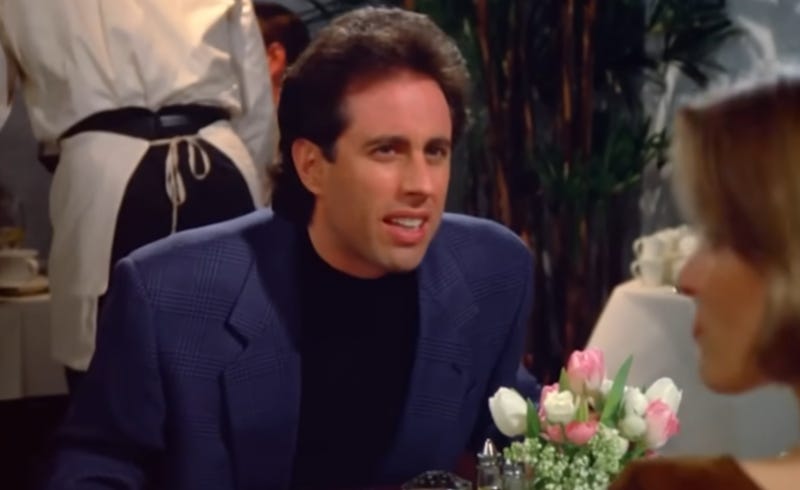
I was scrolling through YouTube Shorts when a clip from Seinfeld surfaced. Jerry is at a rental car counter, confronting a woman about a missing reservation. The joke, as millions have laughed along with for decades, is simple: the company “knows how to take the reservation, they just don’t know how to hold the reservation.” Cue the audience laughter. But what struck me wasn’t the punchline, it was the whole posture.
Jerry wasn’t just making a funny observation. He was berating a woman. He was mocking her and making himself look superior to her under the guise of being clever. There was no empathy here, just a man using language as a scalpel to humiliate someone who could not nor would not fight back.
And the audience loves it.
Mockery, not Comedy
A lot of modern comedy is not comedy. It is straight mockery. In the case of Seinfeld much of what is enjoyed is reveling in Jerry’s cruelty through wit.
Think of Jerry’s classic “What’s the deal with airline food?” quip. The line is a microcosm of an ethos. The entire substance of this “joke” is contempt disguised as wit. Jerry is mocking service workers and the airline industry and what makes it “funny” is the smugness behind the observation.
In short, I think this helps me narrow down a fundamental problem with most if not all stand-up comedy: a lack of consequence. The comedian is insulated by the stage and armed with narrative control. What is essential here is that his performance carries some kind of moral weight which entails he must willingly turns the lens inward. He must, at some point, become the butt of the joke. Otherwise, the act becomes little more than a public berating of those deemed beneath him, cloaked in cleverness but hollow in posture.
This is the problem with Seinfeldian comedy. Jerry elevates himself by diminishing and degrading other people. Everyone and everything becomes a buffet of mockable artifacts to ridicule from one’s high horse.
How Satire Should Work
Mind you, I understand how this brand of humor works. Or, at least, I understand how it ought to work. We call it “satire.” But crucially, satire is not just mockery. It’s not just a series of insult or derision. What distinguishes satire from cruelty or quarrel is that it:
Targets systems, not just individuals: It critiques institutions and ideologies and not just people for their own sake.
Operates from a moral vantage point: Even when irreverent, satire implies a proper standard ought to be held.
Uses wit as a scalpel, not a club: It dissects rather than bludgeons. It invites the audience to see through the absurdity, not just laugh at it.

Consider Blackadder, Rowan Atkinson’s masterwork of historical satire. His character is snarky, manipulative, and often cruel; but he is also vulnerable. His rudeness belies his cowardice. In the end, his schemes unravel and Karma always comes calling.
In Blackadder, wit is a weapon but it’s not a shield. The humor is sharp, but it’s tethered to consequence. Often Blackadder’s arrogance is punished and his cleverness is undone because the writers understood that without moral weight, satire just collapses into theatrical contempt.
Seinfeld offers no such reckoning. In the beforementioned skit, Jerry mocks the rental clerk and the audience laughs.
Culture As Seinfeld’s Playground
There’s a rule at the heart of Seinfeld that explains everything wrong with modern media: “No hugging, no learning.” It was Larry David’s creative mandate: no emotional growth, no lessons learned, and no sentimental payoffs. Thus, the characters remain selfish and petty jerks through and through.
The truth is, Seinfeld’s DNA is everywhere. You can find it in the irony-soaked scripts of prestige dramas, in the emotionally-armored detachment of internet humor and in any cultural posturing that treats sincerity as cringe. Seinfeld is postmodern in the purest sense. It is a show that rejects a grand narrative while mocking emotional depth.
This is a template that is echoed in other shows as well such as It’s Always Sunny, Arrested Development, Veep, and Rick and Morty. Even dramas like Succession and Mad Men also echo its ethos: detachment, irony, and dysfunction.
House M.D. is a prime example a a hero that has been rewritten in the Seinfeldian mold. The show reimagines Sherlock Holmes as the brilliant by miserly Gregory House. He is an atheist, a misanthrope, and extremely manipulative; but his genius is framed as justification for his cruelty while his rudeness is passed off as brutal honesty. This is the Seinfeldian inversion of heroism.
Today’s talk show landscape is also saturated with this same Seinfeldian detachment. Late-night hosts rose to popularity because they were considered to be stewards of cultural reflection. Now, however, people like Jimmy Kimmel operate as snark engines recycling the same insults about Donald Trump and the American Right. This further conditions an audience to mock and not to reasoning. Talk Shows have become celebratory takedowns based on contempt.
The cultural saturation of Seinfeld goes beyond media. In fact, it is embedded in academia. At Rutgers Medical School, psychiatry students were assigned Seinfeld episodes as diagnostic case studies. George Costanza was analyzed for narcissistic traits. Kramer was flagged for schizotypal personality disorder. Elaine and Jerry were dissected for emotional detachment. Fictional characters in a scripted comedy were treated as if they were real patients.
Moreover, at the University of Connecticut, law students debated property rights using Seinfeld scenarios. One class analyzed whether George or Mike had legal claim to a parking space, applying real property doctrine to sitcom absurdity.
Indeed, people have unironically used the sitcom as a pedagogical tool for shaping future doctors and lawyers. Indeed, the show’s was used as a framework for understanding human behavior and legal logic.
Culture is Downstream from Narrative
A well-known phrase often attributed to conservative thinker Andrew Breitbart is that “Politics is downstream from culture.” The idea is that culture shapes the values and instincts of a society and that those, in turn, influence political behavior. In other words, if you want to change politics, you have to first change the culture.
What should be added to this is that culture is downstream from narrative or myth. The stories we tell, the heroes that we elevate, and the moral architecture we preserve are what truly shape our culture.
When we elevate people who are quarrelsome by nature, then is it any wonder regular human interactions also become so quarrelsome? Think about how Twitter, Reddit, YouTube, etc. all rewards and incentivizes cynicism. We have gamified the worst attitudes.
Hiding Our Shame in Self-Awareness
Jerry Seinfeld knows he’s being petty but he’s witty about it. It is the key to how not only Seinfeld but perhaps every modern TV show works and has worked. Many modern TV shows are saturated with self-aware characters and meta-humor. This reflects a broader cultural shift toward detachment and irony. Self-awareness shields characters from the moral reckoning of their actions. As such, these shows all convey a very simple message to their audience:
You don’t need to grow or change. You just need to be clever.
Lately I’ve been playing the video game Dispatch. Like so much modern media, its writing feels soaked in the Seinfeld ethos. The game reminded me instantly of Suicide Squad, where the supposed protagonists are all murderers, psychos and narcissists dressed up as antiheroes. The audience is expected to cheer not for their redemption, but for their ongoing snark.
The characters in Dispatch are not heroic in any traditional sense. They are misfits: rude and cruel but also exceedingly self-aware. To some extent, they talk and act in such a way that indicates they know they’re in a story. Their dialogue is less dialogue and more a commentary on tropes. They mock expectations by subverting them and preempt critique by acknowledging their own flaws before anyone else can.
If any of this sounds familiar, the YouTube Channel, ShreddedNerd has made a commentary about in a video entitled “Millennial Writing.” There he remarked on the self-referential perspective rooted in social media trends, including obligatory rather than insightful commentary about politics. He also mentioned how many serious moments are undermined by forced humor or sarcastic quips, a phenomenon referred to as “bathos,” which disrupts emotional impact.
What ShreddedNerd failed to mention is why this is the case.
In the Garden of Eden, the moment Adam and Eve eat from the tree of knowledge, their eyes are opened and they realize they are naked. This goes beyond physical exposure; an existential crisis occurs here where they realize their vulnerability. Their shame is revealed and they immediately try to hide themselves from God.
This is essentially why self-awareness pervades much of modern media. Shame hasn’t changed. What has changed is the manner by which men have sought to hide themselves from God. That is what self-awareness is: a direct method for the writers’ to deal with their own cynicism but also respond to an audience that is just if not more cynical than they are.
You see, when you create something sincere in a cynical age, you are engaging in an act of shame. No, this is not because the work itself is shameful but because you have been trained treat belief itself as naïve. If you write a story that affirms good and evil and fundamentally suggests that God exists and he reigns over all, then you have exposing yourself. Essentially, you are like Adam and Eve, naked in Eden.
We need stories, but we cannot imbue them with meaning outside of God’s divine revelation.
In our time, we seek to cover our nakedness with irony and detachment and therefore writers make characters who quip about their own sincerity as a preemptive strike against an audience prone to scorn.
Self-awareness as a posture is key because it is intended to prevent consequence. If a character is cruel but self-aware, their cruelty becomes a joke. If they are detached but clever about it, the detachment becomes part of their charm. This all flatters the audience into being “in on the joke” because they’ve figured out how media works.
Restoration
One of my favorite comedy films of all time is Groundhog Day (1993), Starring Bill Murray. The movie is about Phil Connors, a cynical and self-absorbed weatherman, who becomes trapped in a time loop where he is forced to relive the same day over and over again. At first, he responds like a Seinfeld character would: he mocks the town and its traditions, he manipulates people, and he exploits the loop for his own pleasure.
But the loop doesn’t break and he remains stuck.

Slowly and painfully, Phil is forced to confront his own emptiness. Only when he begins to serve others (genuinely and without expectation) does the loop finally break. He learns piano. He saves lives. He becomes kind. Not performatively, but truly. And when he finally wakes up on February 3rd, he’s not just free, he is transformed.
Phil is a protagonist who does hug and does learn and does change. Groundhog Day is a comedic parable that reveals virtue as the only path to restoration. The movie is anti-Seinfeld, demonstrating that wit need not come at the expense of compassion. Sharpness without cruelty is possible and irony alone cannot sustain narrative weight.

Well I started out a bit doubtful about your thesis, but you have convinced me otherwise!
I, too, love Groundhog Day!
Any more movies anti Seinfeld?