


George MacDonald was a Scottish minister and storyteller, born in 1824, whose sermons proved too large for the pulpit that first hired him. He left settled congregational life and wrote novels, poems, and fairy tales that treated the unseen world as a place a child could enter and a grown man would leave changed. Phantastes appeared in 1858. At the Back of the North Wind, The Princess and the Goblin, The Golden Key, and Lilith followed. Chesterton, Auden, and Tolkien all drank from that well. C. S. Lewis called MacDonald his master and said those tales baptized his imagination years before his intellect accepted Christian doctrine. From MacDonald came first, Lewis and Tolkien inherited a way of making worlds in which the act speech precedes scenery. A name does the work of creating the person who hears it.
Eugen Rosenstock-Huessy later gave that practice a grammar. He was born in 1888 to a Jewish family in Berlin, trained as a legal historian, served as an officer in the First World War, and entered the Christian church as a young man. After 1933 he left Germany and taught for decades at Harvard and Dartmouth. His books (Out of Revolution, Speech and Reality, The Christian Future, the great sociology gathered under the title In the Cross of Reality) treat living speech as the act that makes society and time. Commands, vows, names, and responses are, in his account, the events that bind a future self to an earlier word. He called the pattern the grammatical method. Man stands at the center of a cross of reality: past as memory, future as destiny, inward as the circle that sings together, and outward as the world that can be pointed to. Formal speech keeps those four fronts alive. Informal chatter is only the leftover of older form. Rosenstock-Huessy never wrote about Narnia, but His importance here is prior to any one book. He names what MacDonald, Lewis, and Tolkien were already doing when they let a voice found a world.
Memory
Netflix’s forthcoming Narnia: The Magician’s Nephew takes that same inheritance and turns it into facsimile with a soundtrack. One kind of work founds a people. while the other occupies a season.
Rosenstock-Huessy held that living speech is formative. A name anticipates a future the named person has yet to possess. A command opens a cup of time the hearer must live through before the event can close in story and harden into fact. A culture that lives on leftovers produces images that blaze and then go dark because nothing in them binds a later self to an earlier word. Culture only stays alive when each generation renews it in living memory. Outsource the memory and the culture withers.
The trouble sits wider than one studio and one lion. Netflix is only the loudest room in a house built for interruption. Every streaming service, every feed, every autoplay queue runs on the same grammar: keep the eye moving so the soul never sits still long enough for anything of substance to take hold. This is what a media of constant distractions does to memory. Nothing stays. An hour can pass through a person and leave the mind as empty as it found it.
Tolkien used leaf-mould as a metaphor for the dark, forgotten layer in a mind from which new stories grow. A Leaf-mould is what you get on a forest floor: dead leaves, piled up, rained on, left alone. They stop being this year’s foliage and become soil. Seeds sink and plants take root in that soil. You never see the oak in any one leaf. You see it in the heap that those leaves became. He said The Hobbit grew that way. It came “like a seed in the dark out of the leaf-mould of the mind.” Everything he had seen, thought, or read, long forgotten, sunk out of sight, still working. This includes languages, northern myth, Warwickshire lanes, war, philology, and nursery tales.
Tolkien’s leaf-mold metaphor needs fallen matter and time in the dark. Leaves have to lie where they drop, but a culture of continuous remake, remixes, and retellings rakes the ground often enough to ensure the mold never thickens. Today’s songs only last a season and the newest shows only last a weekend. The corporate machine continually recreates the image of something but, fundamentally, changes nothing. Then it recreates the recreation, again and again, until the “face” of what it was is gone and only a generic glow remains. That is the industrial form of leftover speech. The Gerwig Narnia film is a symptom of leftover speech.
Yet, modern media is designed to yield before it binds. Deep memory is the enemy of the metric. Therefore, the design works against the designer. A deconstruction that travels by leftover speech can sting for a season. It can trend and teach a weekend’s worth of contempt for an old name, but it cannot lay a foothold in the heart because the same machine that spreads it will bury it. The audience is trained to move on. Therefore, the remix will have its week and be forgotten. Meanwhile, the voice that claimed Lewis through MacDonald will keep speaking.
Speech
MacDonald, Lewis, and Tolkien wrote as if a reader might still be the same person in twenty years, and still answerable to the voice heard in childhood. Their tales address the hearer as he is: A creature already under names, already capable of obedience, and already destined to become someone who will be remembered. The latent commands issue by the works of these men land on a real soul and years later that soul will still be able to answer them.
Progressive preaching works the other way. It speaks past the reader toward a specimen the author prefers: less particular, more corrected, and already revised into the moral fashion the current year demands. That is why the Gerwig operation, and the wider leftover media that will carry it, will fail to hold. You cannot found a people by addressing a future self the present self is expected to discard. Formal speech binds the one who hears it in the here and now. Leftover speech lectures an avatar that expires within the season. The reader who met Aslan at ten and still answers at forty was spoken to as a soul. The campaign that wants him otherwise has to keep talking and propagating because the first word never took.
MacDonald already worked in that order. The wise grandmother in The Princess and the Goblin and The Princess and Curdie speaks as an ancient presence whose thread and fire demand obedience before they yield understanding. The Golden Key sends children after a light they must follow without a map that would spare them the walking. MacDonald’s fairy tales do the work of baptism on the faculty that later receives doctrine. MacDonald’s worlds last because they issue speech that still holds after the book is shut. A grandmother’s thread is a promise across years. A golden key is a vocation. Anodos in Phantastes leaves Fairyland carrying a duty his earlier self would have fled. Each tale has made a different grammatical person.
Lewis took that inheritance and made it explicit in Narnia. The Magician’s Nephew is the book in which the method stands in the open. Aslan sings. “Narnia, Narnia, Narnia, awake. Love. Think. Speak. Be walking trees. Be talking beasts. Be divine waters.” That is imperative speech.
Creation here is a naming. Digory and Polly stand inside a time-cup that will still claim them when Digory is the old professor with a wardrobe in his house. “Once a king or queen in Narnia, always a king or queen” is baptismal grammar. The Deep Magic is law that binds time. Aslan dies under the older word and rises under the newer one. Children receive a vocation they never chose and spend the rest of the series learning how to bear it. Readers who have forgotten the theology will still walk around inside those names. The grammar did its work before the propositions came up for debate.
Tolkien worked the same forge with different tools. The Ainulindalë is speech as cosmogony. True names carry power because they are residue of the first music. Oaths run across ages. Languages make peoples. Middle-earth is a long memory that still issues commands. A reader finishes The Lord of the Rings as someone who has been placed inside unfinished history.
Harry Potter works one register lower and still belongs to the family. “The Boy Who Lived” is a name that creates a destiny. Houses are vocations. The refusal to speak Voldemort’s name and the insistence on speaking it are a lesson in fearful speech versus responsible speech. In the later books Dumbledore keeps trying to finish what the first naming began. “The Boy Who Lived” started Harry’s story as a charge he never chose. By Order of the Phoenix, Half-Blood Prince, and Deathly Hallows, the old man is no longer hinting. He sits Harry down and tells him the hidden plot of the years already spent: Why the prophecy singled him out, what Voldemort did the night Lily died, what the Hallows and the Horcruxes actually are, what Dumbledore himself wrecked with Grindelwald. Those talks in the office, the memory-lessons in the Pensieve, the confession after the cave, and the meeting at King’s Cross are all the same act. He turns a fog of events into a bequest. This is the past you were walking through without a map. This is the piece of it that is now yours to carry. Harry has already lived the interval.
Dumbledore’s last work is to make the interval speakable so that Harry can walk into the forest knowing what his name requires. Thinner metaphysics, but same family of formative speech.
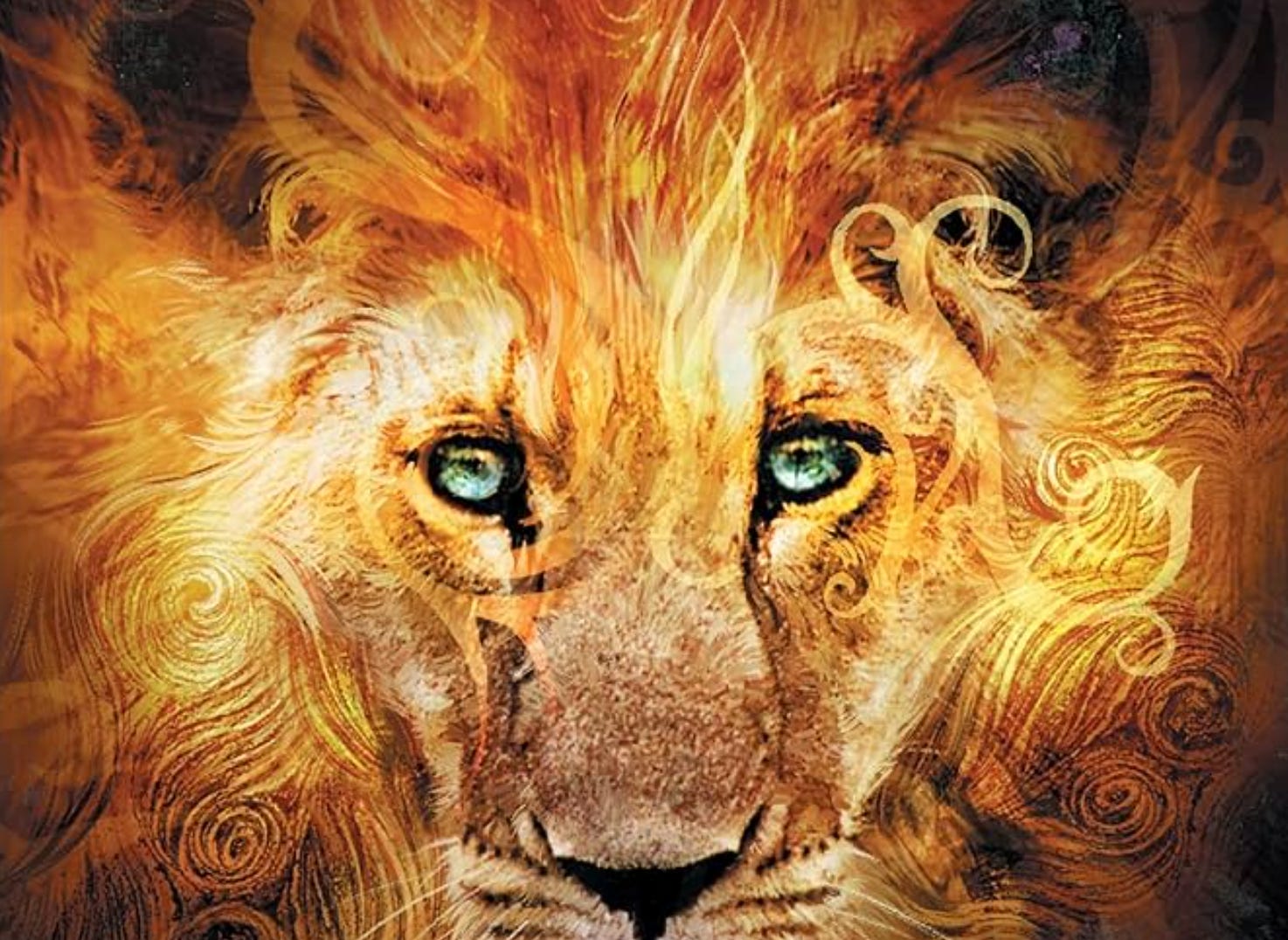
Greta Gerwig’s Narnia: The Magician’s Nephew, set for theaters on 12 February 2027 and Netflix on 2 April 2027, describes a different operation. Empire’s first look gives Aslan heterochromic eyes and a red stripe across the face, an homage Gerwig ties to David Bowie. Meryl Streep voices the lion. For Rosenstock-Huessy that is the decisive cut. Voice is how a world is spoken. Change the speaker and the speech-event has already changed.
Gerwig talked about Streep the way you talk about a great performance: weight without gloom, wisdom that can still sound like wonder, one of the best actors alive. But Lewis did not write a wise animal who just happens to feel sacred. He wrote Aslan as Christ in another world. In The Magician’s Nephew the Christ-figure does the first thing Scripture says God does. “And God said, Let there be light” (Genesis 1:3). “All things were made by him; and without him was not any thing made that was made” (John 1:3). The world is spoken into being by a Word. The whole biblical grammar give that speaker a masculine standing. The Father and the Son are not a casting choice, they are the names the speech already wears.
A female register on that voice is therefore not a bit of unexpected timbre, it puts a woman in the seat of the creating and redeeming Word. The New Testament is blunt about that kind of venue: “Let the woman learn in silence with all subjection. But I suffer not a woman to teach, nor to usurp authority over the man, but to be in silence. For Adam was first formed, then Eve” (1 Timothy 2:11–13). “Let your women keep silence in the churches: for it is not permitted unto them to speak… For it is a shame for women to speak in the church” (1 Corinthians 14:34–35). Those verses are about the assembly where God is proclaimed, not about whether a woman may talk at all. Narnia’s creation-song is that assembly raised to myth. The lion is the preacher, the maker, the slain and risen Lord. Giving that speech a woman’s instrument treats the pulpit of the cosmos as a role up for redistribution.
Gerwig has been clear about the substitute register. She wanted a rock opera. She wanted the film big and transporting. The Beatles, Pink Floyd, The Who, and Led Zeppelin are the groups whose records, she says, once told her she would be okay with Bowie as the face laid over the lion. “Narnia is literally a world made out of music. It is a world sung to life by Aslan, and rock ’n’ roll to me felt like a world made out of music.” Producer Amy Pascal called it a very new take, all about rock and roll. IMAX leadership promised a Narnia unlike the one mothers and grandmothers knew, scored with Pink Floyd and The Doors.
The problem with this is that songs in the tradition of rock and roll rarely end. Instead, they simply... stop. The riff fades, the needle lifts, and the next track starts. Nothing is handed on. The feeling rises, fades, and then it is gone. That is lyric time: the inward pole of the cross of reality, consolation in the present tense. This is not like the music of Christ or, indeed, of Lewis’s Aslan who would speak in the imperative and the vocative. Their speech ends by becoming a burden you still carry into the future. Aslan sings and the world stands up. He dies and rises and a traitor is unmade. A boy who rang a bell in a dead world receives a charge he will bear into old age. That is an ending and an interval that can be told and a people can inherit it.
Death
Lewis’s stepsons once held a family stake in Narnia. They sold that stake back to a company that now manages the estate. These days, books and films are handled by people whose job is to make deals, not to guard a dead man’s theology. Respecting what Lewis said Aslan is can still happen, but it is no longer required. Unfortunately, the contract does not demand it.
Once a story becomes property, a studio can sell “a bold new take” as easily as it can sell a faithful one. Fresh vision is a marketing line. The C. S. Lewis Company has said kind things about Gerwig’s love for the books. But love for a story and submission to its speech are different acts.
As an aside, look at something current: Hazbin Hotel. The show runs the same trick from the opposite door. Whereas Gerwig takes a Christian myth and sands the Word down until a star can voice it, Hazbin Hotel takes the Christian myth and flips everything on its head. The daughter of Lucifer is a would-be savior, Heaven is a cold corporate machine, Hell is full of victims, and redemption is just group therapy and choreography. The old shapes are all still on stage: sin, judgment, mercy, and a cross-shaped hope. What is missing is a voice that arrives before the characters and tells them what they are.
The joke is on the audience. For a great many people this will be the only “theology” they ever meet: a musical in which the Bible is just old stock. It’s funny in an ironic sense, but also bleak: First contact with the Cross arrives already inverted, already insulting, already sure that things like mercy and judgment are just vibes. They will think they have understood Christianity because they have watched someone mock it. And the tragedy is not that the show is rude but that the rudeness is substituting the work of the pulpit and old stories.
Byung-Chul Han, a Korean-German philosopher, keeps writing about what happens to time, story, and ritual once the smartphone becomes our world. The books to read are The Scent of Time, Infocracy, and The Disappearance of Rituals. In The Scent of Time he says we no longer inhabit stories. We inhabit points in time. Digital life chops duration into instants: notifications, clips, updates, the next thing. He calls that a time without aroma. Nothing is allowed to last long enough to become a memory you could hand to someone else.
Infocracy names the political weather of that chopped time. Power no longer needs a long narrative that binds a people. Instead, power relies on a flood of information. Facts, takes, images, and counter-images arrive so fast that no one story is allowed to close. You are informed and exhausted at once. And you are not truly formed by the knowledge, because information is not the same as a story. A tale says: This began, this was required of you, this is now yours. Information says: Here is another item. Now keep scrolling.
The Disappearance of Rituals adds the last piece. Rituals were once used to close time on purpose: the Sabbath, a soccer match, a parade, or a finished play. These events add pauses in daily life and fill an empty space with meaning. Without ritual, everything becomes content. That is the air Gerwig’s Narnia and VivziePop’s Hazbin Hotel both inhabit. A Narnia trailer and a Hell musical both draw from one store of old names, and neither is built to end in a charge you still carry twenty years from now. When every register can borrow the Bible in the same afternoon, the borrowing gets cheaper. The shapes remain, but the command inside them does not.
MacDonald, Lewis, and Tolkien set their worlds in motion by speaking first. A reader is claimed by a name and spends years discovering what the claim required. Adaptations last when they enter that order. The 2027 film can succeed as spectacle, as a Bowie-lit origin myth, as a vehicle for Streep’s instrument. But as Narnia it arrives already late.
When the credits end and the next title is already queued, what still has a claim on you: the lion who spoke a world into being, or the season that borrowed his face?

I'll admit my smooth brain is trying to form a wrinkle following this.
I'm entirely lost on the greater "speech as a predicate of fate" thing, but here's my interpretation of the leaf mould analogy:
A work of genius flowers and inspires many who witness it. Over time, the work ages, withers, and dies. Its leaves and petals fall to the earth.
In a functioning system of fertilization and new growth, the decaying matter would nourish a new work of genius, its roots firmly in the soil of many past such works.
In our current system, where past works are fetishized and new works ignored/underdeveloped, that fertilizing matter, the dried up leaves and dead flowers, are exhumed from the soil, encased in glass, and paraded around to be worshipped.
But the original beauty, which was in the flowering, is long gone, and what is praised now is merely the memory of that flowering.
Meanwhile, the earth is unfertilized and fallow, new works of genius never spring forth.
The past continues to be fetishized, until you reach a point where no one remembers what a fresh and living work of genius looks like. instead, they try to recreate what once was without ever giving a chance to what could be.
And somehow, someone gets a billion dollars to make Rings of Power.
I have long been a fan of Narnia and I enjoy "classic rock," but together? Not so much...