


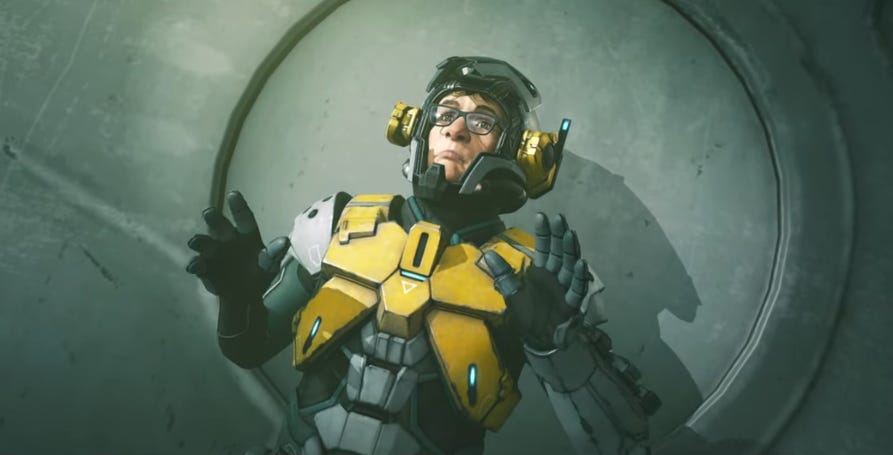
A character named Myles MacKenzie has become the flashpoint in early discourse around Nintendo’s Metroid Prime 4: Beyond. He is a chatty Galactic Federation trooper who accompanies Samus in the opening hours, and his presence has become the test case for whether Metroid can “modernize” without losing its core motif.
Character Overview and Role in the Game
Myles MacKenzie appears as a Galactic Federation trooper who joins Samus during the opening area on planet Viewros. There, he offers tutorial cues and ongoing commentary through exploration and combat. Multiple previews have characterized Myles as a “nerdy,” quippy comic relief presence who is starstruck by Samus and prone to stating the obvious during gameplay. Nintendo’s overview trailer and coverage indicate he’s not the only human companion that Samus meets; she interacts with a wider cast of troopers over early areas which suggests a more populated structure than prior Prime entries.
“It’s about to get reeeal nerdy in here!” — IGN’s hands-on preview describing Myles’ style and role in the opening area.
Why Myles Exists
Early coverage frames Myles as part of a deliberate shift toward modern blockbuster design: companions provide exposition, tutorial scaffolding, and emotional beats that aim to make the game more accessible for new players. Previews and reporting emphasize Nintendo’s ambition to broaden interactions and populate the world with more human NPCs, aligning the series with contemporary expectations around guided, dialogue-forward experiences rather than solitary immersion. Prime 4’s long development, its restart in 2019, and the push to deliver a mainstream holiday release, all supports the inference that Nintendo and Retro Studios were optimizing for broader appeal and onboarding, not just legacy fidelity.

The Backlash
Hands-on previews from major outlets highlight a sharp negative reaction to Myles’ “cringy” incessant chatter, with one reviewer calling him “mildly annoying to downright infuriating,” arguing he undercuts the series’ signature solitude and horror-adjacent atmosphere.
Coverage notes widespread clips and commentary spreading across social media, amplifying concerns that constant banter and overt hints flatten the tension and mystery that Prime traditionally cultivates. Not all responses are uniformly negative. Some writers argue the core gameplay remains strong and that the sidekick may be a contained early-game element. Nevertheless, the discourse is clearly polarized, with anxiety about “procedural drift” dominating the narrative. Meta-discussion pieces and commentary roundups reflect the fan split and frame Myles as a lightning rod for fears that Prime 4’s reinvention sacrifices the franchise’s identity.
The Data-and-Feedback Factor
Industry-facing coverage and preview logic point to familiar drivers behind companion design: playtest feedback about confusion or “getting lost,” retention analytics that treat silence as disengagement risk, and market trends favoring guidance and dialogue to sustain attention amid competition from streaming and social media. The presence of multiple companions, tutorialized banter, and overt hints suggest a design optimized to reduce early friction and keep the players’ screens “alive.” This is a strategy consistent with modern attention-economy pressures and onboarding goals for new players. In short, companions like Myles function as live narrative scaffolding (proxy audience, explainer, and reassurance mechanism) born from measurable retention and accessibility priorities rather than purely creative whim.
The Structural Consequence
Gain: Stronger onboarding for newcomers, clearer narrative context, and alignment with blockbuster expectations of guided play and character-driven
chatter.
Loss: Dilution of Metroid’s mythic solitude and testimonial weight; a shift from environmental inference and silence to overt interpretation, which risks undermining the series’ institutional logic of isolation and consequence.
This is the crux of the backlash: a data-validated accessibility move colliding with the franchise’s foundational aesthetic. Even sympathetic previews acknowledge the tension, arguing the sidekick discourse threatens to overshadow otherwise robust core gameplay.

This has the stink of Other M all over it...
Metroid and Tomb Raider have a very specific ambiance about them: A solitary warrior fights a lonely war against alien & monstrous (for Samus) or animal & supernatural (for Lara) enemies. There are close to zero other humans in the two original games. It's a mood that permeates those games and their art and music. Dumping braindead Hollywood tropes into them will (and for Tomb Raider, did) ruin the aesthetic.
I plan to get it right away. I liked Dread, but the doubts are legitimate, especially because Retro Studios, like Obsidian, has lost important staff and hired questionable personnel. I don't think it will undermine everything, but anything is possible; we must proceed with caution. Additionally, I remember a former YouTuber's warning that the companion mechanic would become abusive. At first, it worked with The Last of Us and Uncharted; in some games, such as Nier, it not only works but also serves to build the lore, but it quickly becomes abusive for genres or stories that didn't require it, such as God of War, and even in Marvel's Spider-Man, they managed to replicate it.
Metroid hasn't had much success in its attempts to be like a film. There's the case of Other M, and while some of the criticism was justified, over time, listening to other critics on the internet, I was left wondering whether they were bothered by the plot, the gameplay, or just the fact that Samus behaved in a somewhat feminine way.