


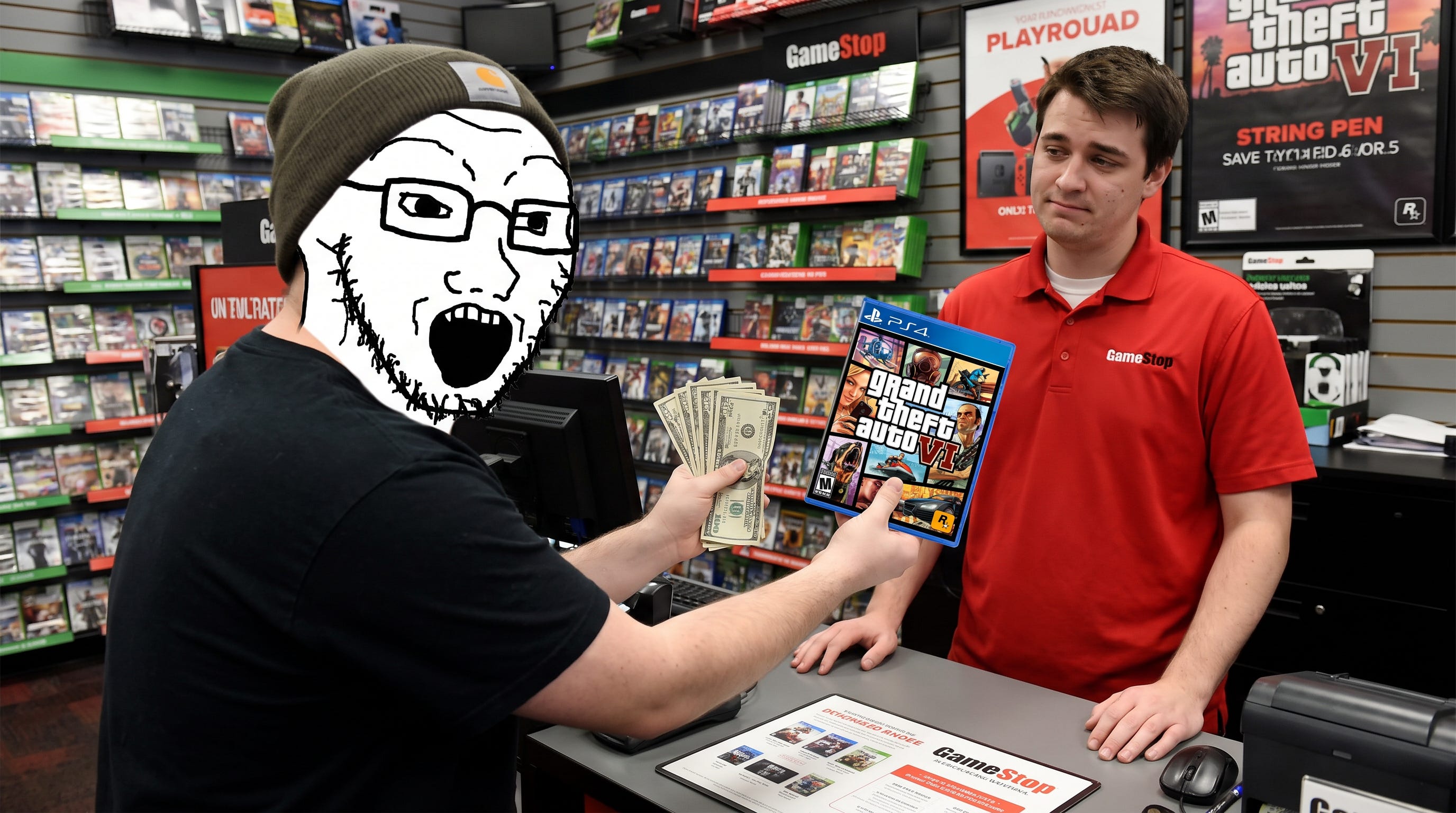
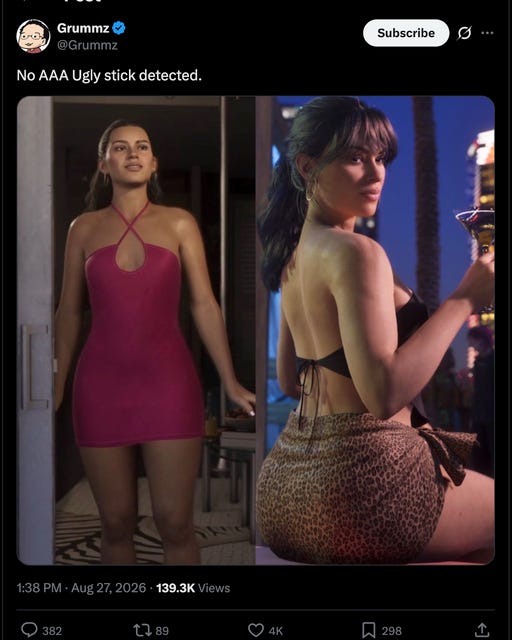
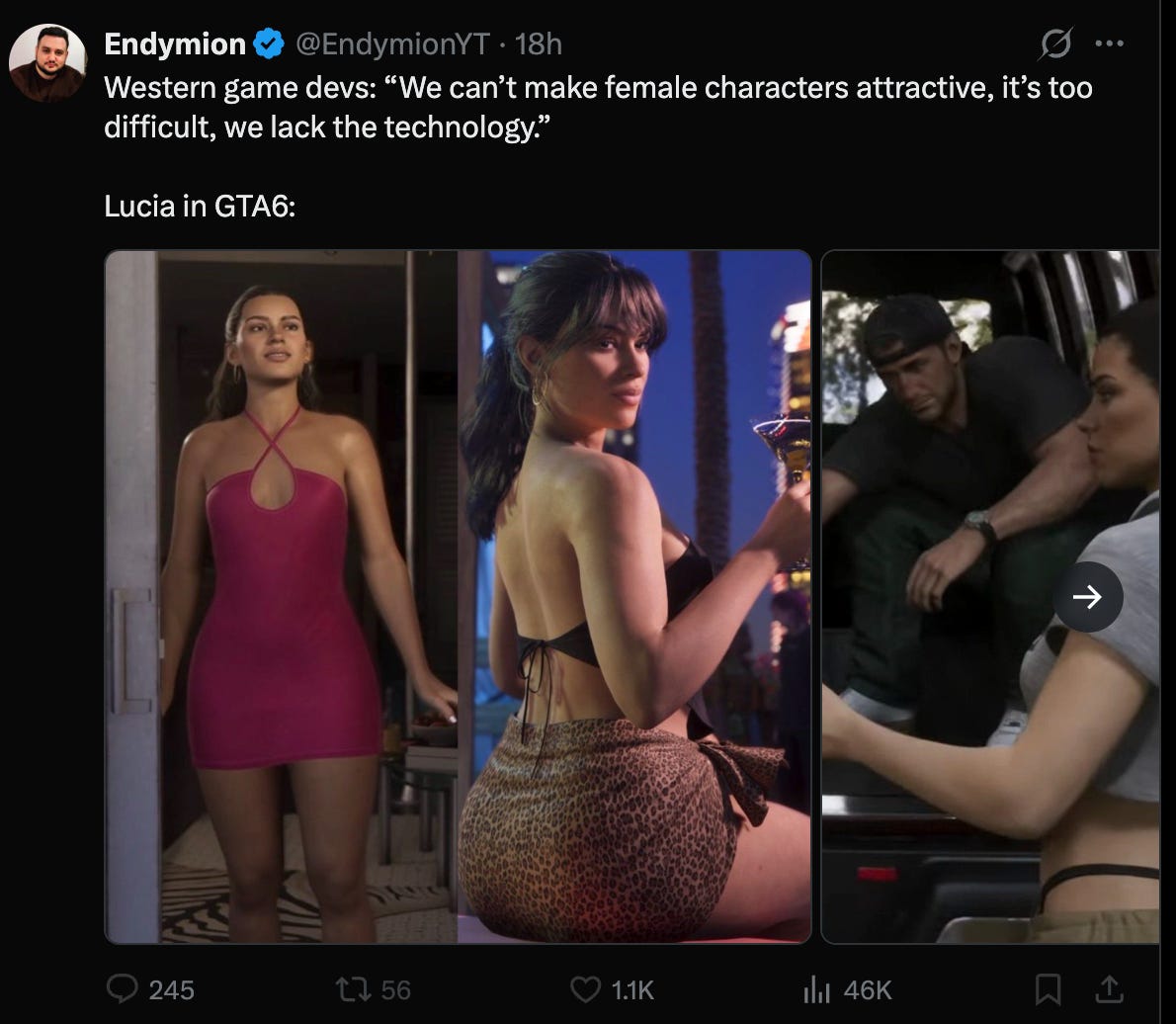
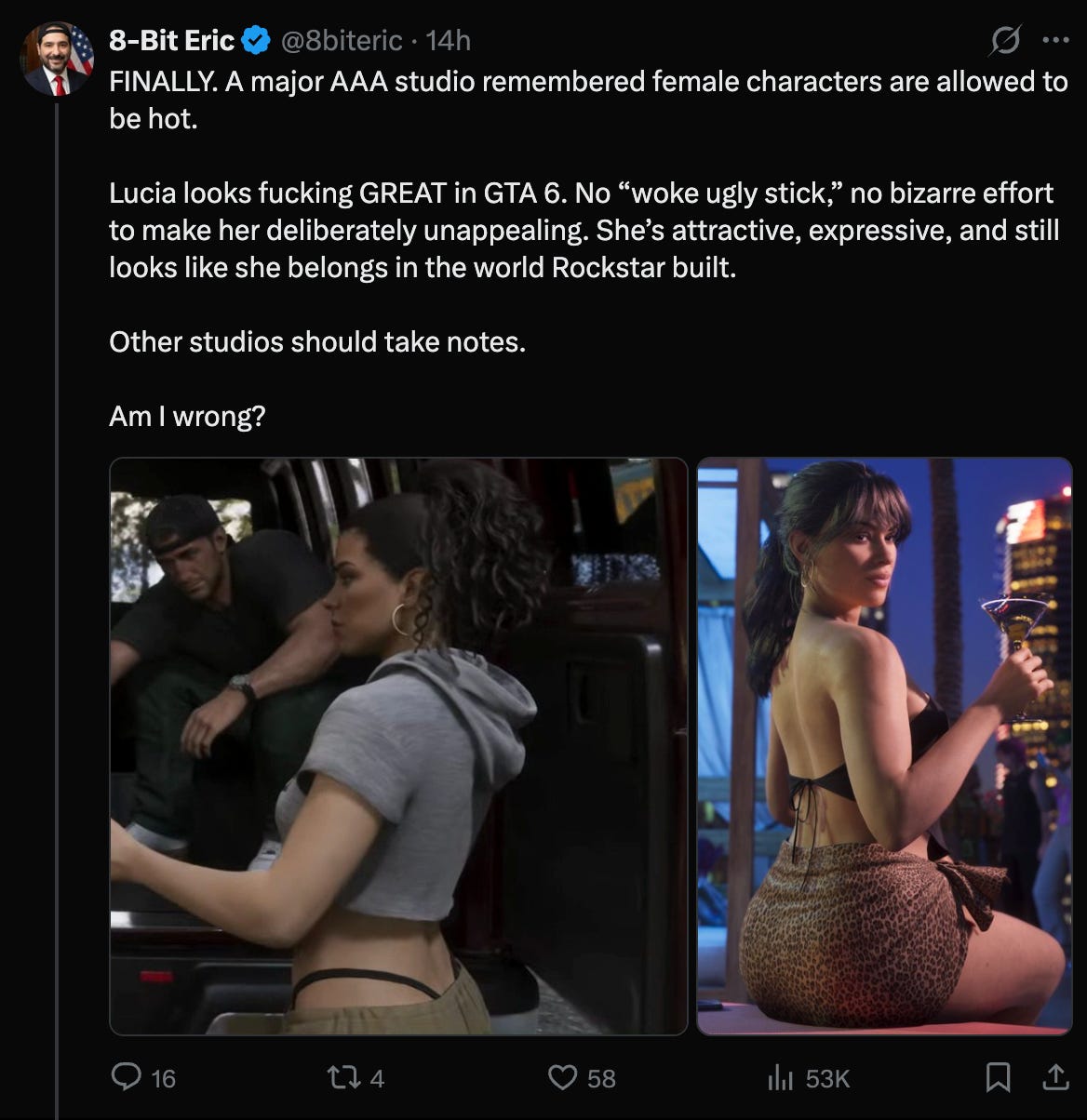
Rockstar dropped twenty-six minutes of Grand Theft Auto VI on Netflix Thursday, then dumped the same reel onto YouTube for everyone who refused to log into a streaming service to watch a video game. By Friday morning, the conversation was not about mission structure, wanted-level design, or whether Leonida still works if you ignore the yellow paint. It was about Lucia Caminos in a pink dress and a leopard wrap.
Grummz posted two stills and wrote, “No AAA ugly stick detected.” Endymion quoted the same images against a familiar Western-dev cop-out: We lack the technology to make women attractive. 8-Bit Eric announced that a major studio had finally remembered female characters are allowed to be hot. “She was never ugly. She looked fine in the gameplay. Other studios should take notes.”
Does anyone remember BuzzFeed? Most people still flinch at the name. Before “slop” and “content mill” became the default insults, BuzzFeed wrote the operating manual: find a face that reads as being in touch with the common viewer, attach that face to a product, and let recognition do the work journalism used to do. The personalities were never the point. The association was.
How many of those faces are still around?
That same machine is running on X and YouTube, only now the hosts have better cameras and worse dignity. A footage drop happens, and the accounts that have spent years turning themselves into brands lunge for the most clip-able frame. Mark Kern can post “no ugly stick” to hundreds of thousands of people and never have to answer a single question about whether the gameplay still functions the way it ought to. And the same circuit of influencers will, weeks after November 19, discover some new way the industry has aggrieved you and ride that for even more clicks.
Whatever the future is for gaming, the current pattern is tiresome: attach yourself to the object everyone is already looking at, extract the most algorithmically feasible position from it, and detach when the object cools. Later, rinse, repeat. The knitting circle congratulates itself for being based and correct. Meanwhile, Take-Two gets a week in which two delays, an $80 price, the physical-media bait-and-switch, the Netflix premiere, and another death-march crunch are treated as unimportant because, “Look! They gave us a picture of Lucia in a wrap skirt!”
Unfortunately, there is no magic wand that removes these grifter accounts from social media. Deplatforming them is a fantasy; their audiences are larger than the audiences of the people who want them gone. What will actually happen is a slow repetition of the same dead takes until the bit consumes itself. Too many hosts will post the same stills, take the same victory laps, and then the next host will eat the last one alive for being insufficiently sincere. This is market glut.
And it won’t even feel like a door hitting anyone’s ass when one person cycles out and some new grifter takes his place. Instead, the feed will simply become worse and worse.
The franchise’s durable promise was never its photorealistic skin. It was that the map would still work, even if you declined to follow the script. You could stand on a corner. You could watch a scene play out without directly joining it. You could fail sideways into a better anecdote than the mission designer wrote. San Andreas and the better stretches of IV and V understood that the player was an agent inside a toybox, not a cursor being walked through a story reel.
While a QTE involving a heel is not the death knell of the series, it is a tell. The studio that sold chaos for three decades now needs a prompt to tell you when to stab a man in the face. That tells you how little it trusts the person holding the controller. And the same footage that launched posts about the end of the “woke ugly stick” also showed the industry’s real house style: high graphical quality paired with a UI that does all the thinking for you. Yellow paint. Giant arrows. Objective text that arrives before the player even has a chance to get his bearings. Corridor segments dressed up as cities.
There used to be a basic assumption in game design, especially in immersive sims like Thief, Deus Ex, and the best levels of Dishonored: you were expected to fucking look around. You walked into a room, and the room itself was the instruction manual. Maybe a note on a desk, a guard complaining to another guard in the hallway, or a locked door made you look for a key, a vent, a balcony, a window, a weak wall, a sewer grate, or some other way around. The environment had logic. Objects had relationships. The game trusted you to notice them.
And if you missed something? You missed it. That was part of the experience.
Now Rockstar, Ubisoft, and Bethesda have spent years training audiences to wait for the next pop-up. Various quest systems do the thinking for you. Press a button and follow the glowing line. Investigate the highlighted object. Can’t figure out where to go? Here is a marker. Look at the magic compass. Listen to the NPC repeat the solution in your ear. Maybe your own character will loudly announce what you need to do every thirty seconds, in case the terrifying experience of being alone with your own thoughts for a moment becomes too much.
Players have been trained, over years and years of design, to stop observing and experimenting. Now they’re just consumers waiting for instructions. A streamer with thousands of viewers will stand in front of an environment absolutely packed with information and conclude that the game has “failed to explain” something because no glowing icon appeared above it. It is impossible to watch the GTA VI trailer and not also see a product repeatedly congratulating itself for being accessible to these kinds of players.
Grand Theft Auto is one of the worst possible series in which to implement these kinds of restrictions because freedom of movement and freedom of refusal are definitive features. Otherwise, you’re just playing a story game inside an extremely expensive parking lot.
Unfortunately, the mainstream discourse isn’t about this anymore. All you see is vocabulary spent on whether a single NPC is ugly or not, a question a thumbnail can answer in an instant. Influencers who live on donation ticks and outrage clips aren’t going to spend a week arguing about whether any other element answers the call to be a video game.
What are you complaining about? Look at the numbers!
The most predictable excuse.
None of what this article portends requires predicting that GTA VI will “fail.” It will sell. Take-Two could print the logo on a brick and people would still buy it. The point is to acknowledge what the industry has become: a series of cultural events with audiences already waiting in line before anyone has properly explained what the thing actually is.
Numbers answer a different question. They tell us how many people bought the game, but they do not tell us whether the game expanded the possibilities of its medium. They do not tell us whether its systems became more interesting, whether its missions trust the player, whether its world invites experimentation, or whether the studio took creative risks proportional to the resources at its disposal.
A billion dollars in revenue cannot answer design questions.
This is where contemporary critical language tends to collapse on social media. People have become extraordinarily good at measuring popularity and strangely uncomfortable discussing artistic or mechanical regression in the medium itself. The game is either a masterpiece or a failure. It either wins or loses, and if it loses, that failure is often attributed to being “woke,” even when it isn’t.
What if GTA VI is technically astonishing and commercially historic, but still represents a retreat in game design?
You won’t hear much about that because that’s not what the industry is about anymore. The larger an entertainment property becomes, the more pressures begin accumulating around it. There are more shareholders and more marketing commitments. There are brand expectations to maintain. More money is at risk, and therefore more consumers must be satisfied. With every additional layer of institutional weight, risk-taking becomes that much harder to justify.
So instead, you get slop with Latina cake attached to it for gamers who have been taught to maintain the lowest standards that can possibly be managed.
Funny how success gives a studio the resources to attempt anything while simultaneously giving it every financial incentive to attempt as little as possible. But that is the tension worth watching as GTA VI proceeds. Of course it will make money, but will that money buy any of the cultural importance its previous titles achieved while doing more with less?
And remember: the game will sell despite the fact that there were two delays, an $80 conversation, and an ongoing fight over physical media. But people have also just as quickly thrown Cyberpunk 2077’s launch into the memory hole. CD Projekt Red recouped the disaster in preorder money, stapled Phantom Liberty onto the wreck, and waited. Time did the reputational work the patch notes could not. And the influencers announced that the game had been redeemed.
Even after so many of the creative teams that made the thing people loved have already left, the brand remains. Brands are always what remain. And for many people, that’s all that matters.
Obsidian will drop New Vegas 2 any day now. Right?
Companies have taken the place of gods in this arrangement. Developers are the disciples. And all your parasocial attachments complete the circuit. Alana Pearce, Yong Yea, Sphere Hunter, SmashJT, Endymion, Grummz. The machine still runs.
And it runs because the people reading this article will condemn microtransactions in public but preorder the deluxe edition in private. It runs because thousands of developers can be on a death march in November, and the replies will still say, it’s GTA 6, bro.
Do you want games that reward your attention? Then stop letting the conversation be settled by trailer stills that photograph well. Stop treating a sequel number as a sacrament. Stop outsourcing your taste to men and women whose entire trade is remaining adjacent to whatever is trending long enough to stay paid.
The “ugly stick” was a real argument, once, about a real habit in a real industry. It is now a reflex.
Reflexes are what you use when you have nothing to say about the work.
If GTA VI becomes the biggest game in the world but sacrifices the design features that made earlier Rockstar games special, does its success prove that nothing was lost? Or does it prove that we have forgotten how to measure what really makes a video game worthwhile?
Gaming is incredibly weird in how segmented it is, with entire ecosystems of tens of millions of gamers, separated from others, that do not cross-pollinate at all.
I have been gaming for 40+ years with hundreds of games owned and thousands upon thousands of hours played.
I played GTA III for a few hours 25+ years ago. It was... OK I guess? The last Madden I played was on a friend's Sega Genesis. I've never touched FIFA, Fortnite, World of Warcraft, Destiny, Overwatch, Call of Duty, Roblox, God of War, DOTA, Counter Strike, Pokemon, Dark Souls of any variety/number, and many, many other HUGE properties.
My point is this: in the vast majority of cases, you either play these types of games or you don't. Most people who play these games ONLY play these games. I once worked with a guy who' only bought and played two games a year: Madden and Call of Duty. I had a friend of a friend who spent actual years of his life on World of Warcraft.
I don't understand these people. Chances are, if you're reading this, you don't understand these people either. I don't understand how GTA VI has already made billions any more than I understand how the Avatar movies made billions too.
You aren't going to stop these people buying GTA VI no matter how many outrage videos you watch or "Rockstar is doomed" articles you read. By the same token, they're not going to stop me playing Castlevania, Wasteland, X-COM, Witcher, Baldur's Gate, New Vegas, Octopath Traveller, Fire Emblem, and Metroid Prime.
For once, I'm saying, "let the normies win."
Fighting this is like standing on the shore and demanding the tide to stop rolling in.
EDIT: I don't mean to crap on things like Dark Souls, or whatever someone's favorite thing is, just pointing out how fractured the gaming archipelago can be. I tend to come off a little strong.
The matter of beauty(best case)/lewdness(worse case) was always going to morph into a trojan horsegirl with big DDs. It's even easier to see that now, and a lot of the people are so desperate or such big shills that they'll all things that aren't even that sexy, let alone beautiful as the hotness.
There's gonna be a lot more dead cat bouncing and skinsuiting.
Still gotta wonder how the tail, not the woman kind, will be on this GTA.
It's unclear too what the numbers of people who have "culture war fatigue" actually are.
Regardless of how this plays out, lotta youtubers and so on are gonna get the burger money out of this mess.