


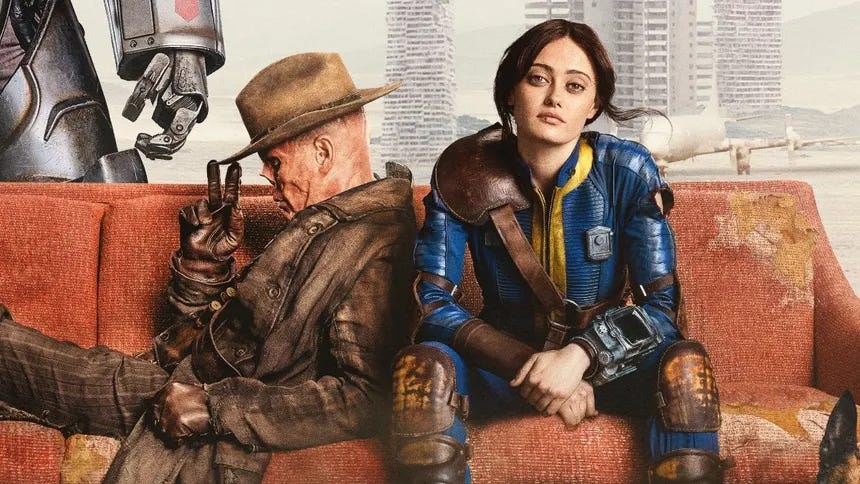
I’ve been meaning to talk about a particular subject-matter ever since it was brought up by Synthetic Man in reference to Season 2 of The Fallout Show. Looking back, this was as obvious as the central message of Fallout: New Vegas’s Old World Blues expansion, as spoken by the Think Tank, a group of pre-War scientists trapped in the Big MT (Black Mountain) research facility:
“There is an expression in the Wasteland: ‘Old World Blues.’ It refers to those so obsessed with the past they can’t see the present, much less the future, for what it is. They stare into the what-was, eyes like pilot lights, guttering and spent, as the realities of their world continue on around them. Science is a long, steady progression into the future. What may seem a sudden event often isn’t felt for years, even centuries, to come.”
Complementing this is a line from the character Ulysses, a former courier and Frumentarius of Caesar’s Legion:
“Who are you, that do not know your history?”
Ulysses had confronted the scientists, who have lost their memories and identities due to recursive mind-scrubbing loops. By asking them this question, however, he bypassed their mental conditioning, causing them to briefly “awaken” and remember their past lives and the ideals of the America they once served.
This is a useful analogy for the modern incarnation of the Fallout franchise, especially the show. While it still wears the colors of atomic America, it refuses the summons those colors once carried. At the core of the original franchise was a satire that required confrontation with history. That confrontation has largely been reduced to parody that lets the audience stroll past it.
Where The Show Deviates
In Season 2 of the Fallout show, Mr. House uses a mind-control device activated via a handheld remote. This is shown right at the start of Season 2, Episode 1 (“The Innovator”). In the pre-war opening sequence, House tests the prototype on a man in a bar and then overloads the chip, causing the man’s head to explode. The same technology (later miniaturized and improved) becomes a major plot element across the season. This technology is completely original to the show rather than something taken directly from the games. Thus, microelectronics were readily introduced to the franchise without a care as to what any of that entails.
To understand this requires understanding the mysticism of old world tech and why it is at the core of what makes early iterations of the franchise so lucrative. Old world tech pointed outwardly. What this means is that the technology was designed as an instrument that aimed beyond the individual body and the self. From this technology, you get a sense there was some grand conquest of nature underway. The aesthetic was made clear by the presence of crude laser or plasma weapons, large fusion cores powering huge machines, bulky power armor, ovular rocket ships, and industrial robots with vacuum tubes for arms. Much of this technology existed to move mass, to generate power, to cross entire continents, or completely reshape environments. Their form, which are now pieces scattered about the wasteland, readily announced their function. The same logic even applies to the broader mid-century technological imagination: the interstate highway, the dam, the jet aircraft, the computer mainframe. These were all public assertions that humanity could bend the external world to its purposes.
Modern microelectronics have reversed this direction. These are machines that require circuits and solid-state logic which now make up the quiet substrate of our smartphones and computer screens. The smartphone has primarily mediated many a users own relationships with other people, in addition to his sense of self within the world. The physical cost and logistical foundations for much of our modern tech have also been rendered almost invisible. A smartphone feels intimate and personal, so the user experiences it as an inward prosthetic rather than an outward instrument. The whole old world horizon has disappeared and what remains is the screen and the self reflected in it.
This is why Mr. House’s sudden access to miniaturized control technology cannot be overlooked.
Thematically, What Does This Do?
For anyone interjecting with complains about “muh lore”, this is not about lore. This is about themes. Keep in mind that the classic Fallout setting organized its critique around technology that pointed outward. A civilization staked everything on such nuclear technology and was forced to confront what it later summoned: the bomb. The satire lived in that confrontation.
Some brain-computer interface chip invented on the fly does the opposite. It is technology aimed inwardly. That is the deviation. Once the franchise privileges this kind of micro-technology, the original themes of technological confrontation will be weakened. Instead, we will have is a technology that feels closer to our own modern systems rather than to the atomic project that once defined the setting.
One suspects broader institutions would prefer people not confront how technology actually works and what it costs to maintain our modern society. Genuine thematic pressure on these questions risks implicating the same logistical and political arrangements that deliver the devices we use every day. These things don’t just appear in stores, they come at the cost of collecting rare earths and are distributed through supply lines secured by forces that are held out of sight and out of mind.
The older atomic aesthetic of classic Fallout kept the cost of technology visible to us. It was all around us. The mystic post-war wasteland pointed to a world beyond our individual bodies where our real-world microelectronic present points inwardly at the self. The message is clear: your technology isn’t free. It comes at a cost because, after all, war never changes.

As a "big whale" Fallout and Elder Scrolls fan, I can tell you the show is NOT Fallout.
The best comparison is there's a "cup of coffee" and there's this hot water beverage colored brown with added caffeine and some notes of artificial coffee flavor.
The show is NOT the real Fallout; it's a slightly woke, slightly feminist skin suit of Fallout made for the normies who've never had a real cup of coffee. It's not "god awful" but at times it came close.
Dam, is it breakfast yet? Need my morning cup o'joe.
My 75 year mother likes Amazon Fallout knockoff, but remember, she also liked The Mandalorian and Grogu movie. As a fellow Grand Mother she loved Sigourney Weaver flying that X-wing.
That's the audience,.
The parody is of a history most players don't know. No one after Boomers understands what "duck and cover" really means (hiding under your school desk for *protection* against the atomic bomb).