


The online world of authors went into a frenzy on Thursday as the Atlantic published a piece showing that AI writing had been trained using millions of books without author consent. Meta released a statement defending stealing the work claiming that they didn’t seed torrent sites.
AI writing has panicked a lot of writers, especially those involved in establishment fiction, during the last year. It caused uproars and controversies within NaNoWriMo (National Novel Writing Month), as the organization refused to disallow authors from utilizing A.I. on the grounds of helping disabled people. The NaNoWriMo month last year was gutted as a result as many authors protested.
On top of this, organizations like the Science Fiction and Fantasy Writers Association have come out with statements condemning AI writing to try to protect their members.
While it’s easy to see the establishment getting angry about AI, one often wonders why, as most criticism about AI writing is that it’s soulless, poorly written, and not up to the quality of even a moderately professional writer. Baen Books author Larry Correia mocked the concept of AI taking over writing last year, dismissing the concept entirely.
Aside from whether AI is a useful tool or not, the legality of stealing work from authors is a different matter that is coming to a head.
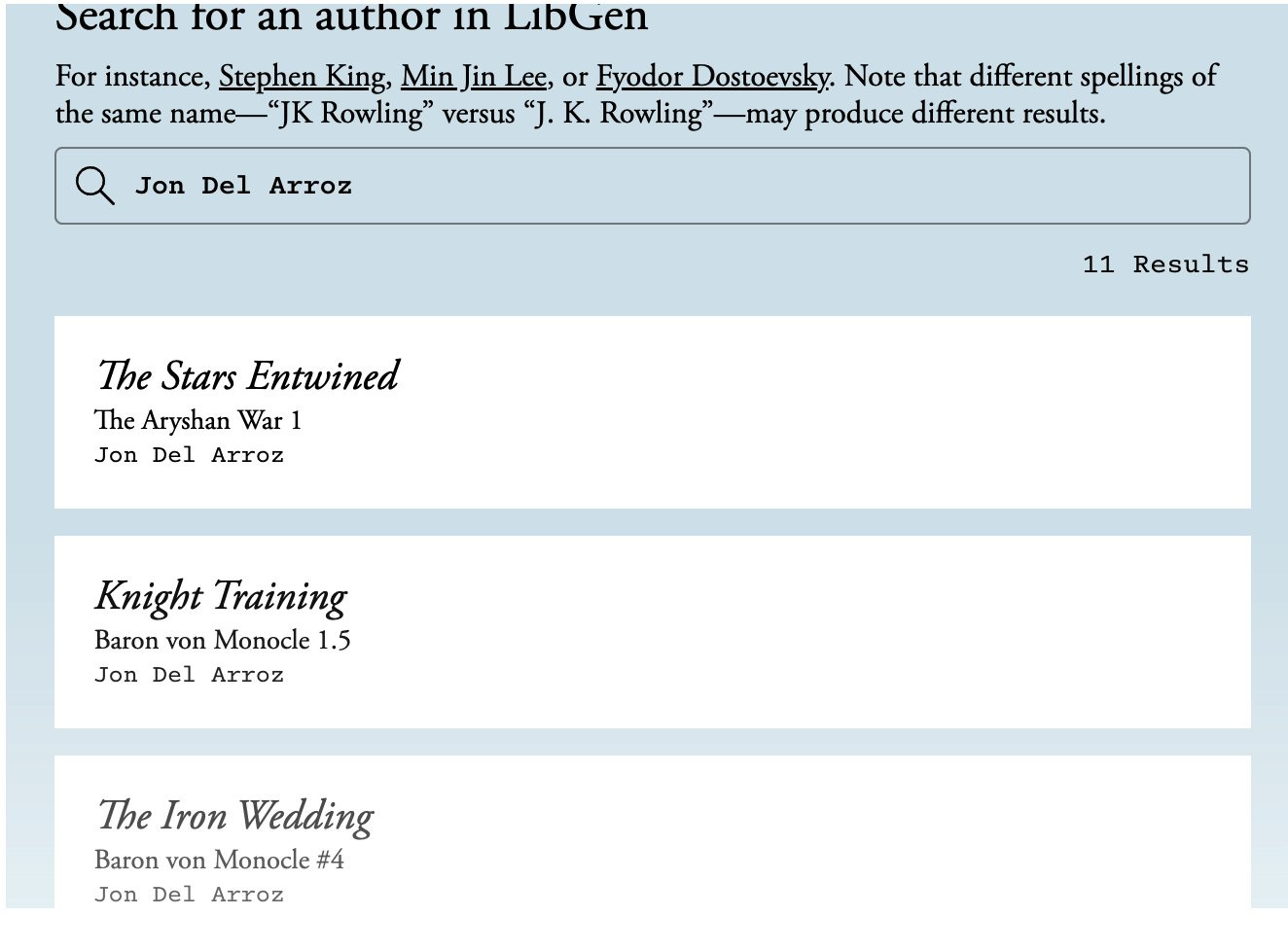
A new expose from the Atlantic has a database showing authors’ work being used to train AI writing, with millions of books from Amazon being used in the process. A quick search will show a number of people being used in the process, including the author of this article.
Serial troll Jason Sanford, famous for attacking Baen Books over allowing an online forum for their fans, replied by saying, “Why didn’t Meta license these books and papers so they could train AI? Because the process was ‘unreasonably expensive’ and might take four weeks or so weeks to deliver date. So instead, they illegally pirated millions of books.”

Popular Western writer Robert Peecher had a more pragmatic take on the situation, “I guess it's a bit of a dubious honor that four of my novels turned up on the list of pirated books that Meta used to train its AI.”
“I'm friends with some authors who had many more books on the list, and I'm not sure if I should be jealous or glad about that. I am a little disappointed that none of the Jackson Speed books made it onto the list. Those might have really skewed the intelligence part of the artificial intelligence. You can decide for yourself which way Jackson Speed would have skewed it.”
“Anyway ... individual readers and giant billion-dollar companies should not read books off of pirate sites. I sell most of my ebooks for under $5 (I think only box sets are priced higher than $5). I've currently got a sale going where you can get 3 of my books for just 99 cents.
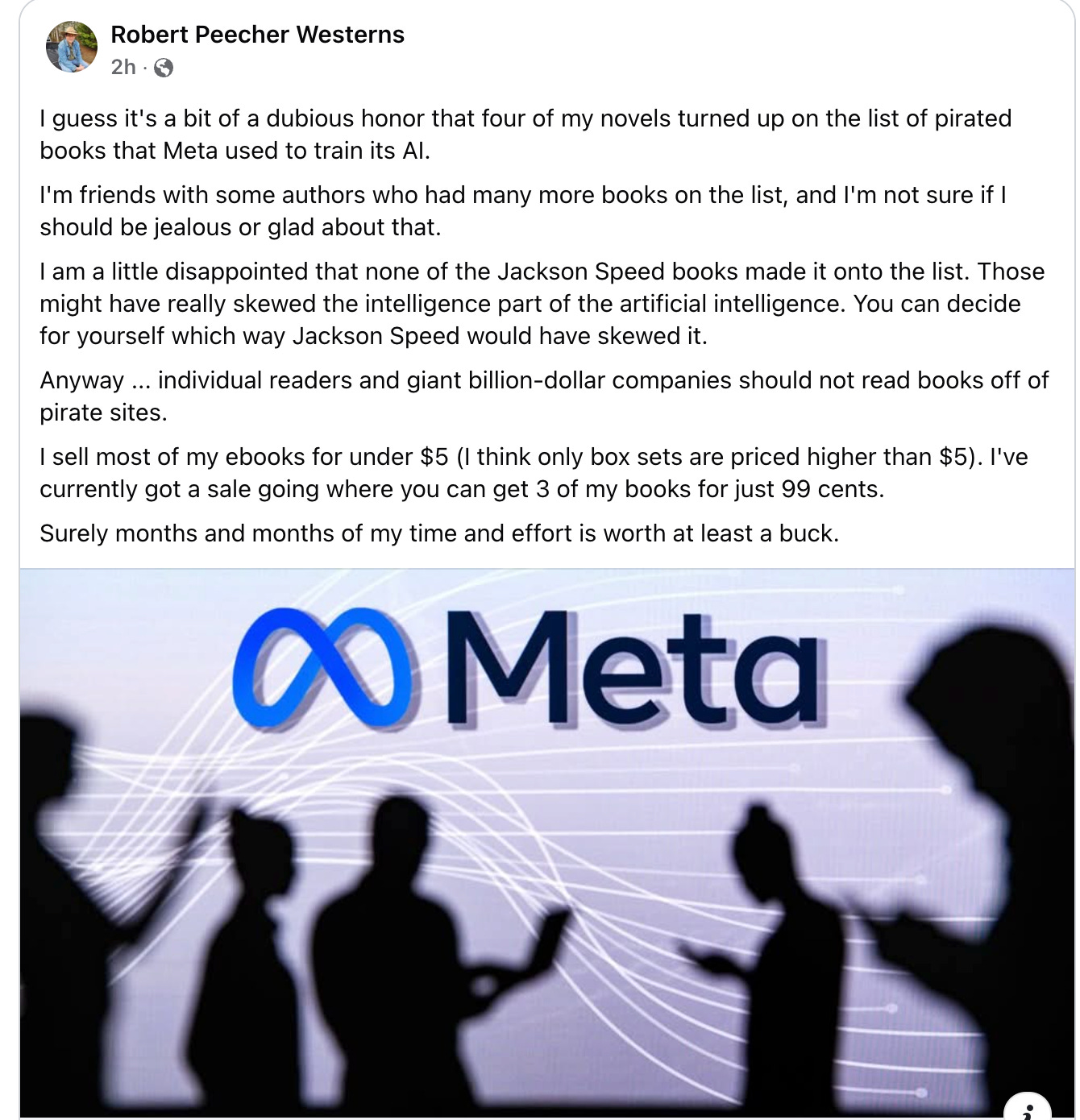
Surely months and months of my time and effort is worth at least a buck,” he concluded.
Meta’s lawyers are already defensive about the topic, focusing on the fact that Meta didn’t seed torrents of writers’ works to push piracy further. They said, “no facts to show that Meta seeded Plaintiffs' books” in a court filing, according to Tom’s Hardware.
Meta’s executives even claimed that they changed their algorithms so there would be the smallest amount of seeding possible.
Most authors are more incensed that Meta took their data in and of itself, with the seeding liabilities aside. The suit against Meta states, “Meta's decision to bypass lawful acquisition methods and become a knowing participant in an illegal peer-to-peer piracy network.”
This isn’t the first case of lawsuits as OpenAI was sued by authors in 2023, and the New York Times are in a suit with Microsoft and OpenAI for lifting their material.
What do you think of millions of authors having their works stolen for Meta AI? Leave a comment and let us know.
For a great novel with a classic sword & sorcery feel, read The Demon’s Eye, an incredible new classic fantasy novel. Support Fandom Pulse!

Thank you for covering this! I checked and I am on the list, even though I'm a tiny indie author with very few units moved. I can't believe it. I am currently putting an explicit "AI & Machine Learning Usage Restrictions" in the copyright section in all my novels.
Stealing is stealing, no matter what lawyerspeak or corpospeak is used to describe it.