


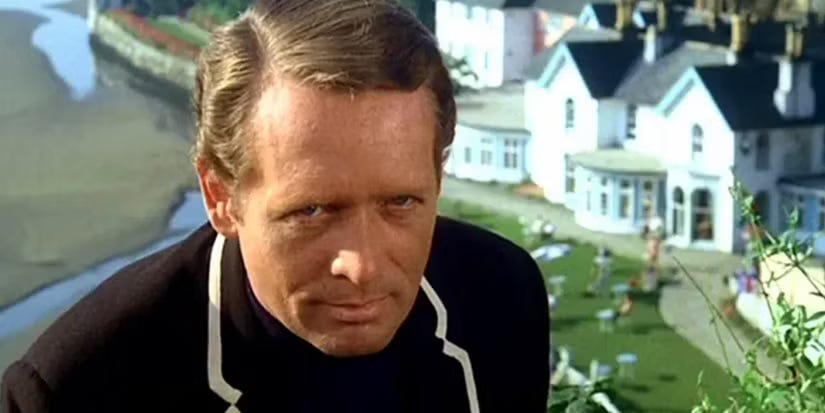
The star of the most argued-over finale in British television history says he had to go into hiding afterward. On Thursday, Amazon announced it wants to make the show again.
The Hollywood Reporter broke the news that Amazon Studios has acquired the rights to The Prisoner and is developing a modern series. The project reportedly has high priority at the company, and a showrunner search is already underway. It has no premiere date. A show built on a man who refuses to be a number is heading into the most data-driven industry there is.
Patrick McGoohan was one of the highest-paid actors on British television in the mid-1960s. He had become a star as John Drake, the thinking spy in the ITC series Danger Man. He grew restless, quit the show, and took an idea to ITC chief Lew Grade, who has been described as not understanding the pitch. The idea was a secret agent who resigns and wakes up in a seaside village where everyone has a number, nobody can leave, and a floating white balloon named Rover retrieves anyone who tries.
McGoohan shot the village exteriors in Portmeirion, a resort in North Wales he had discovered while filming Danger Man. The series premiered in Britain on September 29, 1967, and ran 17 episodes, ending on February 1, 1968. McGoohan wrote and directed several episodes and starred as Number Six. He also served as executive producer, which gave him control few actors of his era had.
The show was sold as a spy thriller. It was something else. It used the surface of a spy series to ask what a society can do to a man who will not conform. Number Six’s refrain in the opening sequence, “I am not a number, I am a free man,” is among the most famous lines on British TV, and the series builds its whole structure on the question of who is asking the questions and why.
The series was supposed to answer one question: who is Number One? Each week the Village’s officials, a rotating Number Two, tried to get information out of Six, and each week they reported to someone above them. For 16 episodes the audience was told the answer was coming.
The finale, “Fall Out,” aired February 1, 1968. McGoohan wrote and directed it. It was surreal, allegorical and full of images that did not resolve, and a good part of the audience felt cheated. The reaction went far past complaints. In a 1977 interview with Warner Troyer, McGoohan described a viewing audience that, by his account, was one of the largest in British history because everyone wanted to know who Number One was, expecting a James Bond-style villain. He said the response was a near-riot. In his own words, “I had to go into hiding in the mountains for two weeks.”
That is a remarkable thing for a director to say about his own finale. It also tells you how he understood the show. He does not describe a failed ending. He describes an audience that wanted something he had never promised, and a decision to give them what the story required instead.
The Prisoner became a cult object. McGoohan said the show had a love/hate relationship with viewers from the start, with a small cult already in place when it aired. The cult grew. David Lynch put an homage to the “Fall Out” monkey-mask scene into Twin Peaks: Fire Walk with Me in 1992. Twin Peaks and Lost are the shows usually named as descendants. X-Files producer John Shiban called the series “the Gone with the Wind of its genre.” That is a producer saying the show set the template for everything that came after, and the quote reads as a judgment about scale. It was a seventeen-episode series by a man who wanted to make seven.
McGoohan told an interviewer that he started with seven scripts and no plan to go further, while Grade wanted more episodes, and that he did not believe the concept could be sustained over that length. His line on the result is worth keeping: “The original concept was completely expressed during its television run.” That is the creator telling you the work is done. We will come back to it.
Hollywood tried to remake The Prisoner for decades. Universal developed a film for years. Christopher McQuarrie wrote a script, Simon West was linked to direct, and Christopher Eccleston was mentioned in the lead. McGoohan himself kept pushing ideas, including Mel Gibson in the role. Variety reported in 2006 that Christopher Nolan was near a deal to direct a contemporary version written by David and Janet Peoples. Nolan later pulled out. Ridley Scott entered talks years afterward, with a draft by William Monahan. None of it reached screens.
A series did. AMC and ITV made a six-part miniseries starring Jim Caviezel as Number 6 and Ian McKellen as Number 2. It premiered on AMC on November 15, 2009, ten months after McGoohan’s death, and drew 2.2 million viewers for its first night, matching the Mad Men numbers in that timeslot. Critics did not like it. It holds a 17 percent Rotten Tomatoes score from 30 reviews, and the site’s consensus calls it a “ponderous, pretentious sci-fi mystery.”
That consensus names both ways the show failed. A critic at the time put the other side even more bluntly, calling it an exercise in “full-tilt dramatic tedium” that would appall anyone who remembered the original and bewilder anyone who did not. The miniseries explained the Village. It gave Number 6 a past at a surveillance company, a name and a backstory. The first thing McGoohan’s show refused to do was supply answers, and the 2009 version did it anyway.
McKellen earned an Emmy nomination for the role, and the cast was strong. The failure was structural, which is the more worrying lesson for Amazon.
Angry Films’ Don Murphy and Susan Montford secured the rights, and THR describes them as lifelong fans of the 1967 series. They will executive produce with ITV’s Philippe Maigret and Lucianne Papon. ITV distributed the original. The series will be set in the present, and Prime Video already streams the original.
Murphy produced the Transformers films. He and Montford produced the Faces of Death reboot that debuted earlier this year, and they are working on a modernization of Buck Rogers at Legendary. Those are not the credits of people who make slow, ambiguous television about identity. They are credits of people who bring recognizable properties back. The Prime Video slate around this announcement leans the same way, with a RoboCop series starring Dan Stevens and a second attempt at Stargate.
The argument for it is real. A village that surveils every resident, asks gentle questions, offers comfort and punishes anyone who steps out of line reads as a description of the present more than as a description of 1967. Number Six is an individualist in a world that treats individualism as a disorder. A good writer could put that story in a world of data brokers, social scoring and algorithmic feeds without changing a word of its argument.
The argument against it is stronger. McGoohan said the concept was fully expressed in 17 episodes, and the finale proves he meant it. The show’s central claim is that the question “who is Number One?” is the wrong question. Modern streaming is built to keep that question open as long as possible and then answer it in a season finale, and then to renew the show for another year. Those two things cannot live in the same series. The 2009 miniseries shows what happens when a producer tries to square them. It answered the question and lost the show.
A new version also has to resist the temptation to turn Number Six into a message. The original works because the villains cannot be pinned to a party or a program. A modern remake will want a target, and whichever one it picks will date the show within a year. The Village has to stay vague enough to describe whatever the viewer fears.
The original is available on Prime Video right now. Anyone who wants to know why people still argue about it can watch it tonight.
The only person who knew who Number One was told us the story was finished in 1968. If Amazon wants more, what question does it believe McGoohan left unanswered, and is a streaming service that needs viewers back next season willing to make a show that never tells them who Number One is?