


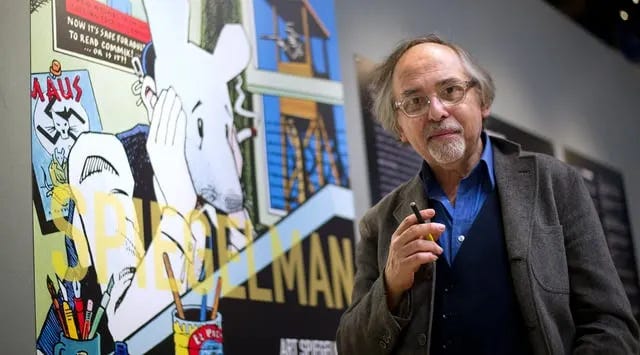
Art Spiegelman wants a revolution. That’s the word the 78-year-old cartoonist used in a new Guardian interview published August 15, telling reporter Sophie McBain that “the US needs a counter-revolution,” and that he does not “know where to look for it because the Democrats are so timid.”
Spiegelman did not stop at policy disagreement. He told the Guardian the Republican Party is “at this point the equivalent of made men in the mafia,” adding, “they’ve committed a murder, they’re complicit in something and they have to keep moving as a complicit unit, so it’s very hard to get someone to blow the whistle and say ‘This is crazy.’” He called the state of American politics “worse than most things I know” and said, “I just don’t see how we get out of this.”
The specifics of the crime he says Republicans are covering up never make it into the piece. Neither does any concrete plan for what a “counter-revolution” would look like. What readers get instead is mafia imagery, a claim that democratic norms have been destroyed, and a shrug toward the opposition party for being too timid to act.
That vagueness is the story, and it lands harder once you know who is saying it.
Spiegelman was born in Stockholm in 1948 to Polish Jewish parents who survived Auschwitz. That history became the subject of Maus, the graphic novel he serialized from 1980 to 1991 depicting Jews as mice and Nazis as cats, built directly from his father’s account of the camps. In 1992, Maus became the first, and still the only, graphic novel to win a Pulitzer Prize.
Before Maus, Spiegelman spent years in the underground comix scene of the 1960s and 70s, and he co-founded the avant-garde anthology RAW with his wife, Françoise Mouly, in 1980. He also drew for Topps, contributing to Wacky Packages and Garbage Pail Kids. After September 11, he produced In the Shadow of No Towers, a book responding to the attacks and their aftermath in Manhattan, where he lived.
In January 2022, the McMinn County School Board in Tennessee voted 10 to 0 to pull Maus from its eighth grade curriculum, citing profanity and a small nude illustration. Spiegelman called the decision “Orwellian” and told CNBC he was “kind of baffled by this,” adding, “I also understand that Tennessee is obviously demented. There’s something going on very, very haywire there.”
A man whose defining life’s work documents what happens when a government strips a category of citizens of their rights, using unaccountable state power and mob complicity as its subject matter, is now reaching for mob language and revolutionary rhetoric to describe an elected political party he opposes. The book that made him famous is a warning about what happens when people stop asking for evidence and start sorting the world into conspirators and bystanders. The interview reads like he skipped that part.
None of this makes Spiegelman unusual among figures in his corner of the entertainment and publishing world. Comparing domestic political opponents to organized crime, or calling for a vaguely defined uprising against a sitting government, has become standard content for outlets like the Guardian. What makes it notable here is the gap between the moral authority Spiegelman carries because of Maus and the substance of what he is actually saying about American politics in 2026. The Holocaust literacy that built his career depended on precision: named perpetrators, documented policies, specific atrocities. The counter-revolution he is calling for right now depends on none of that.
Readers can decide for themselves whether “made men in the mafia” and unnamed “murder” clear the bar Spiegelman spent forty years building. What is harder to argue is that this counts as measured commentary from someone warning about the dangers of unchecked rhetoric.
Does invoking Holocaust-adjacent moral authority to describe an elected opposition party as a criminal conspiracy strengthen Spiegelman’s case, or does it cheapen the very history that made his name?
That Democrats are doing in MN and elsewhere is literally what mafia used to do.
Control the votes, commit fraud, no accountability. If anyone dares to speak up - they are physically removed (Melissa Hortman)
Art, MAGA *is* the counter-revolution. Get used to it because it’s going to win. In the meantime, have fun cozying up with all the Hamas fans in the Democratic Party.