


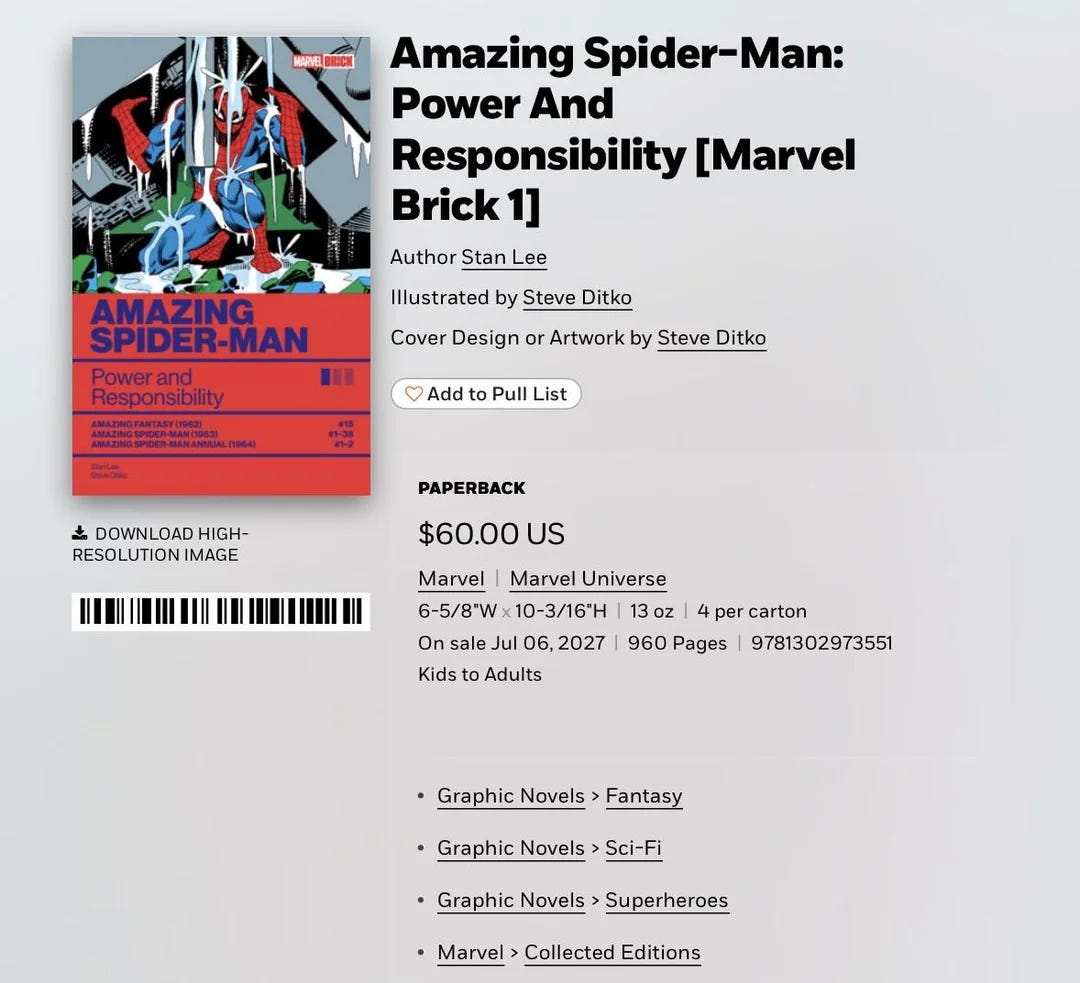
Marvel has a new way to sell you the first 38 issues of Amazing Spider-Man, and this one runs 960 pages. The first Marvel Brick, Amazing Spider-Man: Power and Responsibility, lists at $60 and goes on sale July 6, 2027. Stan Lee and Steve Ditko’s run fills it: Amazing Fantasy #15, Amazing Spider-Man #1-38, and Annuals #1-2.
Marvel unveiled the Brick line, along with a second line called Renown, at the Retailer Day that opened New York Comic Con. Brick is a paperback compendium format set to launch in the second half of 2027. The slide shown to retailers carried four titles: Uncanny X-Men: All New, Superior Spider-Man, Uncanny X-Force, and The Unbeatable Squirrel Girl. The tagline reads “Build your House of Ideas Brick by Brick,” followed by “more to come.” The Ditko volume is the first to get a full listing.
The format copies a model DC has run since 2020. DC’s compendiums are standard-size softcovers, with the smaller ones around 500 pages and most between 1,000 and 1,300. Marvel’s trade dress even puts the Brick logo at the top of the cover the way “Marvel Omnibus” sits on its oversized hardcovers, which tells you where Marvel wants buyers to file it on the shelf.
The Per-Page Math
Start with what favors Marvel. At $60 for 960 pages, the Brick costs about 6.25 cents a page. A recent Epic Collection at 400 to 450 pages and $45.99 runs roughly 10 to 11 cents. Some Epics have climbed past that: Amazing Spider-Man Modern Era Epic Collection: Big Time was priced at $54.99. On cost per page, the Brick undercuts the line Marvel has been selling for years.
The price per issue lands somewhere less flattering. Mighty Marvel Masterworks Vol. 1, the small-format Spider-Man paperback, collected Amazing Spider-Man #1-10 and Amazing Fantasy #15 in 256 pages at a launch price of $15.99. That is 11 books for $15.99, about $1.45 each. The Brick is 41 books for $60, about $1.46 each. Marvel has built a $60 product that matches the per-book price of its cheapest existing way to read the same stories, and asks buyers to pay it in one lump.
What a Paperback That Size Costs You
The Brick is a paperback, and the paper stock and binding sit well below an omnibus. Nearly a thousand pages in a glued spine is a lot to ask of the glue. At least one Epic Collection buyer reported pages falling out of a volume he had owned for a couple of months. If a 400-page Epic can come apart, a 960-page Brick has more weight pulling on the same kind of binding. Nobody outside Marvel has held a copy, and none will ship until next July, so the physical quality is the one question the listing cannot answer.
A Shelf With Seven Formats
This is where the “double dip” complaint comes from. Marvel already sells its back catalog as Masterworks, Mighty Marvel Masterworks, Omnibuses, Epic Collections, and Compacts. Brick and Renown make seven. Each one takes the same pages Lee and Ditko finished in the 1960s and asks the reader to buy them again in a new trim size at a new price. Marvel pays no new creative costs on that material. The art exists and the rights sit in the vault. Every format is a fresh sale on a product that is already paid for.
Collectors have also watched omnibuses and Epic Collections sell out and stay out of print. Marvel’s answer to that is not a reprint of the omnibus. It is two new lines announced in the same week. Renown is described as a line of evergreen books meant to keep Marvel’s best stories in print, which amounts to Marvel acknowledging that its best stories were not staying in print under the old formats. The company is also retooling its compact line at the same time.
Marvel has not stopped reprinting Epics, which is where the “new formats instead of reprints” read needs a correction. Amazing Spider-Man Epic Collection: Spider-Man No More, covering #39-52 in 400 pages, came back in September as a second new printing. Venom got a new printing in 2025 at 504 pages. The Brick ends at issue #38 and the Epic starts at #39, so a reader can build a Spider-Man run across both formats. Marvel is running the formats side by side and letting buyers sort out which ones they need.
That is the real shape of the strategy. Marvel treats the 1960s Spider-Man stories as a catalog to be repackaged every few years, and the Brick is a lower-priced entry on a shelf that keeps getting longer. A buyer comparing the Brick to a pair of Epics will find the Brick cheaper and bigger. A buyer comparing it to a sewn hardcover will find a different product at a different tier. Marvel is counting on both buyers showing up.
Which leaves a decision for anyone who collects these runs. Would you trade 960 pages of glued paperback for two Epic Collections on the shelf, or does Marvel still owe readers a straight reprint of the omnibuses it let go out of print?
Support indie comics! Ayla Rin: Gateway to Doom Crowdfund, as a return to classic and great science fiction with a cover by legendary Green Lantern artist, Ethan Van Sciver:
