


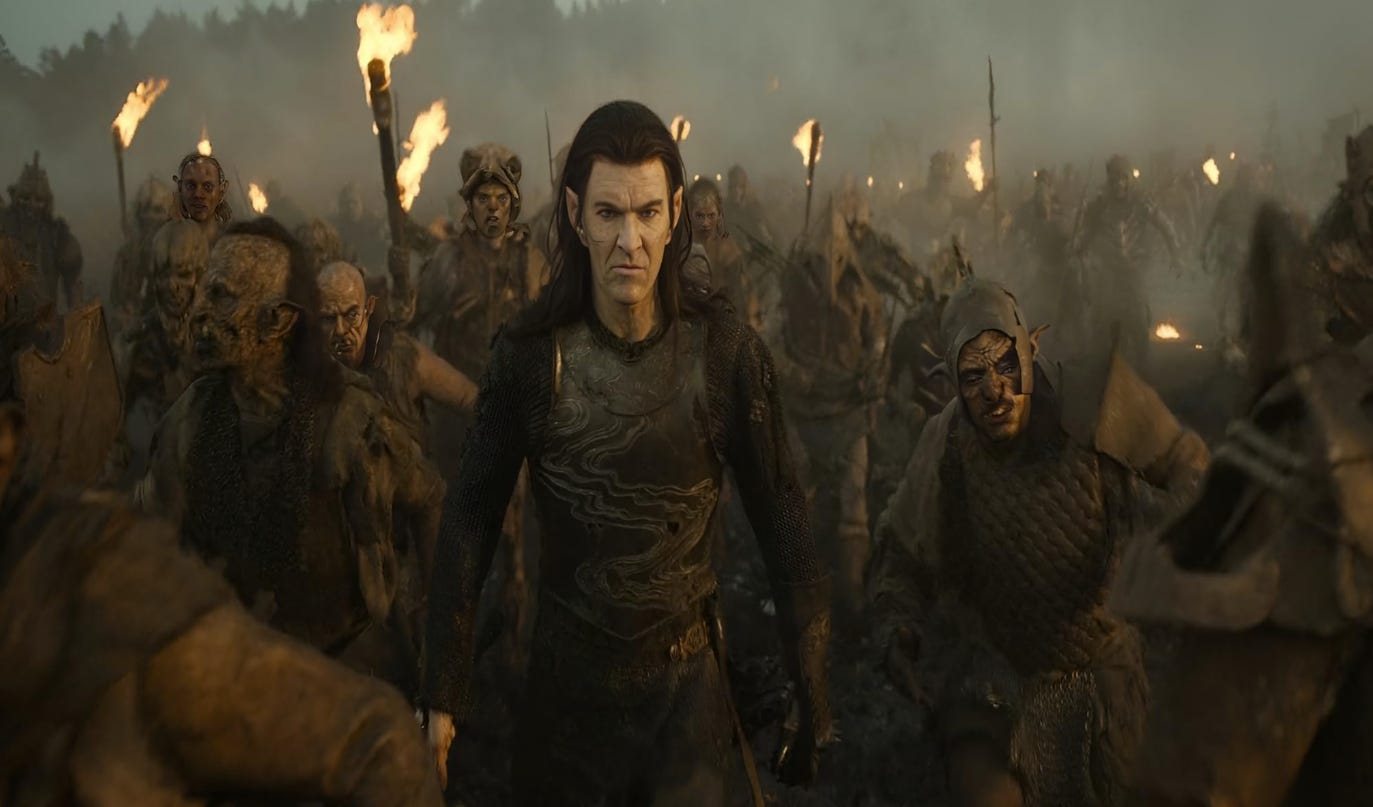
One of Tolkien’s most resonant lines, from On Fairy-Stories, directly addresses the moral and imaginative power of fantasy:
The consolation of fairy-stories, the joy of the happy ending: or more correctly of the good catastrophe, the sudden joyous ‘turn’... is not essentially ‘escapist,’ nor ‘fugitive.’ It is a sudden and miraculous grace: never to be counted on to recur.
This “eucatastrophe” (a term Tolkien coined) is a mythic epiphany that affirms meaning, virtue, and hope. It is the power of fantasy in and of itself: a glimpse of transcendent truth. This is what has long since been lost in modern fantasy worlds and, in particular, Dungeons and Dragons.
D&D currently festers under the rot of Progressive ideology. You know it. I know it: this destruction is being done on purpose. No, I will not pretend otherwise because we all know how that conversation will go:
It’s not happening.
It’s good that it is happening.
You bigots deserve it.
This is how the Left will argue about the state of any cultural artifact. They know how dishonest this is but they don’t care because it proceeds their very objective: to destroy culture.
Now that we’re all on the same page, let’s move on...
Orcs and Black People
Today’s subject-matter is about race. In D&D, fantasy races are not safe from contemporary ideas about racial essentialism. So arises this strange talking point about orcs and half-orcs being directly associated with black people and the myth of black oppression. What’s up with that?
Well, if we are to be charitable to modes of Progressive thought on this, we would acknowledge that this association is not through resemblance or their natural bloodthirstiness. Incidentally, many on the Right are keen to notice how the Left have naturally fallen into projecting their own racism through this lens by naturally associating these savage brutes with black people. However, in good faith, I will acknowledge the Left associate orcs or half-orcs with black people because it is a reflexive association with oppressed minorities.
There is a circular reasoning governing this association. Half-orcs are often hated in-game and therefore they are “coded” as black people. It really is as simple as that: they are oppressed therefore they are black people. This conflation is the predictable outcome of an ideological framework that treats all our cultural artifacts as battlegrounds for systemic oppression. This is intersectionality born of critical race theory which is an outgrowth of Marxist dialectics. Progressive thought issues that society is structured by hierarchies of power and that every narrative, including D&D, must be decoded through the lens of victimhood and domination.
Marxism has sought to pit economic classes against each other. Therefore, we see Critical Race Theory seep its way into every corner of Western media, extending its logic into identity. So, even in D&D, we see this implicit recoding of race and sex as axes of struggle (no pun intended). Intersectionality compounds this fragmentation, insisting that each person’s experience is a unique matrix of oppression. Why this type of stuff signals the death knell of modern D&D is the worldview that cannot tolerate the shared meaning that the franchise was once built on. The D&D fandom will not long tolerate a game where everything has mandatorily been deconstructed and politicized.
And that, in a nutshell, is why orcs and half-orcs are racialized. Dungeons and Dragons is run, largely, by Leftists and Leftists are governed by the religion of Marx. Therefore, the intersectional critic must find oppression to validate their ideological framework. Reflexively, the selected Orcs and Half-Orcs, characters whose outsider status becomes proof of that systemic bias must somehow exist in the D&D universe.
This flattening of fantasy characters into racial avatars mirrors the logic of DEI mandates: identity precedes merit and personal agency. Leftist racists want to ensure that the individual is subsumed by the demographic. This results a reversal of the interracial harmony that the Liberal class once sought.
Race in Classic Fantasy
Gone are the days when you could have a character like Daelen Red Tiger, a half-orc mercenary from Neverwinter Nights. Daelen was not sanitized. In fact, he spoke openly of his orcish heritage, his bloodlust, and the violence that runs through his veins. He does not reject these traits, nor does he weaponize them for sympathy. Instead, he chooses to act rightly, not to prove a point nor to subvert a stereotype. Simply because it was the right thing to do.
This is the moral architecture that current D&D seeks to flatten. Daelen, if he was implemented in a game today, would be written as exceptional because he is a half-orc, and his virtue would be read as a triumph of black representation. His bloodlust would be reinterpreted as trauma and his heroism would be turned into a political statement.
Fantasy once thrived on racial tension because the outsider could become a hero by transcending his origins through action. The character’s race was always a context and not a destiny, one where the player was invited to go about seeing such a character transform and not conform. But now the arc begins with identity and ends with validation. The character is exceptional because he marginalized and all his traits are interpreted through the lens of systemic oppression.
Logomisia
There is real fear called “Logomisia” which means “hatred or fear of transcendent meaning, moral order, or rational structure.” It’s a useful term, especially when used to refer to a social class that loves assigning some new “phobia” to normal behavior.
Logomisia is born of a demonic strategy to dismantle the soul’s connection to objective truth and divine Logos. In The Screwtape Letters by C.S. Lewis offers a vivid dramatization of this phenomenon. Screwtape, the senior demon, instructs his nephew Wormwood to keep his human “patient” distracted from eternal realities. He urges him to replace clear moral reasoning with vague emotionalism, to encourage skepticism and to distort language until it no longer points to truth. In one letter, Screwtape writes:
The trouble about argument is that it moves the whole struggle onto the Enemy’s own ground. He can argue too; whereas in really practical propaganda of the kind I am suggesting He has been shown for centuries to be greatly the inferior of Our Father Below.
This is logomisia in action: a strategic rejection of Logos. Screwtape’s ultimate goal is to sever the soul’s connection to meaning itself. He wants the human to live in a fog of relativism and irony, which are precisely the conditions that intersectional critique thrives in today.
It is precisely because of this fear that the Left have been seeking to undermine the works of Tolkien, even as many of them have overseen the erosion of D&D. Tolkien’s orcs are depicted as corrupted, malevolent beings: elves that were twisted and bred by Morgoth and later by Sauron to serve evil. They are not misunderstood or morally ambiguous; they are sadistic, cruel, and often described in grotesque terms. Their purpose in the narrative is clear: they are the foot soldiers of darkness, the antithesis of the free peoples of Middle-earth.
Tolkien’s world is governed by moral absolutes and spiritual hierarchies which pose a profound problem for contemporary Leftist worldviews; particularly those shaped by Critical Race Theory and intersectionality. The Left insists that all representations of “the Other” must be interrogated for implicit bias. Ironically, in doing so, they have created their own in-group preferences. Those deemed historically marginalized are elevated as morally authoritative, while those associated with traditional values are cast as suspect.
For the Christian, our path is clear: restore the lens of tradition. Reject the false religious and ideological frameworks that turn your characters and stories into a proxy war against you and those you love. Moreover, recover the Western canon, the Christian moral structure, and the mythic scaffolding that has long since given stories their weight.
NEXT: Culture Is Not Downstream From Politics; It Is Downstream From Power

Nice essay, I have said for years that the conformist left has gone so far to stigmatize thinking itself, but I had no idea there was this term "logomisia" until catching your post here. Thanks for spelling this all out – spot on too. I've read Lewis' The Abolition of Man, but not his The Screwtape Letters yet. I love Tolkien's On Fairy-Stories essays as well; the "eucatastrophe" is such a good neologism as well and carries a Christian apologia in tow, as with Lewis' satire.
C.S. Lewis said that Tolkien's characters all wear their souls on the outside. That being the case, the darkness of the evil races in LOTR is due to corruption from within, not to a specific shade of skin, a mere exterior covering.