


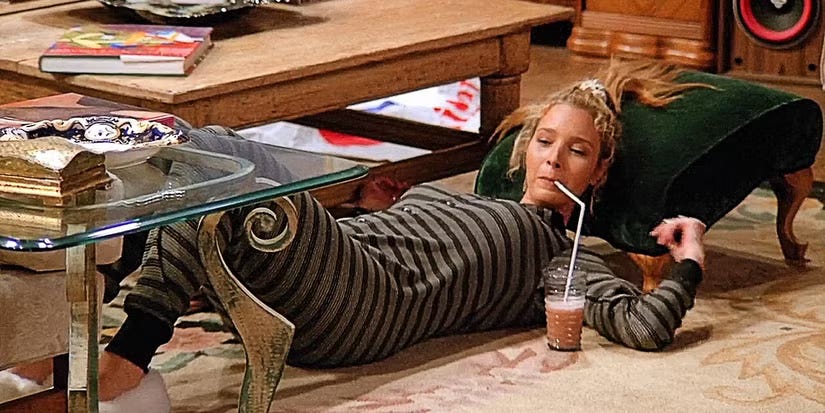
Lisa Kudrow made $1 million per episode by the end of Friends. She has been a working actress in Hollywood for thirty years. She is worth an estimated $130 million.
Last week she told The Times of London that the Friends writers’ room was hostile, that the “mostly men” on staff discussed their sexual fantasies about Jennifer Aniston and Courteney Cox, and that writers berated cast members who missed lines. Her quote on the writers’ conduct toward the cast: “Can’t the bitch fucking read? She’s not even trying. She fucked up my line.”
Her response to all of it at the time: “Say what you like about me behind my back because then it doesn’t matter.”
That second quote is the one that matters. Kudrow is describing something she processed, dismissed, and moved past thirty years ago. She kept her job. She became a multimillionaire. She won an Emmy. She has promoted every Friends reunion project that has come along since the show ended in 2004.
Now, with a new HBO Max project to promote, she has rediscovered how brutal it all was.
Kudrow is not alone. The pattern is becoming impossible to miss. Scarlett Johansson, the highest-paid actress in Hollywood for multiple years running, has given repeated interviews describing the industry’s treatment of women as a form of ongoing abuse, including her widely covered comments about being hypersexualized in early Marvel films, films she chose to star in, re-signed for, and negotiated nine-figure contracts to continue making. Milly Alcock, who plays Supergirl in the upcoming DCU film and has a lead role in House of the Dragon, recently described the pressures on young actresses in language that positioned her as a casualty of the same industry that made her a star before her mid-twenties.
The timing on all of these disclosures follows a consistent pattern. The revelation arrives during a press cycle. There is a project to promote. The grievance is always retrospective, describing conditions the actress navigated successfully enough to reach the top of the industry. None of them quit. None of them reported anything at the time. None of them are poor.

The Friends writers’ room behavior Kudrow describes was already litigated in California court. In 2006, the state Supreme Court ruled against a writers’ assistant named Amaani Lyle who sued Warner Bros. over the same environment, finding that sexually explicit conversation was a necessary component of writing a show whose subject matter was sex and relationships. The court’s decision was not a close call. The behavior Kudrow now describes as brutal was legally determined to be part of the creative process.
Kudrow knew this. She watched the case. She said nothing publicly at the time. Her own framing, “say what you like about me behind my back because then it doesn’t matter,” describes a woman who made a deliberate professional calculation and stood by it for three decades.
What changed is not the industry. What changed is that retrospective victimhood is currently a reliable source of press attention, and press attention sells projects.
Hollywood has real problems with how it treats people. Those problems deserve serious coverage. They do not get it when the loudest voices belong to centimillionaires describing grievances they chose to overlook on their way to the top.
Does the wave of retrospective victimhood from Hollywood’s wealthiest actresses make you more or less likely to take real industry abuse claims seriously?
Three free books. No spam. Just new releases, deals, and the occasional update from the front lines of independent publishing. Sign up for the Jon Del Arroz newsletter and start reading today.

NEXT: Bill Willingham Announces New Fantasy Trilogy After Putting Fables in the Public Domain
Just a quick google search reveled how many male stars went through worse than these two hags https://www.allvipp.com/celebrities/these-male-celebs-have-spoken-out-about-sexual-abuse
Very few believed me when I have repeated what happened to me as an eleven year old in Hollywood. Maybe I should say, "what I narrowly avoided."
I can't repeat exact details without being called racist. Every. Single. Time.