


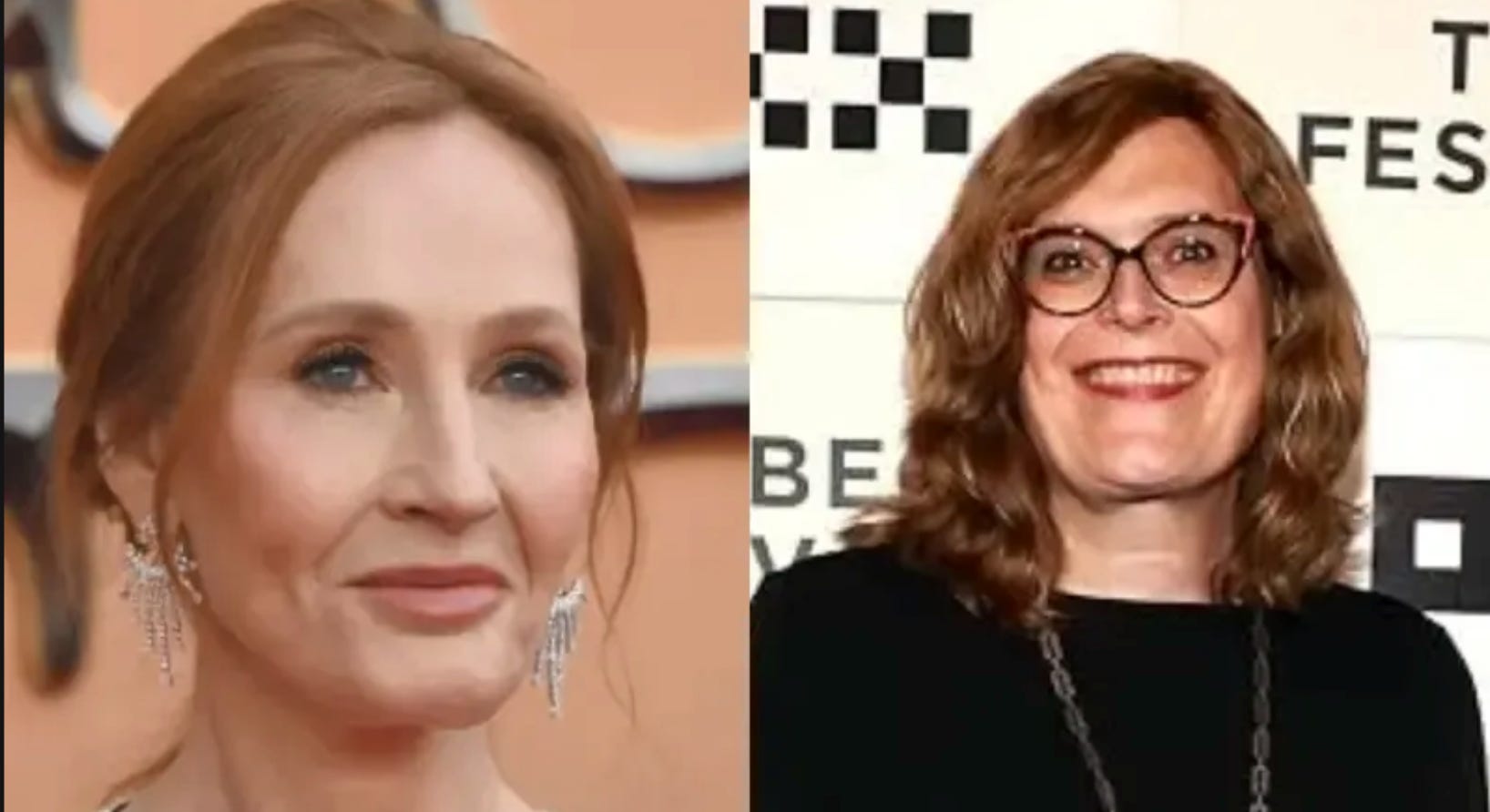
The Matrix just compared bestselling novelist J.K. Rowling to a genocidal regime, twice, unprompted, in a major trade publication. In most entertainment news cycles, that’s the story for days: the accusation, the fallout, the think pieces. This time, the comparison barely made a ripple beyond a single correction from the other side’s camp, and it’s just the latest entry in a campaign against Rowling that’s been running for six years without ever actually landing the knockout blow it keeps promising.
Lilly Wachowski was promoting his new Anarchists United studio in a wide-ranging Variety interview when the conversation turned to the upcoming HBO Harry Potter series and whether fans should feel conflicted watching it. He went for the throat.
“She is funding trans genocide,” Wachowski said. “J.K. Rowling funds trans genocide, full stop. So, if you support Harry Potter, you’re supporting trans genocide. The money that goes into you enjoying these products, a portion of that money goes to J.K. Rowling and that money goes into her funding anti-trans legislation all over the world.” He pushed the comparison further, telling viewers to treat Harry Potter the way they’d treat Tesla or gasoline: “It’s simple math. So, your enjoyment of these shows, and continued support of these shows, is supporting my eradication.” Asked about Rowling and Elon Musk together, he went further still: “I mean... these people are Nazis. They’re literal Nazis. There is a one-to-one connection between Elon Musk and the Nazi community.”
Rowling’s side had a choice here: match the temperature or answer with facts. They chose the second option. Agent Neil Blair issued a written statement to Entertainment Weekly opening with a simple line: “Freedom of speech is a principle we should all cherish.” Then came the actual correction. “To correct Lilly Wachowski, through The J.K. Rowling Women’s Fund, J.K. Rowling supports women taking legal action in the UK to preserve their existing rights under the Equality Act 2010,” Blair said. “She does not support legal actions aimed at harming transgender people or efforts to limit trans rights.” On the genocide comparison specifically, he didn’t soften it either: “People are free to disagree with her views but seriously defamatory allegations of this nature, even outrageously invoking the Nazi’s and the genocide that they committed, should never be presented as fact when they are clearly fabricated and not based on any evidence.”
None of this is new territory for Rowling, and that history is worth laying out, because it shows a pattern of campaigns that generate enormous noise and consistently fail to move the actual needle. The breaking point traces back to 2020, when Rowling posted a series of comments on sex and gender, then followed up with a 3,600-word essay on her own website explaining her position in full. Daniel Radcliffe, Emma Watson, Rupert Grint, Eddie Redmayne, and Bonnie Wright, the core cast that grew up on screen playing her characters, all publicly distanced themselves. Radcliffe wrote a statement through The Trevor Project: “To all the people who now feel that their experience of the books has been tarnished or diminished. I am deeply sorry for the pain these comments have caused you.” Rowling, for her part, reportedly told Watson she would “never forgive” her for taking that position; Watson has since said the two things aren’t mutually exclusive, that she can hold her own views and still “treasure” her personal history with Rowling.
That cast rift produced its own visible snub the following year. When HBO Max staged Harry Potter 20th Anniversary: Return to Hogwarts in January 2022, reuniting Radcliffe, Watson, Grint, and director Chris Columbus for the first time since the final film, Rowling appeared only in archival footage. She was not part of the present-day reunion, a deliberate choice a production source confirmed to NPR at the time.
Then came Hogwarts Legacy in 2023, the biggest real test of whether online anger against Rowling could translate into actual box office damage. The boycott campaign was massive by any social metric: the hashtag alone racked up more than 3 billion views on TikTok before release. It changed nothing about the outcome. The game topped PlayStation and Steam sales charts before it even launched, broke Twitch viewership records for its category, and went on to become one of the best-selling games of the year. Forbes’ own retrospective on the boycott called it, in the piece’s own headline, “a mistake,” arguing that a woman with Rowling’s resources was never going to feel a dent from a consumer boycott regardless of how loud it got online. Cursed Child, the Broadway stage adaptation, absorbed a similar wave of calls for boycott with a similar lack of measurable effect. Actors as recent as Keira Knightley have publicly navigated the same pressure around audiobook work tied to the franchise.
The current HBO series reboot has already absorbed its own version of this fight before a single episode has aired: Nicolas Hoult reportedly exited the production following fan backlash tied to Rowling’s continued involvement, and other cast members have gone out of their way in press to clarify that appearing in the show doesn’t signal agreement with her views, the same dynamic that shaped the 2020 cast statements playing out again in real time. Rowling has also weathered a public dispute with Amnesty International UK after the organization suggested her women’s rights groups were discriminatory, a fight she didn’t back down from either.
Set Wachowski’s genocide comparison against that six-year backdrop and the pattern gets clearer. Each escalation, essay backlash, cast defections, a reunion snub, a 3-billion-view boycott hashtag, now a direct Nazi comparison, generates a real news cycle and real online heat. None of it has changed Rowling’s public position, dented Harry Potter’s commercial performance in any measurable way, or, this week, produced anything from her camp beyond a calm, sourced correction. Wachowski escalated to the most extreme comparison available. Rowling’s team answered with a citation, the same posture that’s defined her response to every wave of this fight since 2020.
What’s stranger is how unevenly the coverage of this particular round has landed. The AV Club’s writeup of the same Variety interview referred to Rowling, in its own reporting voice, not as a quote from anyone, as “noted and rabid transphobe J.K. Rowling,” described her as having engaged in “relentless harassment of trans people,” and cited “the stain of the author’s long history of anti-trans bigotry.” That’s an outlet’s own editorial language embedded inside what’s framed as a news article, applied to one side of a dispute where the other side just got caught making an unsupported genocide comparison and had to issue a correction. When a publication treats one party’s characterization as settled fact and the other party’s actual factual correction as just another quote to run, that’s not neutral coverage.
Six books. One unforgettable world. The Adventures of Baron Von Monocle is steampunk adventure with the kind of worldbuilding and heart that made you fall in love with fantasy in the first place. Start the series on Amazon.
Fuck that Dumbassed troon.
Outside of writing some excellent stories, she's been on the opposite side of me on everything with the exception of her Pro-biological woman politics but the level of betrayal and vitriol sent her way is astounding. I suppose her billions and billions of dollars, and the knowledge that she's standing up for women when others never would, are a comfort.
100 years from now her heirs will either be forced to finally renounce her or will be proud to embrace her. Let's hope their backbones are as strong as hers.