


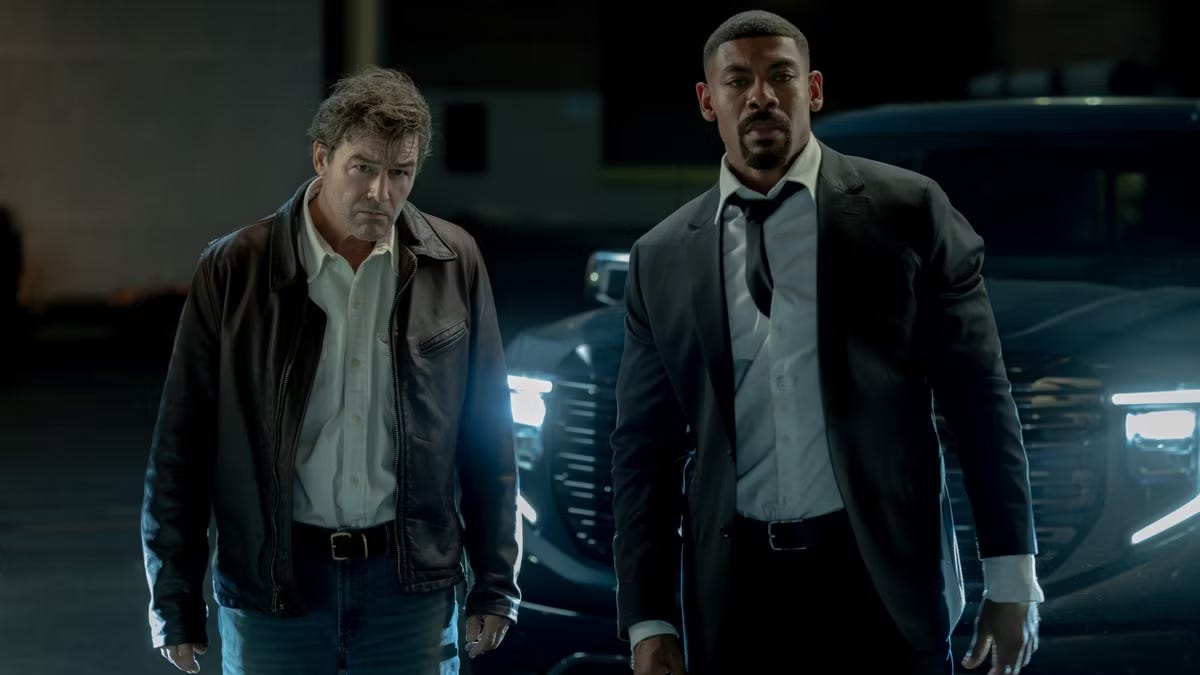
Lanterns spent its penultimate episode on what should have been the first ten minutes of a finale. “The Jordan Boys’ Legacy” runs a full hour and advances the murder investigation by exactly one theory: that Hal Jordan may have killed himself. The case that opened the series in episode one is no closer to solved, and the show has one hour left to close it.
The episode opens in 1975 with a flashback that runs long and adds little. Young Hal sits in his Little League coach’s office after a game in which he refused to leave the mound with a near no-hitter, brawled with his own teammates, and cost the team a forfeit. His father Martin, a test pilot, arrives. The coach expects him to back the adults. Instead Martin asks how good the replacement pitcher was, and when the coach says that doesn’t matter, Martin steps into his face and tells him it’s all that fucking matters. Any real coach who had just watched a kid fight his own team would have gotten a very different reaction from a parent who talked like that in front of the boy, but the scene plays it as a proud origin story for Hal’s stubbornness. It’s also another scene where profanity does the work of characterization, in the same register every character has used since episode one.
A second flashback follows over popsicles at a flight test airfield. Martin hands his son the key to a lockbox and says that if he dies, its contents become Hal’s responsibility alone, a tradition passed down from Martin’s own father. He calls it “the Jordan boys’ legacy.” Noticing Hal still clutching the game ball, he tells him he can’t hold it forever because it’s fucking exhausting, and Hal throws it over the fence. Martin dies in a plane accident shortly after.
In the present, John Stewart stands over Hal’s exhumed body with the ring he pulled off the corpse and summons the Halogram, the backup copy of Hal stored in the ring, last updated in 2006. It’s a younger, more righteous version of the man, and it spends much of the hour needling John and suspecting him of the murder. John uses the Halogram to open the lockbox he and Sheriff Kerry Kane found on Hal’s body, unlocked with the bird keychain tied back to Hal’s childhood. Before that, the Halogram meets Kerry in a tender reunion. Walking out, he announces that she killed him, that he knows guilt when he sees it. John asks if he knows love when he sees it. The Halogram allows that it could be both, since it’s very on brand for him.
The lockbox holds a portal, and it opens onto a dead yellow planet, the same world where the Manhunters wiped out Antaan’s people. John recognizes the place, which is strange, since he never served as a Lantern or used the ring to visit other planets. A toxin in the atmosphere triggers visions of his father and his younger self, and the show cuts between those and a slow boat trip. The boat ride, according to production notes, was filmed by flooding a parking lot. It’s here the Halogram tells John what was in Martin’s lockbox: his father took his own life, and Hal knew because he found the note as a child. It said the pain ran through the family, father to son, and that Martin believed his family would be better off without him. “I’m not fearless ‘cause I’m brave,” the Halogram says. “I’m fearless ‘cause I’m broken.” He then wonders aloud whether the real Hal did the same.
Then a cloaked figure grabs the Halogram and demands the boat. It’s Sinestro, hiding out on the dead world. John punches him to the ground. Before the Halogram fades out, he tosses John his father’s line, “great arm, kid.” The episode closes on young Hal, still in his funeral suit, walking back to the airfield to retrieve the game ball he’d thrown away.
Now to the theory itself. It’s the episode’s only real contribution to the mystery, and it’s almost certainly a red herring. The Halogram walks it back within the same hour, suggesting Kerry may have found the body and covered up for him. Hal’s behavior in episode six, begging John not to tell anyone he was in Rushville, reads at least as easily as fear of someone else. Sinestro is loose and hiding on the same planet the lockbox portal leads to. Hal was shot in the head with a 9mm, the kind of standard-issue handgun a sheriff carries. None of it adds up to a man who ended his own life, and everything in the season’s structure suggests the finale will point somewhere else.
That’s what makes the choice so cynical. The show may not intend to confirm the theory, but it spent an hour on it anyway. Six episodes have stripped Hal of his ring, his freedom, his reputation, the town he tried to save, and any dignity at a funeral three people attended. Now the penultimate hour hands him a family legacy of suicide and lets the audience wonder whether he did it himself, before likely walking it back. Some critics read that as a poignant tribute. The Ringer called it a revelatory tribute that repositions Hal as a tragic figure. The stronger case is that the fearlessness the character is built on has been recast as a symptom of brokenness, and that a franchise hero who waited years for a proper live-action portrayal, after the 2011 film flopped, has been dismantled piece by piece to make his Black successor look better by comparison. Even if the finale clears him, the damage of the implication is already on screen.
There’s more to complain about. The episode barely moves the murder investigation forward, and the profanity is again spread evenly across adults and children alike, flattening every character into the same voice. If you have one episode left to solve a mystery that has run for seven, an hour of childhood flashbacks and a boat ride is a strange use of it.
What the episode does have is Kyle Chandler, who makes even this material land, and a Sinestro cliffhanger that gives the finale something to work with. If the finale resolves the murder in a way that respects the character, this hour may look better in hindsight.
Is Lanterns setting up an answer, or has it just spent a season teaching the audience to expect the worst of Hal Jordan?
Modern Hollywood produced stories seldom have any redeeming qualities or enough content to call substance with very few exceptions of course (e.g. The Sheep Detectives, Project Hail Mary). Most of them can't or won't tell a straightforward stories without resorting to flashbacks that give the characters in the play some kind of professed "depth". Lanterns from what I've read in this site (given that I bailed out immediately after episode 1 expecting exactly this) seems to be another show enamored with it's own cynic worldview, to which I credit it's writers. After watching the first episode of Lanterns and a many other show in the same genre, I came to the conclusion in which I have abandoned all DCU content and superhero media in it's totality since I can't seem to find anything good, useful or true in it. This is a critique based on my experience and in no way, shape or form should it be attributed to anyone else but myself and those who might agree with me.