


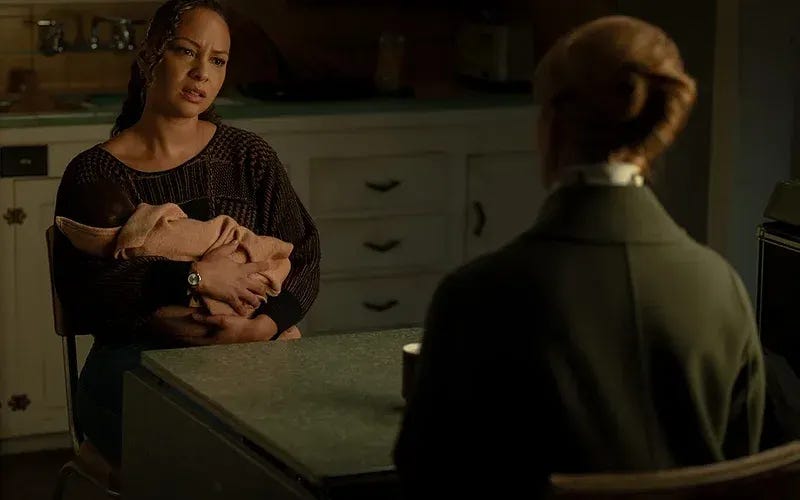
“Lanterns” hit its third episode, “OutKast,” this week, and the hour does something that has become a habit on nearly every prestige streaming drama: it stops the story cold to spend an entire episode explaining how everyone got here. Two episodes of the Rushville mystery, the militia compound, and Hal Jordan’s murder all disappear. In their place, “OutKast” hands the whole runtime to John Stewart’s backstory, and the choice drains the show of the momentum it had just started building.
The episode opens with John falling through darkness onto a pile of mattresses inside what looks like an abandoned shopping mall, then following a trail of arrows to a small office where a Guardian of the Universe, played by Laura Linney, conducts something between a job interview and an interrogation. From there, the episode flashes back to explain how John Stewart got to that room in the first place. It turns out Hal Jordan was not the ring’s first choice. Years earlier, a green bubble lifted John’s father, John Stewart Sr., out of bed in the middle of the night and asked him the one question the ring needs answered: are you afraid? He said yes, honestly, and the ring moved on to Hal. That single moment breaks the man. His wife Bernadette does not believe his story about an alien abduction until a Guardian shows up at their door to apologize, and once she does believe it, Bernadette decides her infant son will be the one to finish what her husband could not. John gets raised from childhood to feel nothing when it matters: trained as a marksman, sent to walk home alone through dangerous neighborhoods as a boy, made to stand still while his father shoots an apple off his head in the backyard, all in service of a ring that has not even chosen him yet. The same episode explains John’s dishonorable discharge from the Marines, revealing he took the fall for a mission gone wrong that traces back to Hal’s own reckless decisions years later, a detail that reframes the tension between the two Lanterns established in the first two episodes.
That is, on paper, a lot of story. It also takes the entire hour to unpack it, and watching a show stop dead to explain what should have unfolded as a mystery is one of the most tedious habits streaming television has picked up. Set up a cliffhanger, cut away from it for a full episode of connective tissue, and expect the audience to sit through an hour of throat-clearing before the plot picks back up: every prestige drama does this now, and every time it happens, the show loses whatever tension it had built.

The bigger problem is what the episode chooses to spend that hour saying. When Bernadette finally confronts the Guardian about what happened to her husband, she does not just push back on being lied to. She turns it into a lecture on race in America. “Do you understand how unfair it is to ask a Black man in America if he’s afraid?” she asks the alien, who is played, notably, by a white actress in human form before her true blue-skinned appearance gets revealed later in the episode. It is not an isolated moment. It follows a similar racial framing from episode two, and by the third hour of the season, the pattern is hard to miss: every setback gets filtered through a lesson about how being Black makes a character a victim of forces beyond their control, while whiteness, embodied here by an alien who cannot even grasp the basic concept Bernadette is explaining to her, gets cast as obliviously privileged at best.
The episode also leans hard into the girlboss dynamic the show has already used once with Sheriff Kane in the first two hours. Bernadette becomes the one who drives the entire plan, pushing her broken husband and eventually her son toward a goal neither of them chose for themselves, while John Sr. spends the episode reduced to a man who failed simply because he told the truth about being scared. It does answer one nagging question from the pilot: the scene of a father shooting an apple off his son’s head now makes a twisted kind of sense once the audience understands these are parents who spent years engineering a fearless child on purpose. Knowing the reason behind it does not make the scene less disturbing. If anything, walking through exactly how calculated it was makes it worse.
Visually, nothing changes. The same flat grays and browns that have defined every episode so far carry over into a flashback that spans years and multiple locations, robbing what should be a rich, differentiated visual palette of any distinction. Even the episode’s one genuine reveal, the audience’s first real look at a Guardian’s true form, gets shown only from behind in dim lighting, and it looks about as unconvincing as everything else the show has put on screen.
“OutKast” wants credit for depth it never quite earns. The performances from Jasmine Cephas Jones and J. Alphonse Nicholson carry real weight, and the explanation for John’s fearlessness gives some of the show’s stranger choices a reason to exist. But an hour built entirely around backstory, delivered through a lecture on race dressed up as character work, makes for the weakest episode “Lanterns” has produced yet. Three episodes in, and the mystery that hooked viewers in the first place is nowhere to be found. Call it a four out of ten.
How many more episodes will “Lanterns” spend explaining its characters before it gets back to explaining who put a bullet in Hal Jordan?
Sign up for the Ayla Rin: Gateway to Doom Crowdfund, coming soon for great cosmic comic books with a cover by legendary Green Lantern artist, Ethan Van Sciver:

NEXT: Grant Morrison Watches “Lanterns,” Delivers Mixed Verdict After Slamming Damon Lindelof
Written by a woman. Need I say more?
Lanturds. It's green shit.