


Blaine Pardoe wrote Hour of the Wolf, the bestselling BattleTech novel Catalyst Game Labs has ever published. In July 2022, Catalyst stopped publishing him. Four years later, a tabletop miniatures game built on his newest novel series cleared its Kickstarter goal in under six hours and sits at $65,431 against a $37,500 target, with 181 backers and 28 days left. That is the answer to anyone who asked whether BattleTech fans wanted an alternative.
Pardoe did not drift into BattleTech. He was one of FASA’s earliest freelance writers, and the BattleTech wiki Sarna dates his work on the franchise from 1986 to 2021, through FASA, FanPro, WizKids and Catalyst. He wrote the MechWarrior: Dark Age novels. The same wiki reported that many of his books remain cornerstones of the universe’s story. When fans of the old game talk about the Clans and the lore that made them care, a good share of what they are remembering came out of his keyboard.
On July 30, 2022, Catalyst announced it had suspended publishing new works by him “primarily due to Mr. Pardoe’s online activities, which do not align with Catalyst’s publishing vision.” It names no book, no scene and no line of dialogue that bothered them. It names no act at all. It points at his life outside the work and says it conflicts with a vision, ridiculous since Blaine is a mild-mannered family man, which is how a company talks when it has decided it dislikes the man and cannot point to anything he wrote. Sarna reported that statements from Catalyst and its head, Loren Coleman, confirmed the separation had nothing to do with his BattleTech novels. The publisher said the work was fine. The author was the problem.
Pardoe laid out his side with receipts. The campaign against him came from an online accuser who turned out to be using a false persona, and police found the persona was fake. He warned Catalyst. Catalyst ignored the warning and offered the accuser a short story slot to calm him down. Pardoe’s account of the conversation with the company is that his political beliefs were fine as long as they stayed out of his novels, and they did. Catalyst cut him loose anyway.
The years since have been a long argument between Catalyst and the people who bought the game. The company has leaned into the politics of the moment, and BattleTech fans who wanted the game they grew up with have complained about it ever since. This summer Catalyst answered with a refit: two new box sets and a rulebook released at Gen Con in August 2026, after what it called the largest public playtest in BattleTech’s four-decade history. Fans who did not like where Catalyst was taking the line had nowhere else to go.
Now they do. LAND&SEA is the work of Brent Evans, who created the universe, and the campaign page credits him as the creative mind who relaunched the BattleTech miniatures line and developed the BattleTech: Clan Invasion Kickstarter. Pardoe writes the novels that built out the setting, and the series now runs to 13 books, with the full signed set sitting at the top of the reward tiers. Two men who spent years inside BattleTech went and built their own game.
The setting is twenty years out. Huge alien colony ships come down undetected and disappear beneath the oceans. The invaders reshape Earth’s marine life with their own DNA and turn it into living weapons. As the campaign puts it, the aliens do not carry weapons, they are weapons. The war is a year old, the world’s navies have been pushed back, and the fight has come ashore along the coastlines. Humanity’s best hope is a handful of elite troops and a new generation of combat mechs called ASHURs, short for Augmented Soft/Hard Unconventional Combat Rig. The campaign calls it technology against biology, and the first line on the page sets the stakes: “The oceans are lost... and the Coastlines have become a war zone!”
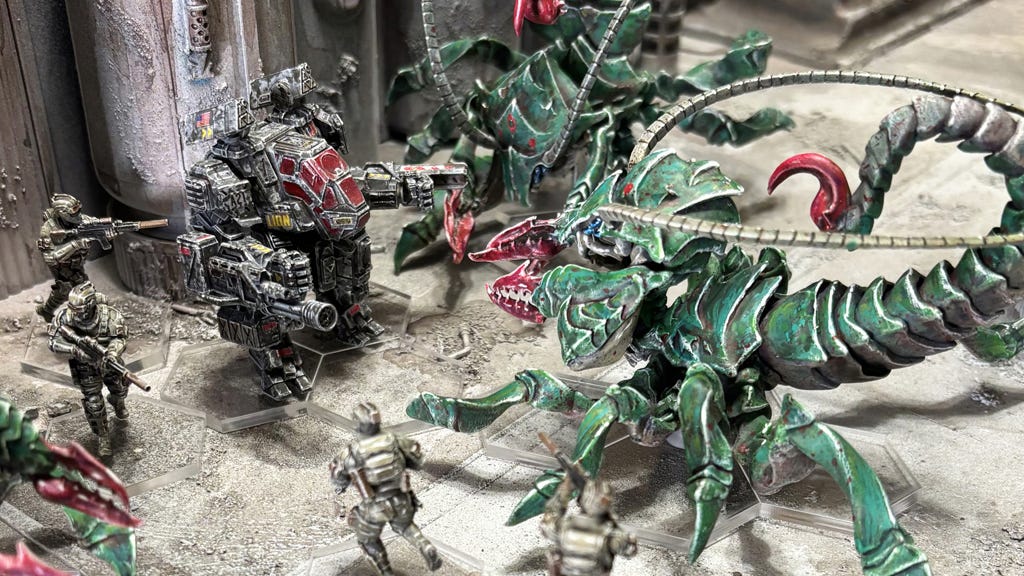
The Core Set puts that war on a table for two players. The human side gets a Rhino-class ASHUR, four infantry and a Greyhound drone. The alien side gets three Crabs, each in a different pose, and a Fox. The campaign photos show the painted miniatures on a rubble-strewn city board. The Rhino is gunmetal with red markings and carries an arm-mounted cannon. The infantry are in modern combat gear with rifles. The Crabs are armored in glossy green and purple with magenta-red claws, a ridged shell and a scorpion tail that curls over the back. In the grey sculpt renders, a Crab beside a rifleman and a Rhino rivals the mech for bulk, and the infantryman looks small next to both. A soldier standing under that tail is a different problem from the one a mech faces.
That difference runs through the rules. The campaign says the two sides should never feel like mirror images. Humans rely on training, firepower and machines. The aliens attack with biological weapons evolved for different jobs. One of the reward descriptions says it in a sentence: the aliens must close the distance before the humans can bring their firepower to bear. A human player lines up shots and holds ground. An alien player charges and grapples, and the unit cards in the box include a Grapple and a Claw Attack to prove it.
The Impulse system keeps both players moving. Each impulse stands for about five seconds of combat, and a full round is twelve impulses, about a minute. Units act in a shifting sequence on a numbered impulse tracker, so neither player sits through the other’s whole turn. You decide when to press a lead, when to pull a weak unit back and when to hold an activation for the moment it counts. Battles are small-unit fights designed to finish in 30 to 120 minutes. Players bring their own standard polyhedral dice, and cards carry the rest: character abilities, circumstances and equipment sit at the table so nobody is hunting through a rulebook. Every unit has its own record sheet and action cards, and Tactical Cards set mission objectives. The scenarios ask the same hard questions in different locations: hold a position, break the enemy line, protect an asset or destroy it before the other side can react. The maps are hex-gridded, and the two Central Park maps in the Core Set combine into a larger board. A $150,000 stretch goal adds downtown Beverly Hills.
The Core Set is $150. A $60 Militia tier sells a print-and-play edition with printable rules, maps and cards and 3D-printable STL files for the Core Set miniatures. The $600 Special Forces tier bundles six boxed products at a $150 savings: the Core Set, a Reinforcements Pack, a Defenders Pack, an Alien Horde Box Set, a Terrain Pack and an Active Camouflage Pack. The top tier, Rickenburg, costs $1,500, or $1,350 on launch day, and includes two Core Sets, all five expansions, every add-on, the digital game, the signed 13-novel set and a militia unit of the backer’s design written into future canon. Twenty-one of the 45 launch-day slots are gone. Everything is manufactured in the United States, the fulfillment target is March 2027, and the tiers list May 2027 as the estimated delivery.
The game was playtested for ten months, and the page says the core rules, maps, cards and miniatures are done. Evans says his first Kickstarter, CLASH, shipped in under 90 days. Backers will hold him to that. The average pledge works out to about $361, which tells you these buyers want armies, not sample boxes. Catalyst pushed out the author of its bestselling novel and assumed the audience would stay. How many of them just showed up for the other side?