


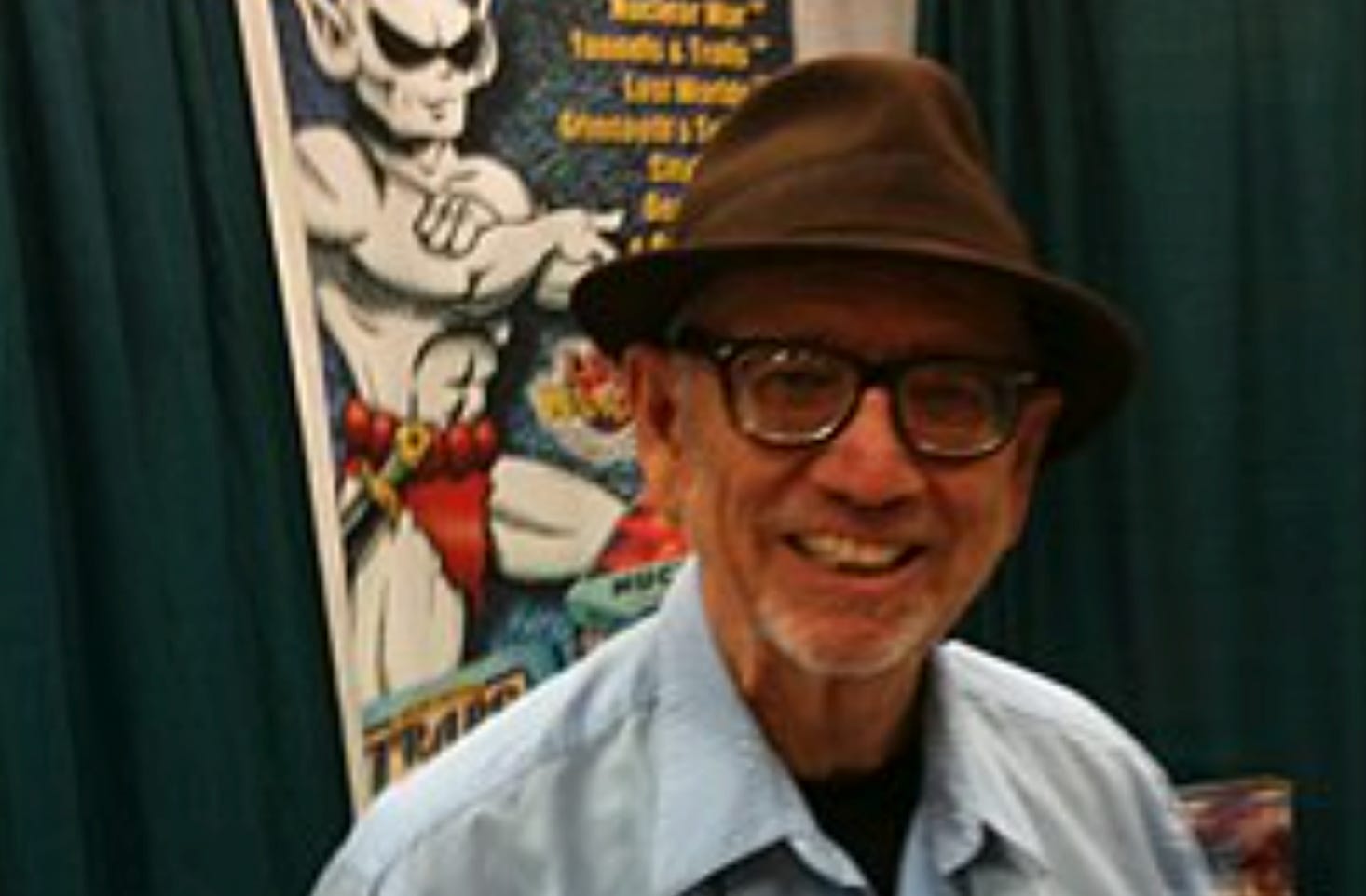
In April 1975 a Phoenix librarian sat down with the rules to a new game called Dungeons & Dragons, decided they made no sense, and wrote his own. Within a few months Ken St. Andre had printed about 100 copies of that rival game and handed 40 of them to a friend headed to a convention. By the end of the year it had a publisher. He called it Tunnels & Trolls.
St. Andre died Sunday, November 15, 2026, at 79. His friend and collaborator Steve Crompton announced that he had fought cancer for more than a decade and then developed heart trouble. His wife Rocio and his brother Brian were with him at the end. He lived in Sun City, Arizona, and is survived by Rocio and two children from his first marriage.
The librarian who made a rival game
Kenneth Eugene St. Andre was born April 28, 1947, in Ogden, Utah, and grew up in Phoenix. He founded the chess club at Maryvale High School in 1965 and was its first president. He learned Diplomacy in graduate school in 1974 and wrote his own variants of it, set in the worlds of Robert E. Howard, Michael Moorcock and Edgar Rice Burroughs. The Tarzan movies that ran on Saturday afternoon TV in Phoenix led him to the books and then the comics, and he said swords and sorcery was what he most wanted to write. He worked as a public librarian for 36 years and retired from the Phoenix Public Library on August 27, 2010.
He was not a miniatures wargamer, and he said that was the point. In a 2012 interview, he put the origin of his game bluntly: “rebellion spawned Tunnels & Trolls.” He had never seen anyone play D&D when he wrote the first edition in what he described as a red-hot creative frenzy. He said the entire game happened in the theater of his mind, and that moving figures by inches made no sense to him. Had D&D’s first-edition rules made sense to him, he said, there might never have been a Tunnels & Trolls.
That quote explains the game’s design better than any history of it. Miniatures wargames fed D&D’s mechanics, and St. Andre lacked that background. He built something from the fiction he loved and left out what he did not understand. The result used ordinary six-sided dice, simple character creation and a saving-roll system that let a referee resolve nearly anything quickly.
His working title was Tunnels & Troglodytes. His Friday-night players laughed it out of the room, and artist Rob Carver suggested Tunnels & Trolls instead. St. Andre embraced it. He said he came to champion trolls because they were the underdog next to dragons.
How it reached the market
He asked Rick Loomis of Flying Buffalo to sell 40 copies at the Origins convention in July 1975. They sold out, Flying Buffalo acquired the publishing rights, and a second edition followed in December 1975. Loomis died in 2019. Flying Buffalo and T&T were sold to Webbed Sphere in 2021, and in 2023 the game was sold again, to Rebellion Unplugged. Rebellion ran a Kickstarter in 2026 to reboot it with a new core rulebook.
St. Andre made a point in 2012 of keeping his name on the game. When Loomis first had success selling copies, he offered to buy it outright, and St. Andre declined because he thought like a writer and wanted royalties. He had in mind what happened to Superman’s creators, Jerry Siegel and Joe Shuster. Even so, he said he did not feel he controlled T&T and that it had a life of its own. Crompton’s tribute says that after the sale he concentrated on Monsters! Monsters!, which he kept the rights to.
What the game gave the hobby
Tunnels & Trolls was among the first fantasy role-playing games to follow Dungeons & Dragons. Loomis’s Buffalo Castle in 1976 and St. Andre’s Deathtrap Equalizer Dungeon and Naked Doom in 1977 were solo adventures. Players worked through numbered paragraphs, rolled dice and made choices with no game master and no group. For readers who had no gaming table nearby, that was how they first met an RPG. The format also fit the British fantasy gamebook boom of the 1980s.
Author Michael Tresca wrote that the game explained its rules better than its rival did and “brought a sense of impish fun to the genre.” The jokes are real. A spell was named Take That You Fiend!, another Hellbomb Bursts. The tone ran against the grim seriousness of much of the early hobby. A game that made you laugh at the dungeon turned out to hold a different kind of player than one built around wargame procedure.
His next designs went off in other directions. Starfaring in 1976 was one of the earliest science fiction RPGs. Monsters! Monsters!, published by Metagaming in 1976, had players take the roles of the monsters. In 1981 he wrote Stormbringer, the first licensed RPG from Chaosium, based on Moorcock’s Elric stories. He co-wrote it with Steve Perrin, who edited and shaped it.
Wasteland
In 1988 Interplay published Wasteland, a post-apocalyptic computer role-playing game that St. Andre designed with fellow tabletop veterans Liz Danforth and Michael Stackpole. It was an important precursor to the Fallout series, and he rejoined Danforth and Stackpole on the design team for Wasteland 2, released in 2014. He also worked on FASA’s Shadowrun line, including the 1990 campaign Harlequin, which won an Origins Award for adventure writing. He joined the Science Fiction and Fantasy Writers of America in 1989, and in June 2018 the Academy of Adventure Gaming Arts & Design inducted him into its Hall of Fame.
The Trollgodfather
Fans called him the Trollgod and then the Trollgodfather. He kept blogs, ran a Facebook group for fans and answered letters long after most of his generation had stepped back. He published under his own imprints and with art partner Steve Crompton, the Trollhalla Press Unlimited and Trollgodfather Press lines. In recent years a Japanese fan community has held TrollCon events devoted to his games. In 2015 he and Crompton, Liz Danforth and James “Bear” Peters, a group called the Fellowship of the Troll, released Deluxe Tunnels & Trolls through a Kickstarter.
Crompton’s announcement describes a man who helped others into the field. He named Danforth, Stackpole, Loomis and himself as people who owe at least the start of their careers to St. Andre. He recalled that St. Andre had survived being run over by farm equipment as a child, serious car accidents and more, and wrote that “every player misses a critical saving throw” eventually. The line works because it is in St. Andre’s own idiom. T&T’s saving roll is the mechanism by which a character survives something deadly, and the game’s players know exactly what a failed one means. Crompton wrote it for them.
Crompton added that he met St. Andre in 1980 when he worked as a clerk in the Flying Buffalo store. He visited St. Andre a week before the end and said they shared memories and a few chuckles. He closed by saying he likes to think the Trollgod has gone to Zimrala, the world the two of them built after T&T was sold.
The question
Rebellion Unplugged ran its Kickstarter for a new T&T rulebook in 2026 without the man who wrote the original. As it ships, will the new edition play like the one he printed 100 copies of in 1975, or like a different game with his name on it?
Intriguing….
Curious how one might get into such a game.