


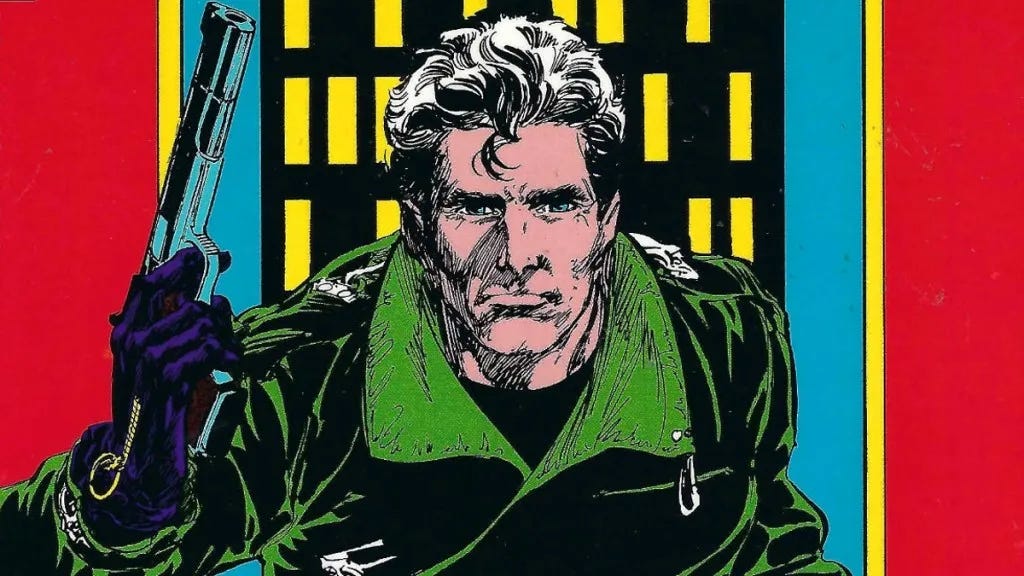
Jon Sable, Freelance hit newsstands in June 1983 with no superheroes, no cosmic powers, and no publisher backing from either of the Big Two. What it had was Mike Grell, a razor-sharp Bond-and-Hammer concept, and 56 issues of some of the most mature, character-driven storytelling the direct market had seen up to that point. Four decades later, the series still doesn’t get the conversation it deserves.
Grell described the book at a late-1980s convention as “something like a cross between James Bond and Mickey Spillane’s Mike Hammer.” Jon Sable is a bounty hunter and mercenary who previously competed as an athlete in the 1972 Munich Olympic Games. After witnessing the terrorist massacre there, he married a fellow athlete and they relocated to Rhodesia, where Sable became an organizer of safaris and later a game warden. His family was murdered by poachers. After avenging them, Sable returned to America as a freelance operative.
That backstory hits every note a thriller needs: trauma, a world-spanning origin, a man defined by loss rather than a radioactive spider bite. But the genius move is what Grell layers on top. Sable also carries a double identity as a successful children’s book author under the name “B.B. Flemm.” Unlike many such characters, his literary agent is aware of his secret activities, but is persuasive in enforcing his writing contract obligations as well. The literary agent knowing and still hounding him to meet deadlines is the kind of detail that makes a fictional world feel lived-in. It’s also funny. Grell never lets you forget it. F
The Run Itself
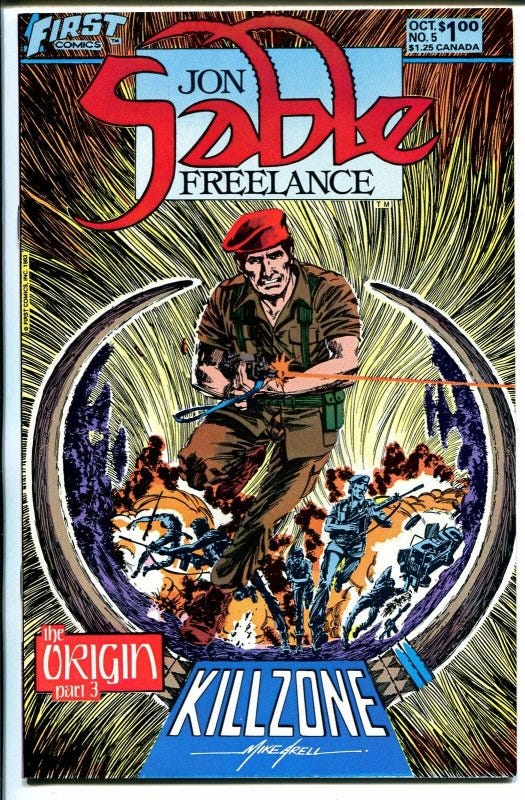
First appearing with a cover date of June 1983, Jon Sable Freelance was a successful non-superhero comic book in an era when successful non-superhero comic books were almost unheard of, and a graphically violent comic sold in mainstream comic book stores in an era when such was equally rare. It was one of First Comics’ first titles and was completely creator-owned, marking a shifting trend in the industry toward giving creators more control over their work and better financial incentives.
The series ran 56 issues from June 1983 to February 1988. While Grell wrote the entire run and handled all the covers, he stopped drawing the interior stories after issue #44. That first stretch of 44 issues, with Grell doing everything, is where the book reaches its ceiling. The origin arc spanning issues #3 through #7 established the character’s history across Rhodesia, the Olympics, and Vietnam in a four-issue run that readers at the time called one of their favorites. Early issues had Sable protecting a sitting president, working the streets of New York, and rotating back to Africa depending on what the story required.
Grell often went pages without dialogue in his stories, using the art to carry the narrative load. That’s not a stylistic quirk. It’s a creative choice, and one that separates Grell from most writers working in mainstream comics then or now. Because this was his own book, he had room to experiment. Different stories called for different visual approaches: noir-inflected black shadows for the urban New York crime work, wide open geography for the African sequences, and a more intimate, almost watercolor quality in the flashback material. The battlemask Sable wears in the field, a theatrical touch that reads a bit superheroic on paper, functions in practice as a way to compartmentalize the character visually. In the mask, he’s the killer. Out of it, he’s B.B. Flemm, the guy who shows up at a cop’s kid’s birthday party and just thanks him quietly for doing the job.
Grell put that kind of character work throughout. He is skilled with facial expressions, and those small character moments, like Sable appearing as B.B. Flemm at a party and expressing simple appreciation for a police captain’s work, accumulate into a portrait of a broken man who is, in some sense, trying to kill himself through his mercenary assignments. That’s not subtext. Grell put it in the dialogue.
Notable Stories
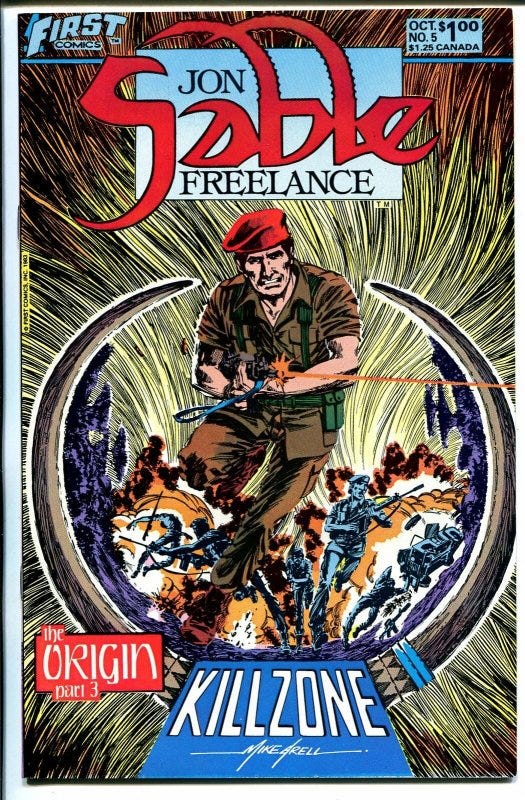
The origin arc, issues #3-7, remains the emotional anchor of the entire run. The flashback sequences covering Sable’s days as an Olympic athlete and mercenary in Rhodesia still rank as standout material from the period. Issue #1 opens with the President of the United States coming to New York and Sable getting pulled into the security operation, which plants the character in the real world immediately. The 108-page origin saga that followed gave the series the mythological weight it needed to sustain a five-year run. Fante’s InfernoAmazon
One issue has Sable hired when a conspiracy to assassinate Ronald Reagan develops, with Reagan himself involved in the response, and the hired killer turning out to be an old war buddy of Sable’s who is every bit as capable. It’s a tight thriller with a genuinely difficult central conflict. Issue #14, “The Wall,” puts Sable into Cold War territory with a Berlin backdrop. The series also used real-world issues as story material: the psychological fallout of the Vietnam War, the uncertainty around soldiers unaccounted for after its end, and the poaching of elephant ivory all appeared as plot drivers.
Femme fatales cycle through the book consistently. Maggie the Cat, a recurring thief and foil, got her own spinoff material later. Shado would show up in Grell’s work again. The women in the book are written as competent and dangerous, which fits the Bond template, but Grell never makes them decorative. They push the story or they complicate Sable. Usually both.
The Omnibus Editions
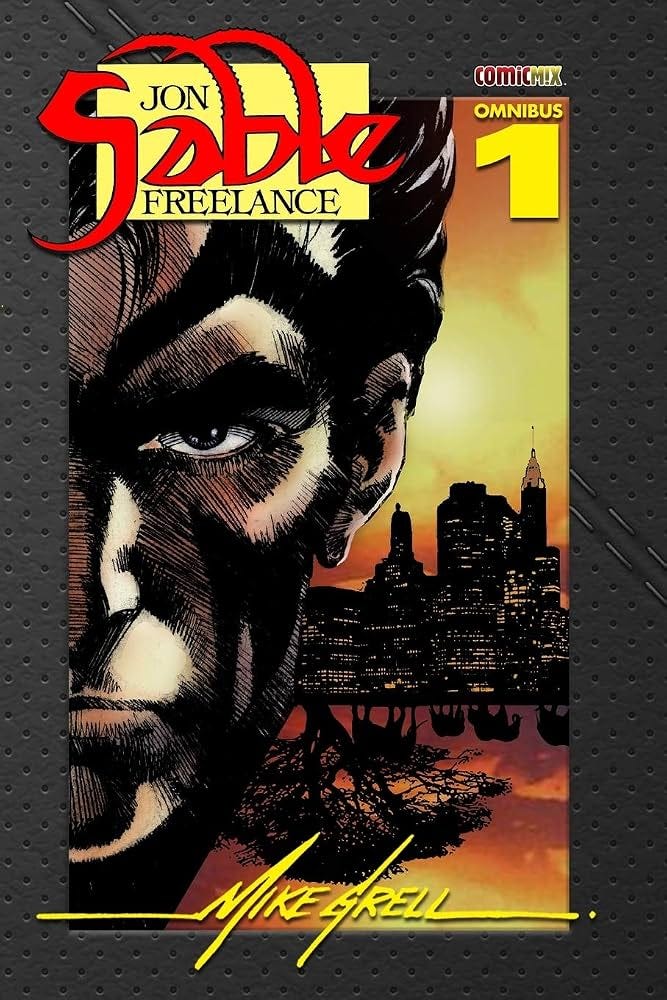
For years, the best way to read Jon Sable, Freelance was the IDW trade paperbacks from the early 2000s or the ComicMix paperback omnibuses that followed. Both got the job done but neither gave the art room to breathe. Masterstroke Studios, via Kickstarter, launched a series of five deluxe hardcover omnibus volumes measuring approximately 8.5 by 12.25 inches, the same format as DC’s Absolute Edition releases, with glossy interior pages, rare and never-before-seen artwork, new covers, and dust jackets designed to line up into a complete image when shelved in order. Each volume runs around 400 pages. At that size, Grell’s linework, his shadow work, and his page construction read completely differently than they do at standard comic dimensions. The remastered coloring does what remastering is supposed to do: it doesn’t make the book look modern, it makes it look like the original artist intended it to look.
Sable had never previously been collected in hardcover. The Masterstroke editions represent the first time the series has received that treatment.
What Grell Did Next
Grell left art duties on Jon Sable, Freelance with issue #44, continued writing through issue #56, and then departed to do Green Arrow: The Longbow Hunters for DC in 1987. The Longbow Hunters miniseries reset Green Arrow entirely: Grell did away with the trick arrows and rearmed Oliver Queen with penetrating broadheads with which he actually killed his opponents. The Longbow Hunters showed the first instance in which Green Arrow ever deliberately killed someone.
That three-issue prestige format miniseries led to an ongoing Green Arrow series, on which Grell served as writer for 80 issues, that ran for 11 years. His approach on Green Arrow carried the same DNA as Sable: he avoided references to the fantastical elements of the DC Universe, and in no Grell Green Arrow story is the character ever referred to by his superhero name (with one exception in the Longbow Hunters itself). It’s a grounded crime and espionage book wearing a superhero costume. Same instinct, different character.
The Sable-to-Green Arrow pipeline shows what Grell was doing with his decade of independent work. He built a template for gritty, character-driven men’s adventure storytelling at First Comics and then brought those instincts back to DC, where they were new. The direct market in 1983 wasn’t ready to reward that kind of work the way it deserved. The audience found it anyway.
Made for a Streaming Adaptation
The bones of Jon Sable, Freelance fit a streaming series better than most properties optioned in the last decade. A mercenary with a tragic African backstory. A children’s book author alter ego that generates built-in comedy and character contrast. A literary agent who functions as the version of M who calls you about your royalty statements instead of classified briefings. Femme fatales who are actually written as characters. Real-world locations and real-world politics. No mythology to explain, no universe to set up.
The ABC series that ran in 1987 barely made it past a single season. The show co-starred Rene Russo in one of her first screen roles and folded after a few months. It didn’t fail because the property was wrong. The network format wasn’t built for what Sable needed to be.
A streaming adaptation that kept the Africa origin intact, kept the dual-identity structure, and didn’t sand down the violence would work. The show practically writes itself from issues #1 through #20. Whether anyone in Hollywood has the discipline to resist updating the politics or switching the mercenary angle into something more palatable is the open question. Given recent track records, bet the under.
What Jon Sable, Freelance proves, and has proved since 1983, is that a Bond-Hammer hybrid with a real human backstory and a creator willing to experiment with the form doesn’t need a cape to carry a long run. The Masterstroke omnibuses make that case in the best possible format. If you’ve never read it, the first volume is the place to start.
Do you think the dual-identity concept, a mercenary whose cover is children’s books rather than a tech billionaire or a playboy, still holds up as a more interesting setup than most of what passes for character depth in modern comics?
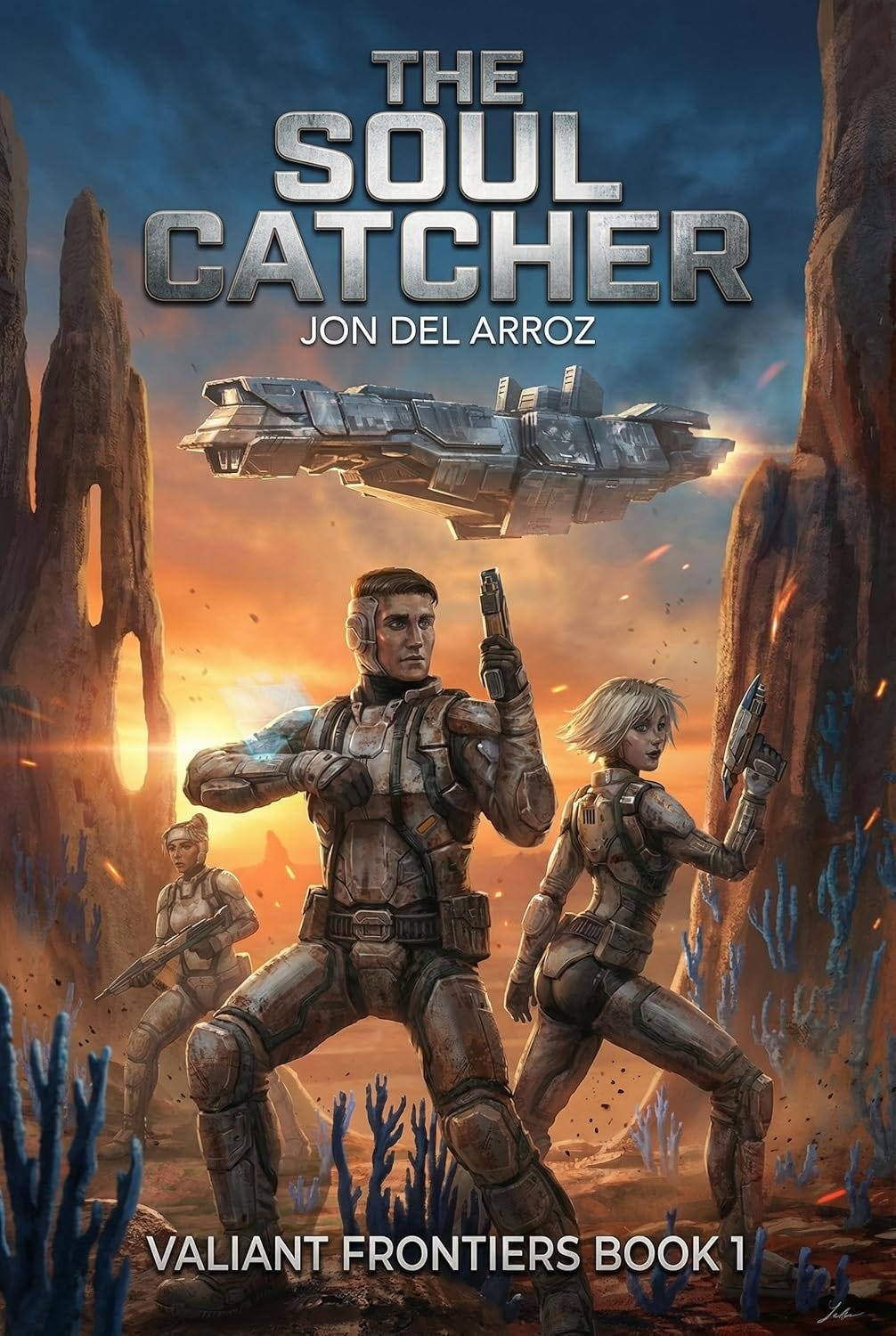
First contact with the Oridians was supposed to be humanity’s proudest moment. Instead, their chief engineer is dead, their ship is sabotaged, and an ancient alien technology is stealing souls. Book one of the Valiant Frontiers series delivers exploration, mystery, and the kind of crew you’ll want to follow across the galaxy. Read The Soul Catcher on Amazon and start the adventure.
I bought every issue at my LCS. Still have them all.
LOVED Jon Sable. Still have the first 40 issues or so bagged in my sacred place.