



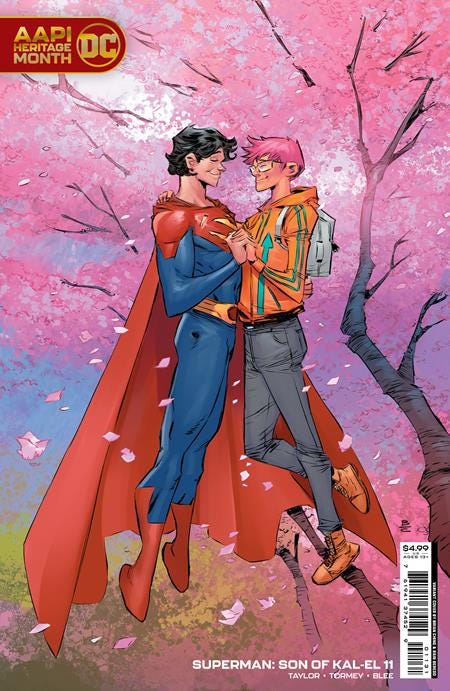
Back in 2021, DC Publisher and Chief Creative Officer Jim Lee articulated his enthusiasm for the portrayal of Superman’s son, Jon Kent, as homosexual within the pages of the comics.
“We couldn’t be prouder to tell this important story from Tom Taylor and John Timms,” Lee declared to Rolling Stone. “We talk a lot about the power of the DC Multiverse in our storytelling, and this is another incredible example. We can have Jon Kent exploring his identity in the comics as well as Jon Kent learning the secrets of his family on TV on Superman & Lois. They coexist in their own worlds and times, and our fans get to enjoy both simultaneously.”
The remark is offered as a celebration of narrative freedom, yet it discloses a fundamental constriction that has only lead to the destruction of so many IPs and characters. So many modern writers elevate sexual orientation to the privileged site of “exploring identity” under the assumption that the most compelling drama one can depict is the discovery and affirmation of same-sex desire.
If this is done as often as it is, then how can it be innovation?
In truth, this is a ritual reenactment of a modern myth that reduces a human person to the autonomous expression of erotic preference. These so-called "creatives" are repeatedly marketing character reduction as depth.
To declare that a character is gay (or belongs to any other designated identity cohort) conveys precisely one piece of information: membership in an abstract collective. It says nothing about the concrete shape of that person’s life, the texture of his desires, the contours of his virtues or vices, or the particular way he moves through the world. Yet, contemporary storytellers treat this single datum as though it were a revelation heavy with narrative weight. The character is thereby rendered “interesting” by the mere fact of his placement within an identity group. While his individuality is not denied outright; it is quietly subordinated. The person becomes a representative specimen first, a flesh-and-blood agent second.
For the modern creative, the self is understood as a sovereign chooser who constructs meaning by affiliating with pre-packaged identities. In this scheme, the group is not a secondary reality that emerges from the interplay of particular persons. Instead, the group is the primary reality, and the person is interesting only insofar as he exemplifies it. And so, we encounter yet another homosexual character. Yet another figure whose only mark of distinction is the particular orifice in which he chooses to lodge his penis.
What is never explained is why a category itself warrants something dramatic or interesting. Why should the audience be expected to find fascination with yet another man who prefers men? The reason we are never told why is because the underlying metaphysics forbids the question. To ask why would be to suggest that an identity is received rather than chosen and that real drama, in any story, lies in the particular manner in which a person navigates the given order of things.
Consider Blizzard’s Overwatch roster where each new character arrives trailing a cloud of cosmetic distinction: a skin tone, a pronoun set, a sexual orientation announced. Their costume changes, their accent shifts, but the inner logic of every single character remains identical. They are not formed by a history of moral struggle nor do they have a concrete vocation within a larger cosmos. Instead, we are told the characters are "exceptional" from outset precisely because they deviate from a preconceived norm. The deviation is treated as self-justifying and the player is invited to admire them not for any particular excellence but due their addition to the demographic completeness of the roster. None if this is organic. All this is idealized quota management.
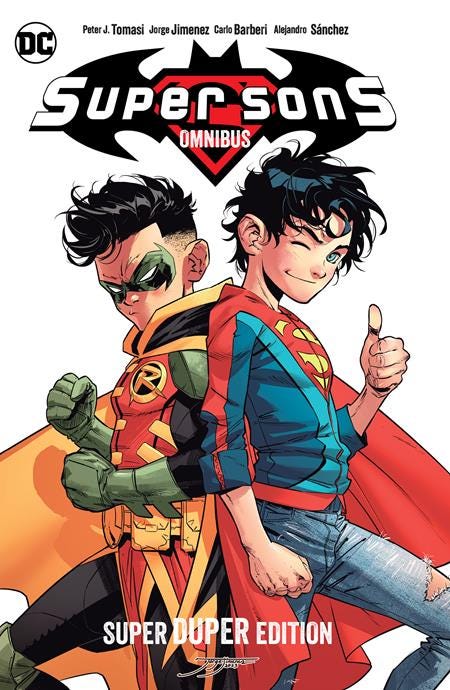
Do any of these creatives stop and consider the obvious question: What would initially draw us to these characters if not the fact that they are super-human? Jon Kent bears the double inheritance of Kryptonian power and human limitation. Yet, his true exceptionalism is that he prefers to stick his penis in another dude? Really?!
In place of “exploring his identity” through erotic experimentation, a worthy narrative might depict Jon confronting the temptation of self-sufficiency that power inevitably offers. It might show him learning, through failure and repentance, that true heroism is not the assertion of autonomous desire but the offering of one’s self in service to a common good that exceeds the self.
This entire superhero genre is rooted in the exploration of tension between superhuman capacity and the moral formation required to wield it rightly. Power is gift that must be disciplined by virtue. In the case of Jon Kent, the story writes itself: a character could be formed in the image of his father’s commitment to truth and justice, not as abstract slogans but as habits of the body and the will. He might learn that strength without mercy distorts the imago Dei, that the protection of the vulnerable is not a political slogan but a participation in divine stewardship. The secrets of his family could become the occasion for a deeper reckoning with his origin, with the mystery of being both alien and native, both mighty and limited. Such a reckoning would echo the classical and Christian understanding of the person as relational and ordered toward ends that transcend the self. Jon’s hybridity would then function not as a metaphor for fluid identity but as a sign of the union of divine and human natures in Christ, where the difference is assumed and redeemed rather than dissolved into a choice.
Again, this stuff writes itself. The entire superhero genre works because it dramatizes the reception of a given power, a given name, given mission that arrives outside the self and demands a response. What’s funny is that the attribution of sexual identity functions in precisely the same way, but only insofar as modern creatives utilize identity politics as powers endowed by the modern State and its institutions. The individual is proclaimed sovereign, yet this sovereignty is strangely dependent: it requires the backing of bureaucratic, educational, and cultural apparatuses to confer meaning and prestige upon the chosen marker. Without that scaffolding, the declaration that a character is homosexual would register as mere biographical trivia, no more narratively potent than a preference for coffee over tea. With it, the datum is elevated to the status of moral and dramatic revelation.

The modern State and its allied institutions make this possible by transforming identity into a consumable product. What presents itself as radical individualism is, in reality, a carefully managed pluralism. The creative class does not invent new depths of character; it simply assigns the approved labels and waits for institutional applause. Group affiliation, especially along the axis of erotic preference, is treated as self-justifying because the surrounding culture has already decided that deviation from the presumed default constitutes intrinsic value. This is also why the multiverse exists. Every multiverse is a theological warrant wherein several contradictory Jon Kents can coexist. One honoring familial inheritance in an animated feature while another can be reinvented through sexual self-definition in the comics.
Consider the archetype: Superman does not invent the mantle of truth and justice; he receives it as the son of Jor-El and Lara, as the adopted son of Jonathan and Martha Kent, and ultimately as the heir of a moral order that transcends both Krypton and Smallville. His drama lies in learning to bear that inheritance without being corrupted by it. The power is a dangerous gift that must be schooled by virtues he did not create: restraint, mercy, courage ordered toward the common good. The same pattern recurs across the great characters of the genre’s Golden and Silver ages. Batman inherits the trauma of his parents’ murder and the wealth that allows him to wage his war; he accepts the burden of becoming the symbol Gotham needs rather than the vengeance he might prefer. Spider-Man receives both the radioactive bite and the dying words of Uncle Ben; his greatness emerges from the acceptance of responsibility that flows from that dual inheritance, not from any reinvention of his core self.
In each case, the hero is not primarily a consumer of possible identities within a multiverse of options. He is a son or daughter who must answer the question: What will I do with what has been given to me? The inheritance may be biological, adoptive, cultural, or vocational, but it is always prior to the self’s deliberation. It carries weight, limit, and direction. Acceptance of that weight forms the character. Rejection or endless renegotiation dissolves it. The story gains tension precisely because the inheritance is not infinitely malleable. There is a givenness to the power that resists complete reinvention.
The current regime of superhero storytelling has largely abandoned this logic. Today's mainstream writers insist that rendering anti-normal as the new normal somehow confers upon that figure an intrinsic interest, as if immutable traits carry within themselves a surplus of meaning never requiring further specification. The character becomes “interesting” precisely by deviating from what is taken as default, and the deviation itself is treated as self-explanatory. No thicker account of the good, the true, or the beautiful is required. The gesture suffices because the imagination that produces it has already accepted a prior metaphysical claim: that identity is a project of self-construction rather than a participation in given reality. Postmodernity here reveals its characteristic emptiness, promising what has never existed and then congratulating itself for the novelty. Yet nothing new appears, no matter how often this pattern is repeated. Only the same thin assertions dressed in the language of empowerment.
Where the Christian imagination has traditionally formed desire toward participation in the body of Christ and the common good, late-modern cultural production trains desire toward the self. The comic book, like the marketplace, offers an endless array of possible "selves" from which one may choose, each marked by the appropriate badges of race and sexuality. The multiverse becomes the theological warrant for this pluralism where contradictory portrayals of Jon Kent need not trouble one another because they inhabit separate worlds and times. In this economy, Jon Kent does not inherit the moral and metaphysical weight of his father’s legacy. He simply chooses a new marker of difference and is thereby rendered “relatable” to everyone and to noone at the same time.

I wrote this essay in response to John F. Trent asking the question as to whether Jim Lee should be removed from his position. Such a query, while understandable as a reaction to institutional failure, remains trapped within the logic of managerial correction. Even if Jim Lee were removed from his position tomorrow, that single act would not undo the long accumulation of postmodern habits that have already corrupted the hearts and minds of so many working creatives today.
The path forward, therefore, does not lie in futile attempts to reform institutions that have grown rotten at the root. The mainstream comic industry is thoroughly captive to an ideology that has seeped into the industry for decades now. As such, the industry deserves to die a slow death, starved of talent, audience, and cultural authority as its repetitions grow ever more tedious and its pretensions more hollow. In its place, Christian creatives must step forward and work outside its decaying bounds. They must build anew: independent publishers, creator-owned imprints, webcomics, prose novels, animated series, or any other medium that allows our cultural inheritance to be honored rather than renegotiated.
Christian storytellers are uniquely equipped for this recovery because they already possess the thicker vision of the person: not a blank canvas for identity construction, but a creature addressed by name, situated within family, tradition, and creation, and called to participate in a good that exceeds every autonomous choice. We can tell tales in which the hero becomes great not by deviating from our givenness but by accepting it and offering it back in love. Such stories would not need the approval of corporate boards or the applause of institutional critics.
The mainstream may linger for a time, propped up by institutional inertia and captive capital. But its imaginative poverty is already evident. As it slowly expires, a new generation of creators who refuse the tyranny of the reinvented self can plant seeds for something better: superhero tales that once again remind us that the most compelling drama is not the assertion of preference, but the faithful reception of what God has given to us. Our inheritance awaits. The question is whether enough hands remain willing to take it up outside the walls of a dying empire.
Fandom Pulse is reader-supported independent journalism. Paid subscribers get exclusive scoops and investigative reporting daily.
In a gritty interstellar sanctuary teeming with 1,462 exiled governments, hard-nosed military policeman Chief Warrant Officer Graven Tower—a man who hates aliens—teams up with a beautiful xenocriminologist and his sharp-witted AI partner to solve the savage murder of an alien royal heir.
Packed with explosive military-SF action, noir intrigue, and politically incorrect edge, Quantum Mortis: A Man Disrupted delivers a fast-paced whodunit that will keep you turning pages until the final twist. If you crave old-school sci-fi thrillers with zero apologies, this is your next addiction.

NEXT: Military Science Fiction & Fantasy Author John Ringo Explains "Why Woke Stories And Characters Suck"

Bag it.
Tag it.
Jon Kent is a
Faggot.
Excuse me Sam but do you read these comics gay comics? Like in depth?
Because whatever Del Aroz and Trent are paying it's not enough if they're making you read gay porn.
Great article as always.