Joe Haldeman holds five Hugo Awards, five Nebula Awards, a Grand Master title from the Science Fiction and Fantasy Writers of America, and a place in the Science Fiction Hall of Fame. The name usually calls up one title, The Forever War (1974). The other four Hugos came across two decades and three lengths of fiction, and that work rarely comes up when people talk about him. At 83, Haldeman has a bibliography that includes two Star Trek novels, a pulp adventure series written under a pseudonym, a Vietnam horror story, and a novella about a forged Hemingway manuscript that won both the Hugo and the Nebula.
A Combat Engineer With an Astronomy Degree
Haldeman was born in Oklahoma City on June 9, 1943, and grew up in Puerto Rico, New Orleans, Washington, D.C., and Alaska. He married Mary Gay Potter in 1965. In 1967 he finished a bachelor’s degree in astronomy at the University of Maryland and was drafted. A college creative writing class that year produced the first two science fiction stories he would later sell.
The Army made him a combat engineer in the Central Highlands of Vietnam with the 4th Infantry Division. He was wounded in 1968 and received a Purple Heart. He sold his first story in 1969, and his first book, War Year (1972), drew on his army diaries. Fellow writer Ben Bova helped him sell it.
The Forever War began as his master’s thesis at the Iowa Writers’ Workshop, where he earned his MFA in 1975. Haldeman told The Worldshapers podcast that he wrote it as a series of novelettes because he needed income and knew he could sell novelettes to Analog. Analog was the former Astounding, the magazine John W. Campbell edited until his death in 1971. Campbell’s successor, Ben Bova, encouraged Haldeman to keep going. Installments ran between 1972 and 1975, and St. Martin’s Press published the book in 1974.

The story follows William Mandella, a drafted physics student fighting the alien Taurans. Troops travel between battles through collapsars, and the speeds involved mean months pass for Mandella while decades pass on Earth. Each return lands him on an Earth he no longer recognizes. His fellow soldier Marygay Potter shares a name with Haldeman’s wife. The novel won the Nebula in 1975 and the Hugo and Locus Awards in 1976.
The Pulp Years
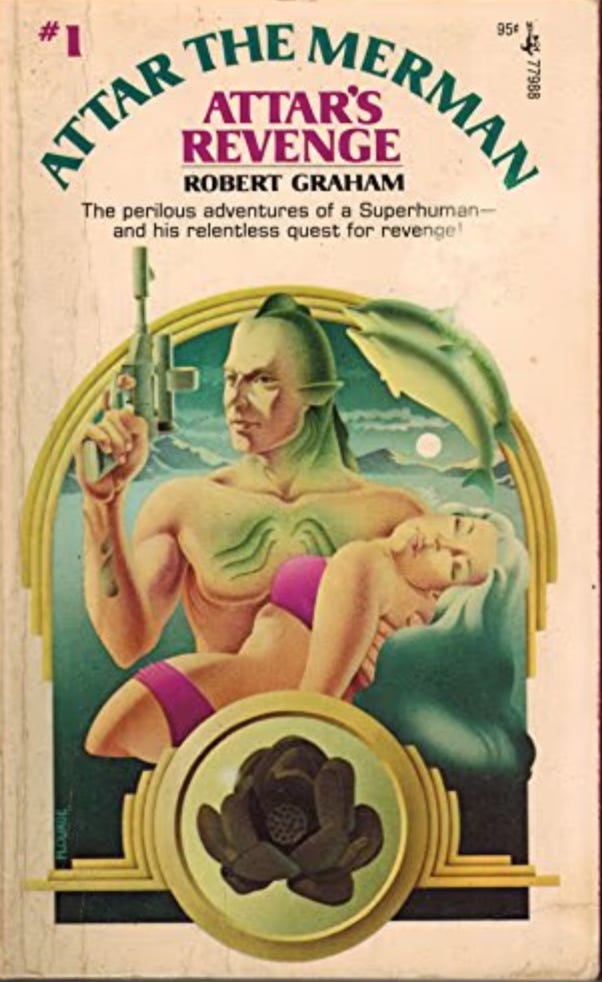
Haldeman was writing for a living in the 1970s, and he took work across the field. In 1975 Pocket Books published two paperback originals under the pen name Robert Graham, Attar’s Revenge and War of Nerves, about Attar, a sea-adapted fighter who moves between land and ocean. Mindbridge (1976) earned a Hugo nomination for Best Novel. In 1979 he contributed “Blood Brothers” to the first Thieves’ World anthology and created One Thumb, the owner of the Vulgar Unicorn tavern. He later wrote the screenplay for Robot Jox.
Bantam published his two Star Trek novels, Planet of Judgment in August 1977 and World Without End in February 1979. In the author’s note to the second, Haldeman wrote that he had been overseas when most of the series aired. He thanked Gene Roddenberry for letting him take liberties with the characters and for suggesting a few, and he thanked Gregory Benford for working out what happens to bodies of water inside a planetoid. Haldeman has said Planet of Judgment took three months to write and World Without End took nine, and that the second was “like pulling your own teeth.”
The Hemingway Hoax
The Hemingway Hoax ran in Asimov’s Science Fiction in April 1990 and won the Hugo and the Nebula for best novella. Avon published an expanded novel edition in 1991. Hemingway’s first wife, Hadley, lost a bag on a Paris train containing the manuscript of his first novel. A Hemingway scholar named John Baird decides to use that loss to account for a fake manuscript he creates. The forgery drags him into time travel and parallel universes, and Hemingway’s reputation becomes tied to the fate of the omniverse. Haldeman’s unused subtitle for the book was “A Short Comic Novel of Existential Terror.”

His short fiction drew the same recognition. “Tricentennial” (Analog, July 1976) won the Hugo and the Locus Award for short story. “Graves” (F&SF, 1992), a horror story set in Vietnam, won the Nebula and the World Fantasy Award. “None So Blind” (Asimov’s, November 1994) won the Hugo and the Locus Award and gave its name to a 1996 collection.
Forever Peace and the Later Novels

Forever Peace (1997) won the Hugo and the Nebula, along with the John W. Campbell Memorial Award. It is thematically linked to The Forever War but takes place in a different universe. Forever Free (1999) is the sequel to the original. The Worlds trilogy (1981, 1983, 1992) follows a human society fractured by nuclear war and scattered across space habitats. Camouflage (2004), about an alien shapeshifter long stranded on Earth, won the Nebula and the James Tiptree Jr. Award. Old Twentieth (2005) sends immortal time travelers from the future back to the twentieth century. The Marsbound trilogy closed with Earthbound in 2011, and Work Done for Hire followed in 2014.
MIT and the Grand Master
From 1983 until he retired in 2014, Haldeman taught writing at the Massachusetts Institute of Technology as an adjunct professor, and he set The Accidental Time Machine (2007) there. He served as SFWA treasurer in the early 1970s and as its president from 1992 to 1994. SFWA’s officers and past presidents selected him as its 27th Grand Master in 2009, and he received the Damon Knight Memorial Grand Master Award at the 2010 Nebula weekend. The Science Fiction Hall of Fame inducted him in June 2012. In a 2016 interview, Haldeman said, “Jack of all trades, master of none I think.”
A reader who finishes The Forever War has two choices that won the same awards: The Hemingway Hoax, or Forever Peace more than two decades later. Which should a new reader pick up next, and why does so little of the rest of his catalog get discussed?
If the golden age of Trek and Babylon 5 left a hole in your sci-fi diet, The Stars Entwined fills it — interstellar espionage between two civilizations on the brink of war. Read The Stars Entwined on Amazon!