



Jack Posobiec, the creator of The Island of Free Ice Cream and Agent Poso: Task Force Aegis blasted Universal Pictures recently released Wicked film for “celebrating DEI and wokeness targeting children.”
In a post to X, Posobiec wrote, “The cast themselves explain it is a film celebrating DEI and wokeness targeting children. The film adaptation of *Wicked* is not just a retelling of a beloved story; it's an explicit statement on diversity, identity, and social justice, as articulated by its cast themselves.”
He then listed out eight different points. First, he wrote, “1. **Racial Identity and Representation:** - With Cynthia Erivo stepping into the role of Elphaba, the film proudly showcases Black representation in a lead role traditionally portrayed by white actors. Erivo has stated that her interpretation of Elphaba is deeply personal, infusing the character with her own experiences as a Black, queer woman.”
To that point Erivo told Rolling Stone, “I hope it’s a bit of a love letter to everyone who feels different, who feels out of place, to all of the Black women who have walked into rooms and felt like they haven’t been welcomed. To anyone who’s walked into a room and felt like they haven’t been welcomed. I am really glad to be the conduit through which this character has been brought to the world.”
Second, he stated, “2. **Queer Themes and Representation:** - The film embraces its queer theme more explicitly than ever. Both Erivo and other cast members like Jonathan Bailey (Fiyero) and Bowen Yang (Pfannee) bring their own identities into their performances, making *Wicked* a film that celebrates queer narratives. The actors have openly discussed the film's queerness, highlighting how the story of Elphaba and Glinda can resonate with the LGBTQ+ community, particularly through themes of otherness and ‘love beyond societal norms.’”
Eviro specifically discussed her disordered queer identity and how she injected it into the film with Rolling Stone, “Wicked is a reclamation and a reimagining of the labels used against her,It is the proclamation of her right to exist in all her power. If that sounds familiar to you colorful, magical people in this room — it should.”
Posobiec continued, “3. **Intersectionality:** - *Wicked* in its new form examines the intersection of various identities—race, gender, sexuality, and disability. Marissa Bode's casting as Nessarose, who uses a wheelchair, adds another layer to this intersectional narrative. The film doesn't shy away from showing how these identities can compound the challenges characters face, reflecting real-world complexities.”
Bode told People she described her casting as “an incredible accomplishment” for the disabled community. She added, “"I think when you don't understand something, it makes it more scary or it's something to, I don't know, just make judgment of because you don't know much about it.”
Bode continued, “So I think representation, obviously in the conversation of representation being on this has definitely been very front and center as it should be. . . I would love if [people] haven't already, to put in the work to make sure that they're being as inclusive and thoughtful of the disabled community as well.”
“4. **Social Outcasting and Discrimination:** - The narrative of being ostracized for being different is central to Elphaba's story. By casting a Black actress in this role, the film amplifies the theme of racial discrimination, making a direct connection to contemporary discussions about systemic racism and colorism,” Posobiec said with his fourth point, which is clearly done on purpose based on Eviro’s comments to Rolling Stone seen above.
For his fifth point, Posobiec wrote, “5. **Challenging Binary Morality:** - The movie, like its source material, deconstructs the black-and-white morality of its predecessor, *The Wizard of Oz*. It asks viewers to question who decides what's ‘wicked’ and why, a theme that parallels current debates on morality, justice, and the labeling of marginalized groups.”
The film’s director John Chu discussed with America Magazine the challenge Elpha faces, “Are you wicked? Are you good? Or maybe you’re a combination of the two.”
Chu also shared, “[It was] this uncomfortable feeling that we don’t know what the next chapter is going to look like. And that it’s gonna be on us to determine what that story is: how big we dream, how much we decide we’re a citizen of the world or not. How much we decide to defend a home that maybe we discover…isn’t necessarily made for you or for your dreams. And what is it worth to you to defend that and fight for that?”
Next, Poso wrote, “6. **The Power of Allyship:** - Glinda's journey from a popular, privileged student to someone who uses her status to support Elphaba touches on themes of allyship. Ariana Grande, playing Glinda, has spoken about how this character's arc mirrors the importance of using one's privilege for advocacy, a core principle in many social justice movements.”
When asked about allyship, Grande said, “Oz is just a celebration of uniqueness. And everyone is so beautiful in Oz. And I don’t think it even is a conscious discussion or decision. Everyone is just so beautifully queer and that roots all the way back to the L. Frank Baum books, where like literally the most commonly used word in the books is queer. And it starred her queer, lovely, and beautiful friends. It’s just a celebration and how you honor that history.”
READ: Report: Major Corporations Remain Committed To DEI Despite Massive Backlash
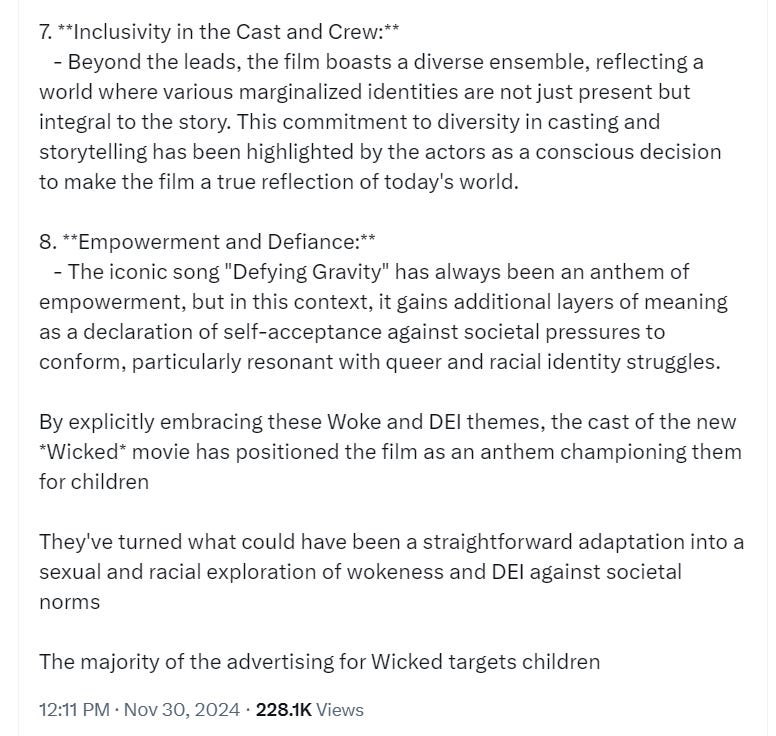
For his seventh point, Posobiec wrote, “7. **Inclusivity in the Cast and Crew:** - Beyond the leads, the film boasts a diverse ensemble, reflecting a world where various marginalized identities are not just present but integral to the story. This commitment to diversity in casting and storytelling has been highlighted by the actors as a conscious decision to make the film a true reflection of today's world.”
Finally, in his eighth point he wrote, “8. **Empowerment and Defiance:** - The iconic song ‘Defying Gravity’ has always been an anthem of empowerment, but in this context, it gains additional layers of meaning as a declaration of self-acceptance against societal pressures to conform, particularly resonant with queer and racial identity struggles.”
Posobiec then concluded, “By explicitly embracing these Woke and DEI themes, the cast of the new *Wicked* movie has positioned the film as an anthem championing them for children. They've turned what could have been a straightforward adaptation into a sexual and racial exploration of wokeness and DEI against societal norms The majority of the advertising for Wicked targets children.”
What do you make of Posobiec blasting Wicked? Become a paid member to leave a comment and support our journalism.
For a book that promotes moral integrity and strong Christian and conservative values for children read Jack Posobiec’s The Island of Free Ice Cream on Amazon.
NEXT: Star Trek Doubling Down On Lower Decks As Star Tawny Newsome Developing Live-Action Comedy Show