


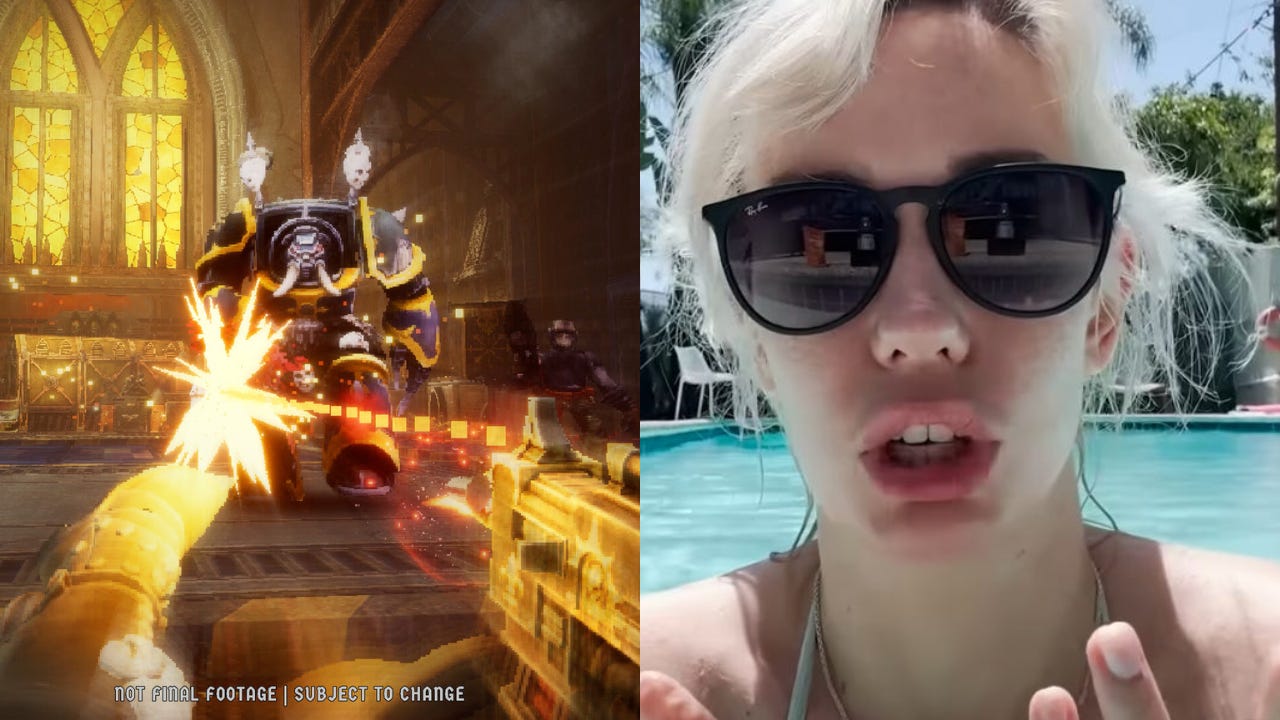
As many Warhammer 40K fans are aware, Warhammer 40,000: Boltgun 2 is scheduled to release in 2026 for PlayStation 5, Windows and Xbox Series X/S. Like its predecessor, Boltgun 2 will be another first-person shooter video game developed by Auroch Digital and published by Big Fan Games, a label of Devolver Digital.
The appeal of the game is obvious: it is set in the Warhammer 40,000 universe and is a direct sequel to Warhammer 40,000: Boltgun. While it exists, ostensibly, as a reskinned boomershooter, the game demonstrates how nostalgia and brand recognition function as legitimating myths in contemporary gaming. The game itself is buoyed by the Warhammer 40k license which makes an otherwise unremarkable game stand out.
Boltgun 2, however, is worth our attention because the game promotes the introduction of a new playable character, a Sister of Battle, and the celebrity voice attached to her.
Alanah Pearce’s involvement in Bolt Gun 2 illustrates the way gaming culture increasingly relies on the symbolic capital of celebrity culture rather than the craft of game‑making itself. Pearce, who has previously been associated with God of War: Ragnarok through minor contributions such as menu options and ancillary material, has often passed herself off as a “writer” and, more recently, as a voice actor. The significance of this has less to do with whatever quality she contributes but in the way her presence functions in the industry. The industry hired her not because she demonstrated mastery of design or performance but simply because she is an influencer.
The connection deepens when we recall that the protagonist of the first Bolt Gun was voiced by Rahul Kohli, who is also personally connected to Pearce. This is nepotism and it reveals the circularity of recognition within games media. Apparently, what matters is not the quality of the work, but the circulation of names within a closed economy of influence. The myth at work here is that proximity to celebrity confers authenticity and that the mere presence of recognizable figures guarantees value.
The YouTuber, Craftianist, has much to say about this here:
How Did We Get Here?
The rise of Let’s Play culture in the 2010s demonstrated how developers would incorporate references to popular streamers to harness their audiences. What began as incidental has now, many years later, evolved into something systemic. Now studios are actively cherry-picking and grooming influencers for brand recognition. The video game Dispatch illustrates this clearly. Though celebrated as a creative risk, its casting of YouTubers and the entire Critical Role ensemble reveals the same logic as BioWare or Obsidian before it. Random figures from the internet are folded into the credits, not because they are the best candidates, but because their names guarantee visibility.
The rhetoric of risk and creativity is all just a lie. Publishers and developers alike know that parasocial attachments ensure an audiences will accept the art as authentic. Whether or not Charlie White (MoistCr1TiKaL) said children should be allowed to consent to genital mutilation or Alanah Pearce lied about writing for God of War: Ragnarok is all beside the point. Everyone, on some level, understands that these influencers are being used for entirely cynical purposes.

The deeper problem is the current conditioning of audiences. Consumers have become accustomed to treating influencers as products, and in turn, to being treated as wallets. The parasocial economy thrives on this attachment and that has eroded the capacity for critical thought. What matters is how the structure of the industry has come to depend on this cycle.
Influencer Culture And Games Journalism
Influencer culture in gaming has been well-recognized as an extension of media corruption. GamerGate is proof in the pudding in that regard. And, unfortunately, not much has changed. In fact, the corruption has just intensified because the public either isn’t aware or they simply don’t care. Moreover, very few influencers who are in the know will be reluctant to expose said corruption because they themselves thrive on it and they risk being cancelled if they bring too much attention to it.
Ultimately, however, it goes without saying that the category of “game journalist” has long been a misnomer. What passes as journalism is indistinguishable from marketing. Influencers who fancy themselves as journalists have been fully realized in promotional development. These are parasocial figures who will align themselves with any company that offers compensation, thereby collapsing the distinction between unbiased journalistic critique and straight-up product marketing.
Consider the case of Matty Plays, who notoriously described Fallout 4 as “near perfect” upon release. Was his role as a journalist to provide independent analysis or to reinforce the legitimacy of Bethesda’s product? Matty Plays has become a fixture in the RPG commentary space with his presence algorithmically reproduced across recommendations. Like Alanah Pearce, his work exemplifies the broader dynamic of celebrity privilege, regardless of merit.
Tourists Are Killing Franchises
Developers collaborating with or even hiring fans is not a new phenomenon. For example, Dragon Age: The Veilguard and its “community council” provides a particularly revealing example of how the rhetoric of fan participation functions as a legitimating facet. The council was composed of figures drawn from YouTube channels, commentary spaces, and fan communities; all individuals who were presented as representatives of the audience. They were given direct lines of communication with BioWare and played a role in shaping the game that was eventually released.
By placing fans in advisory positions, the company could claim that the game was responsive to its community and that it was participatory and democratic. Yet the underlying dynamic remained one of control because the terms of participation were still set by the company. Their names in the credits were designed to present the product as authentic.
There is an ongoing parasitic logic of using celebrity influencers in contemporary gaming. Influencers will move from one project to another, attaching themselves to successive titles, not because of deep investment in the craft, but because their visibility makes them useful to developers. Just slap a franchise t-shirt on an e-celeb and, somehow, he or she represents the “real fans.” In reality, all they represent is the circulation of attention. Their role is not to embody community, but to embody a shallow market logic that is killing these franchises by trying to make them appeal to the mythical “modern audience.”
Participation Is Commodified; Influencers Are Now The Product
When the game is poorly received, many of these figures distance themselves, refusing accountability. This too is part of the cycle. They can claim authenticity when convenient, and disavow responsibility when the product fails. There’s a very short drop from “This franchise means the world to me” to suddenly saying, “it’s just a video game. Get over it.”
Failed journalists and influencers are now leveraging their online recognition to pivot into higher roles, including voice acting. And so we see figures such Charlie White (MoistCr1TiKaL), Alanah Pearce, Jack McLoughlin (jacksepticeye) or Ben Cassell (CohhCarnage) selected to participate in video games not because of their craft but for the branding they bring. Their presence is free advertising for whatever viewership their platforms bring.
Years ago, Matthew Mercer was enlisted in Pillars of Eternity and later in titles like Fallout 4 or Baldur’s Gate 3. The idea was to use celebrity presence to draw in “tourist” consumers whose attachment to recognizable names could be converted into sales. Even titles like Rogue Trader have not been immune to this logic, incorporating influencers into their casts for the sake of visibility.
The YouTuber YongYea, whose performance in Yakuza was widely criticized, has nonetheless been given roles in titles like Avowed and The Outer Worlds 2. Similarly, Alanah Pearce’s sudden appearance in Boltgun 2 and also wearing Warhammer 40k apparel illustrates how recognition itself, rather than investment within the franchise, is mobilized as a marketing tool. The veneer of fandom is deployed to mask the reality of commodification.
This is parasitic. Celebrity tourists are attaching themselves to projects under the guise of authenticity before they move on to the next opportunity once the product’s visibility has been secured. The myth at work is that these figures embody the voice of the community when, in reality, they embody the circulation of capital.
Influencer culture is a plague on the system simply because it undermines the possibility of industry access through genuine merit. Instead, the current cultural economy is one governed by parasocial attachments and shallow market logic.
Gaming is dead.
NEXT: ‘Final Fantasy VII Remake’ Voice Actor Calls For Fans To Stop Tagging VAs With Smut

My only minor criticism of this piece, is you saying “Gaming is dead”, and it’s not. It’s just infected.
Warhammer gets another Whorescammer. Sad.