


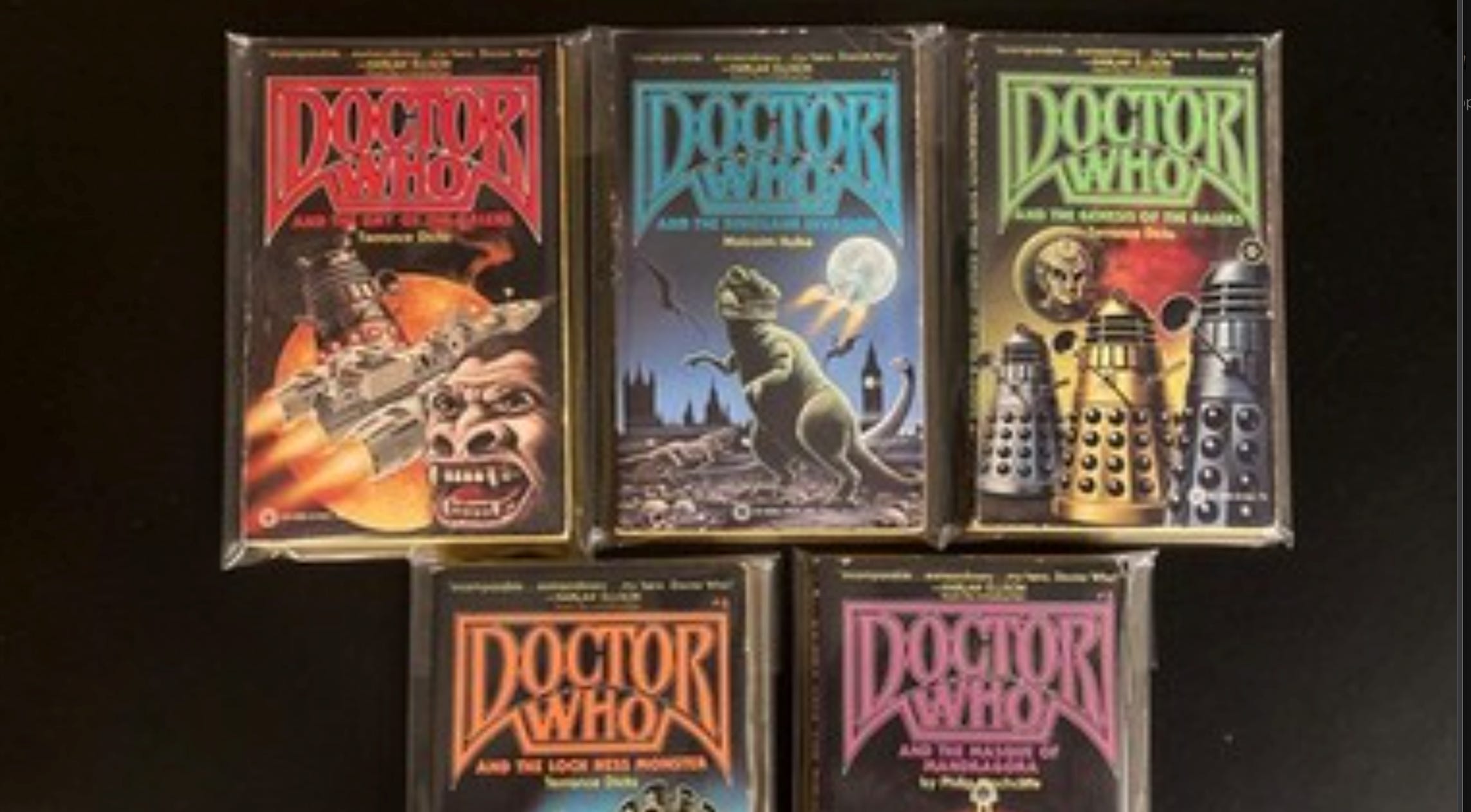
Harlan Ellison attacked Star Trek and Star Wars in the introduction to Pinnacle Books’ American Doctor Who paperbacks in 1979, and the text ran in front of readers in all ten volumes. The same writer later took Star Trek’s publisher and studio to court over tie-in books.
Ellison dismissed Star Wars and Close Encounters of the Third Kind, then turned on Star Trek. He wrote that it “can turn your brains into purée of bat guano.” He followed that by declaring Doctor Who the greatest science fiction series of all time and daring his audience to argue with him.
The Star Wars shots came wrapped in a scene. Ellison describes standing on the lecture platform at the World Science Fiction Convention in front of fifteen hundred people and telling them Doctor Who was better. Children in Luke Skywalker pajamas and adults in Darth Vader masks howled back at him, and he says convention monitors moved in with truncheons. Later in the essay he calls Star Wars a sophomoric work that hides simplistic, clichéd structure behind homage, and he rates the Doctor above Han Solo and Luke as a hero who acts. His complaint about Star Trek runs the other way: it presents itself as deep and intellectual and delivers superficial, self-conscious material.
Pinnacle released the line between April 1979 and June 1980: ten Target novelizations from the Jon Pertwee and Tom Baker eras, starting with Day of the Daleks and Doomsday Weapon. Terrance Dicks wrote Day of the Daleks and Genesis of the Daleks, among others, and Malcolm Hulke wrote Doomsday Weapon.
Pinnacle Americanized the text. Spellings changed, bonnets and boots became hoods and trunks, and jelly babies became jelly beans. David Mann painted covers that left the Doctor and the TARDIS off. Short bios of the Doctor and his companions were written so that all ten books read like Tom Baker stories, Pertwee ones included. The back pages advertised Pinnacle’s Richard Blade and Knight Rider series.
The books mattered because Doctor Who was an obscure import in America in 1979. Target had launched the novelization line in 1973, and many of its books were written by the show’s own scriptwriters and script editors. This was before home video, and the show aired in scattered syndicated slots. Pinnacle’s paperbacks gave American readers the stories, and Ellison’s introduction gave them a guide to the TARDIS, the Doctor’s two hearts, and the Daleks. Doomsday Weapon and Day of the Daleks had reached fifth printings by November 1984. Nelson Doubleday also issued a combined hardcover in 1979 with the introduction included. Pinnacle went bankrupt in 1985, and Windsor Publishing Corp., which bought it, kept the reprints going until April 1989.
Ellison traces his own conversion to 1975, when Michael Moorcock sat him down in front of a London television set. He writes that he despised TV after sixteen years of writing it, and that Doctor Who belongs with the pulp reading he grew up on, Burroughs, Doc Savage and Conan. He says outright that the Doctor’s adventures do not reach Dickens, Twain or Kafka.
The odd part is the venue. Ellison wrote “The City on the Edge of Forever” for Star Trek in 1967, saw it rewritten, and fought Gene Roddenberry over it for the rest of his life. Pocket Books took over the Star Trek fiction license in 1979, the year Pinnacle’s Doctor Who line launched. In 2006, Ellison went after Simon & Schuster and Pocket Books over a Trek novel that used his “City” characters without his permission. In 2009 he sued CBS Paramount Television, claiming unpaid royalties on derivative works that included tie-in novels and merchandise, and the case settled within six months.
He made one known exception. Peter David said Ellison assured him that “Imzadi” would stay out of the litigation because “he’d never cause a close friend that kind of grief.” David had also asked his permission when he first conceived the plot.
The pattern in those fights is rights and money. Ellison’s public stance for decades was that writers get paid and that studios do not get to use a writer’s work for free. A commissioned introduction in every book of a licensed line fits that stance, and the likeliest explanation is a Pinnacle fee. Doctor Who also gave him a clean target. He had no grievance against the BBC, and the line handed him a pulpit to swing at the franchise he did have a grievance with.
A reader dictated the full text on Reddit for your reading pleasure.
Did Ellison write it because he loved Doctor Who, because Pinnacle paid him, or because it let him hit Star Trek and Star Wars in print?
First contact with the Oridians was supposed to be humanity’s proudest moment. Instead, their chief engineer is dead, their ship is sabotaged, and an ancient alien technology is stealing souls. Book one of the Valiant Frontiers series delivers exploration, mystery, and the kind of crew you’ll want to follow across the galaxy. Read The Soul Catcher on Amazon and start the adventure.
Talented as he may have been, the man was an insufferable, miserable, litigious, little troll.
His work could have expanded science fiction in meaningful and excellent ways. Instead, he chose to wall everything everywhere and launch, often unprovoked, attacks at every neighboring kingdom that offended his perfect view of himself in the clouds.
What an absolute clown.