


Image Comics announced on Monday, November 16 that Daniel Warren Johnson’s Chainkata #1 had sold out. The comic went on sale on Wednesday, November 18. For two days the most successful new comic in America was a comic nobody had read.
That sentence is not an insult to the book. It is how the direct market works, and it is the reason the number Image gave deserves more scrutiny than most comic media gave it.
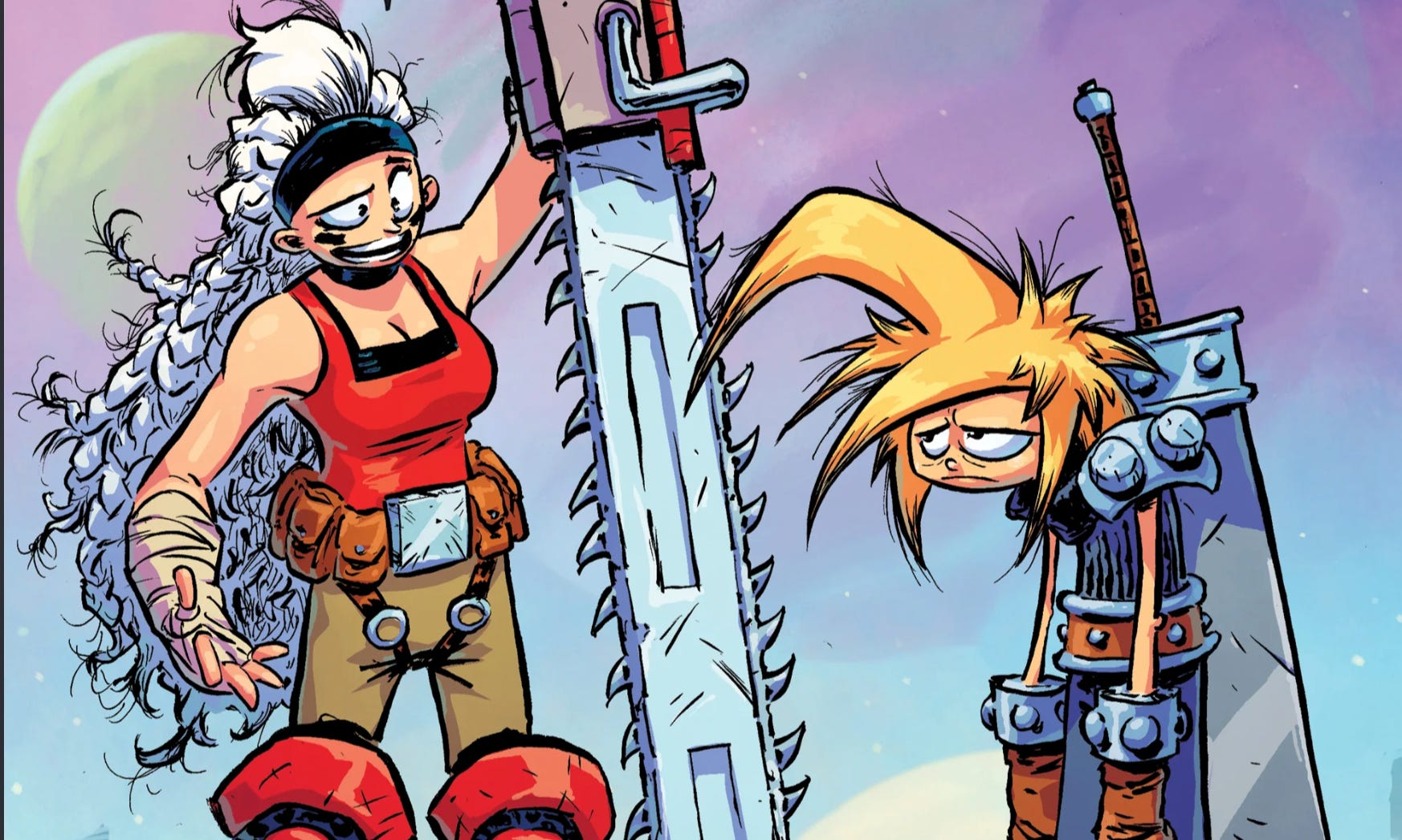
Chainkata is a new creator-owned science fiction series from Johnson, who writes and draws it. The hero is Luma, a warrior queen with a chainsaw who is searching the vastness of space for an unknown power. Image’s synopsis says she wants peace and that violence and terror follow her through every black hole. The issue costs $3.99, and Bleeding Cool lists it at 40 pages with no ads.
Image’s marketing line for the series is “Chicks. With chainsaws. In space.” That slogan carries a lot of the book’s appeal, and it appears in the October release announcing the variant covers. It tells you what Image expected shops to order and what it expected collectors to chase.
Johnson says he drew the first sketch of Luma in 2017 and spent nine years finding a story worth putting on the stands. He took the title from Equilibrium, the Christian Bale film with gun kata, and he has said Warhammer 40k and Princess Mononoke shaped her design. It is his first series since Transformers ended at issue #24 in September 2025.
Image’s release says the first issue sold out of an initial print run of over 250,000 copies at the distributor level. ICv2 and The Beat both report it as Image’s announcement, and neither published distributor data. The announcement describes copies that comic shops ordered. It says nothing about copies readers bought.
A shop that orders 20 copies of a book has not sold 20 copies. It has bet on them. Whether the bet pays off shows up in the weeks after release, in how many copies leave the shelves and how many go back in a longbox at the back of the store. A sellout at the distributor level tells you demand among retailers was high. It says little about how many people wanted to read the story.
Image also called the launch “the biggest launch of the year,” according to ICv2. ICv2 added in the same piece that it has a way to go to catch the Marvel Midnight launch issues, which sold over 1 million. The Beat quoted a different claim from the same Image release: that the publisher is rushing the issue back to print to keep up with “exceptionally high volume of reorder activity.” That is evidence of demand, and it comes from Image’s own order data. Shops can reorder because they sold copies, and they can also reorder because they sold out of the ones they ordered. The second printing will be in stores on December 23, the day issue #2 ships.
The cover count is the strongest evidence for a collector-driven launch. Image’s own October release says the direct market showed up with 116 retailer-exclusive covers for Chainkata #1. On top of those, the standard run has nine official covers, including two 1:100 incentives and a 1:1000 original head sketch. Bleeding Cool reported in the summer that Image sources said retailer support was tracking at “Energon or Absolute Batman levels.” Those are the two books that set the bar for variant counts this year.
A retailer-exclusive cover is made for collectors. A shop commissions it to sell to people who want that image, and the shop usually prints it in a limited run. One example is Third Eye’s exclusive by Jim Rugg, a Texas Chain Saw Massacre homage limited to 400 copies at $29.99. I could not find a published minimum order for the 116, so I can’t say how many of the 250,000 copies are variants. If each exclusive ran 400 to 500 copies, that would be roughly 46,000 to 58,000, but that’s my arithmetic on a guess.
I also found no data on how many orders came from speculators, and no film or TV deal behind the hype. Anyone who tells you the 250,000 is speculator padding is asserting something nobody has measured. What I can say is that the order number has a large, documented collector component, and that Image has not said how large.
Image’s own history gives a useful comparison. ICv2 has Spawn #300 at over 265,000 orders in 2019, Fire Power #1 at over 200,000 in 2020, and Spawn’s Universe #1 at over 200,000 in 2021. Battle Beast #1 hit nearly 400,000 worldwide. A quarter-million is a very big number for Image. It is not a record, and it sits in the same range as a handful of earlier launches that came with collector mechanics of their own.
To understand the reception, it helps to recall Johnson’s previous high-profile project. In October 2025 he wrote and drew Absolute Batman 2025 Annual #1 for DC. At San Diego Comic-Con that summer he said the book would feature “Batman beating up white nationalists,” and it does. Reports describe Batman fighting white nationalist gangs and corrupt police.
Johnson also posted a sketch of that Batman gripping an ICE officer, and the response online was heavy. Chuck Dixon answered with his own sketch of Batman as an ICE agent fighting Antifa. The “Antifa” label came from that exchange. It did not come from Johnson.
I should be clear about what happened next, because it complicates the story. The annual sold well enough to top a weekly sales list, and it won the 2026 Eisner Award for Best One-Shot/Single Issue. In his acceptance speech Johnson said, “Thank you, DC, for standing with the story.” So the backlash was real, and so was the commercial and critical success. Anyone arguing that the Batman story damaged Johnson’s standing has to explain the Eisner.
That history matters to Chainkata for a plain reason. Johnson now has an audience that formed around politics he put into a mainstream superhero comic, and a collector market that formed around a book that won awards. Some of the 250,000 are readers who followed him there. Some are people who bought the cover.
I haven’t read the issue, so I can’t tell you whether Chainkata carries any of that politics. A $3.99 space opera about a chainsaw queen could simply be what Image says it is, though it reeks of strong female lead-itis. Reviews exist, and one early Patreon writer called it possibly Johnson’s real magnum opus.
The facts that hold up are these. The 250,000 is Image’s own unaudited order figure. At least some of it is variants made for collectors, and 116 exclusives is a lot. The reorder claim is the best argument that real demand exists, and it also comes from Image.
When Image reports sell-through for Chainkata #1 after the first month, how many of those 250,000 copies will have gone to readers, and will Image tell anyone?