


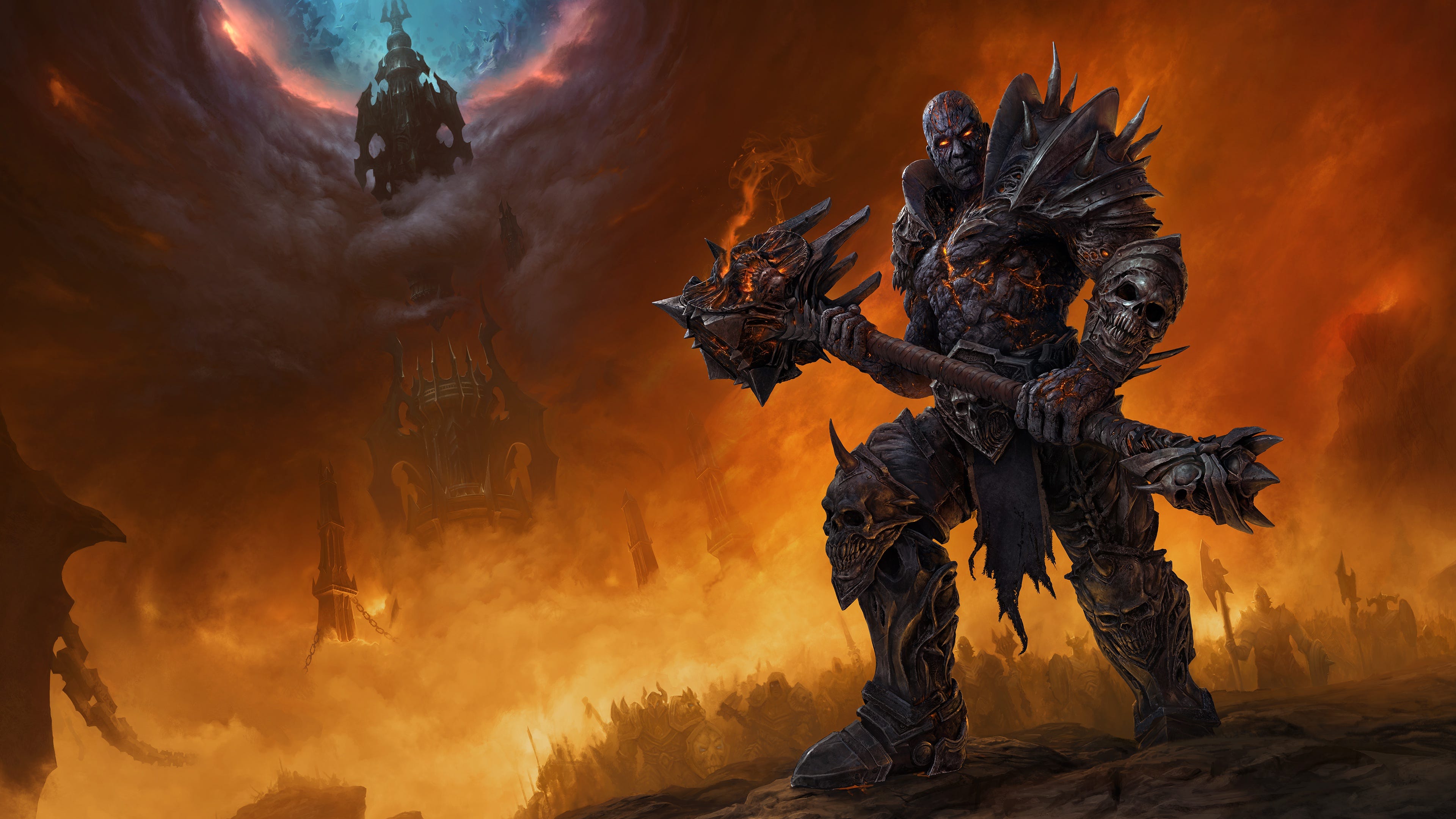
Jon Del Arroz’s Fandom Pulse piece on the BlizzCon show laid the dates on the table: Diablo V in spring 2029, a StarCraft open-world shooter in spring 2030, a Netflix Diablo cartoon still “in development,” and a Warcraft III campaign that shipped on the spot. The slate looks fat. The calendar says come back in three to four years. Jon is right about the stagecraft. Announcing StarCraft as a shooter four years out, on a franchise whose last mainline game sits about sixteen years behind us, is the speech of a company that needs an escape route for investors while Microsoft’s gaming arm eats layoffs, a fresh harassment suit five years after the “frat boy” settlements, a $250 million shareholder payout over the Kotick sale, and hardware revenue falling off a cliff. Rockstar has been on GTA VI since roughly 2018 and still needed two delays. This is a punt dressed as vision.
The delay is the business story. The older story is why Warcraft stopped being a war for a kingdom and became a long seminar on why the kingdom deserved to fall. The YouTuber Frank the Fox made that case in two videos this summer, “How Blizzard Declared Warcraft on Millennial Men” and “How World of Warcraft Destroyed the White Man.” The argument below follows his, with credit.
Warcraft on Millennial Men
Fox’s first video treats the RTS trilogy as formative culture work. Warcraft: Orcs & Humans (1994) inherited a Western picture millennial boys already knew from paperbacks, arcades, and religious foundations they had only half noticed: castles, knights, peasants, clerics, kings. The Horde arrived as a force of pure evil, not refugees with a list of grievances. The orcs came through the Dark Portal to burn everything to the ground.
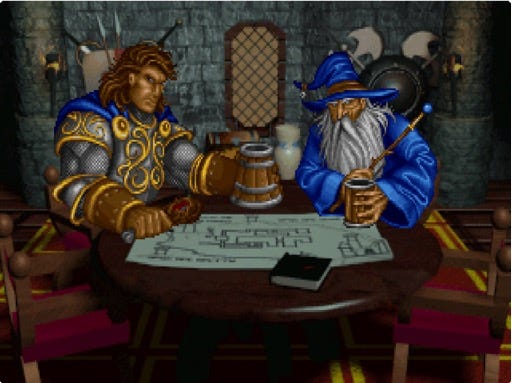
So click the footman. He said yes, my liege. That is an entire moral universe in one sentence. The footman is cheap infantry, sword and shield, but he still answers to you. Liege is an old word. It means the one to whom you owe faith and the one who owes you protection in return. To click the unit is to command him, and his reply is his consent.
That was the engine of the early RTS games. Warcraft I was built so a young man would feel like a leader. You were a commander of men, each of them waiting on your word. The pleasure of the genre was the responsibility: spend your troops well and hold the line against the forces of evil. Men are supposed to want that. They are supposed to take a place above other men in a chain of command and answer for what happens to the men beneath them. The game made that hunger playable.
Frank the Fox is right that the early human faction sounded like a remembered Europe. The game even put a church on the build menu, as if worship of Christ were simply part of the world’s infrastructure.
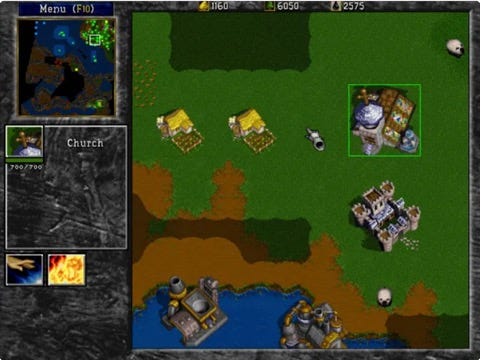
Warcraft I had one clean idea: humans defend the kingdom, orcs are the enemy, stop them.
Warcraft II made the good side bigger: dwarves, elves, and gnomes fighting alongside the humans. The war felt larger and far more exciting. At the same time, it added a new idea that quietly ruined the old one: the orcs were monsters only because demons had twisted them. They were victims first, villains second. Nature versus nurture.
That second idea is the seed. Once you accept it, “kill the Horde to save your people” stops being a simple duty and turns into a story about an abused enemy, and maybe about your own side as the real problem. Warcraft III grew that seed until it blossomed. Former enemies are now victims, and, hey, maybe your own people are the distrustful ones.
Warcraft III completed that inversion. The Alliance, Christendom in fantasy, fell to rot inside its own house. Terenas died at the hands of his son. Gilneas shut its gates. Stromgarde walked away. The coalition you had spent two games building lost to desertion rather than to a greater army. It quit. It splintered. It treated the old bonds as optional right as the real enemy arrived.
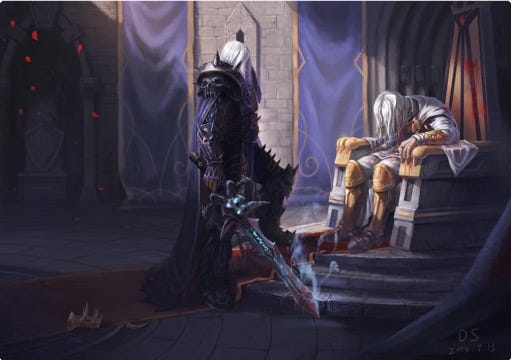
Arthas is the blond-haired, blue-eyed prince of Lordaeron: pale, European, paladin-trained, son of the king, and the face the first two games taught you to defend. He is what the West looks like when it still believes it produces heroes. Blizzard handed you the ideal and then, mission by mission, walked you through his undoing.
That is the deconstruction. A generation that had spent two games defending a civilization was trained to play as the hero who burns his kingdom to the ground. You watch Christendom fall, and you play the golden-haired son who brings it all down. By the time Wrath of the Lich King lets ten million people put him in the ground, the lesson is already installed: the tragedy is the corruption of the best man. The civilization he ruined stays in ruins. Meanwhile, the exile who sailed west keeps his eyes on the horizon.
Thrall is the replacement myth. Raised among humans, he sheds their internment camps, recovers shamanism, and sails west for a new world. He is young, clean of the old bloodlust, spiritually plugged into earth and ancestors instead of cathedral and crown. The game wants you to feel the wind at his back. The future belongs to the exile who found a truer god than the one in the human churches.
So the inversion is personal, and it is racial-coded in the old fantasy sense, even when later writers stay quiet about that coding. The Horde receives sympathy, spirit, and a new land. The Alliance receives a beautiful corpse: Arthas, the man who becomes the Lich King. That is what “went woke” means here, if the word is going to mean anything exact. What happened to Warcraft is not as blatant as a Pride Month event and a rainbow mount. Woke, in this case, is the transfer of moral authority away from those who ought to inherit it and into the hands of those outside the system. The old story said evil is real and comes from beyond. The new story said your own people are corrupt, while the displaced orcs and their shamanistic powers are only misunderstood victims.
How World of Warcraft Destroyed the White Man
Fox’s second video chronicles what happens when the early games’ sermons become a place you pay to live in. World of Warcraft launched in 2004, a year set inside a hangover. The World Trade Center towers had fallen three years earlier and, for a brief season, the country sounded like Warcraft I again. There was an enemy at the gate, a weapon that needed picking up, and a job only a man could name. Then the war in Iraq stretched on, and the weapons we were searching for stayed missing. The briefings soured. The men who had not died came home broken. The feeling of a clear war with a clear command faded into noise and distrust. The people who said “charge” no longer had the moral authority they had on day one.
At home the other pillars were already thin. Trades that once turned boys into men had been talked down for a generation. Shop class gave way to the university brochure. Manufacturing jobs left for cheaper shores. Everyone was told the upgrade path was in his credentials. So we collected the debt and trusted the science. After graduation we walked into a labor market short on the jobs the brochures had promised. Work still existed. Work with meaning was scarce.
Effort in the real world landed in opaque hierarchies where the rewards felt arbitrary and the ladder to success disappeared into fog.
The family unit followed the same delay. Marriage receded. Children receded. The ordinary sequence—job, wife, household, sons—stopped looking available on any honest timeline. A man in his twenties with no shop, no church, and no household is a man with time to fill and no one who will notice if he vanishes for six hours after dinner. The churches noticed less and less. Plenty of buildings still opened on Sunday. Fewer of them spoke to young men as if those men actually mattered.
So the moment was ripe. A generation formed on the early Warcraft games had been trained to want a kingdom, a chain of command, and a fight that made sense. Then Azeroth opened its doors. The guild noticed you. The raid required you. The ladder was visible. Twelve million people stepped through the WoW login screen into a new destiny.
This was a migration. A digital one, but a migration nonetheless.
Just as the orcs had sailed for Kalimdor with Thrall, young men logged into Azeroth with a name and a password. For a people whose inherited world had stopped commissioning them, they found a world that still would, all for the price of a subscription. Where the RTS campaigns had ended, the MMO kept going. World of Warcraft arrived in time to absorb the men left adrift by yesterday’s society. A Molten Core raid was the more available form of purpose. And Wrath of the Lich King is the homily at scale. Ten million people finally stood in front of Arthas and received grief in place of a clean kill. They got a tired son asking his murdered father if he could rest.
The game asks you to mourn Arthas as a fallen son, but it does not rebuild the civilization he wrecked. The lesson you walk away with is no longer that evil must be opposed, or that Christendom is worth defending. It is that the greatest tragedy is the corruption of the best of us. If that becomes the only idea you internalize, you are left without the capacity to defend anything. You can grieve a fallen hero and understand him completely, and still be unable to answer how you ought to rebuild.
Same Hunger, New Packaging
Cataclysm tore up the original map so the Azeroth you first loved could be cleared from the shelf and replaced with a new model. Mists of Pandaria offered a calming import: an isolated, balanced, Eastern-coded cure for what Frank the Fox calls “Western civilizational exhaustion.” Every new expansion and patch thins the Light and lengthens the login menu. Modern retail is a flavor catalog in which some new conflict is announced, processed, and sold to an ever-dwindling mass.
WoW Classic and WoW Forever exist because a slice of the audience wants a sealed product line, a time bubble in which new stories cannot contaminate the live game with “problematic situations.” When your own designers have to wall the past in glass so the present can keep selling both versions, the present has already admitted it is a store. Stores do not answer to their dead. They rotate stock.
WoW has also picked up that modern dialogue curse some people call Millennial writing. It sounds like a conversation around the corporate water cooler: bright, careful, a little quirky. Very Reddit. If conflict appears, it gets named and then soothed. Nobody talks like a king or a commander. The tone gets processed through female leads and group-therapy cadence. A good example is the meeting between Faerin Lothar and Danath at Thoradin’s Wall. She prompts the heritage talk and the worry about outsiders. He answers that pride in Stromic legend breeds superiority, and that the Sons of Lothar promote “tolerance and mercy.” That is a war story pausing for a brand-safe moral. It has no bite. Blizzard’s first question is whether anyone will be offended.
The men taught to pity a people without a home became that people. They did not pour through the Dark Portal as conquerors, they logged in as refugees. The strategy games capitalized on a feeling and the MMO fulfilled it. In a generation whose West had already shrugged off the old kingdom as meaningless, World of Warcraft farmed the empty space. Inside it, work counted.
Rank was visible and a guild noticed when you were gone. That can quiet the hunger for a while, but it cannot finish it.
Did Azeroth ever offer you more meaning than the life you were supposed to build? Were you actually part of a real community, or just buying a feeling that resets every expansion?

World of Warcraft offered me little. I played it with family for family reasons before diving in with my wife to experience it as a duo.
We firmly criticized story elements, just as you detailed: Arthas when human was a symbol of sense. The equivocation of the supporting characters at Stratholme was our first real taste of what was to come. There was no longer right or wrong or safeguarding the innocent, now the storyline devolved into feelings and fake outrage as a prop.
Still determined to play, we ignored the story and played into Battle for Azeroth. When I read the details of the development direction of Shadowlands, I stopped playing. Good that we did as my daughter went back in and played it. In Shadowlands, every quest was about helping someone's gay spouse: a man tells you to get a cake for his husband; etc.
Just looking at the Blizzard WoW development team should tell everyone who plays what they need to know: the men are gone and in their place are lesbians. The few "men" left try to hide what they are behind bizarre hairdos and emasculating pronouns.
The question we need to face on a secular level: Can a lesbian develop a good game? Has it ever happened?
On a spiritual level: Can a bunch of lesbians and emasculated males produce anything worth our time?
I believe the answer to both is no. But the corporate committees will not ever allow a redress of the staff composition that brought us here - not when the president of Blizzard is a proud pride celebrator himself...